Recipes
Pan-Seared King Oyster Mushrooms
Pan-sear king oyster mushrooms with deeply browned faces and tender centers using measured cuts, pan loads, doneness cues, and safe storage guidance.
Food source
Cook identified edible mushrooms
Recipes assume mushrooms sold as food by a reputable supplier, not foraged specimens needing identification.
Open the recipe hub →Kitchen safety
Handle leftovers promptly
Cool leftovers in shallow containers, refrigerate promptly, and discard food held unsafely or showing spoilage.
Review preparation safety →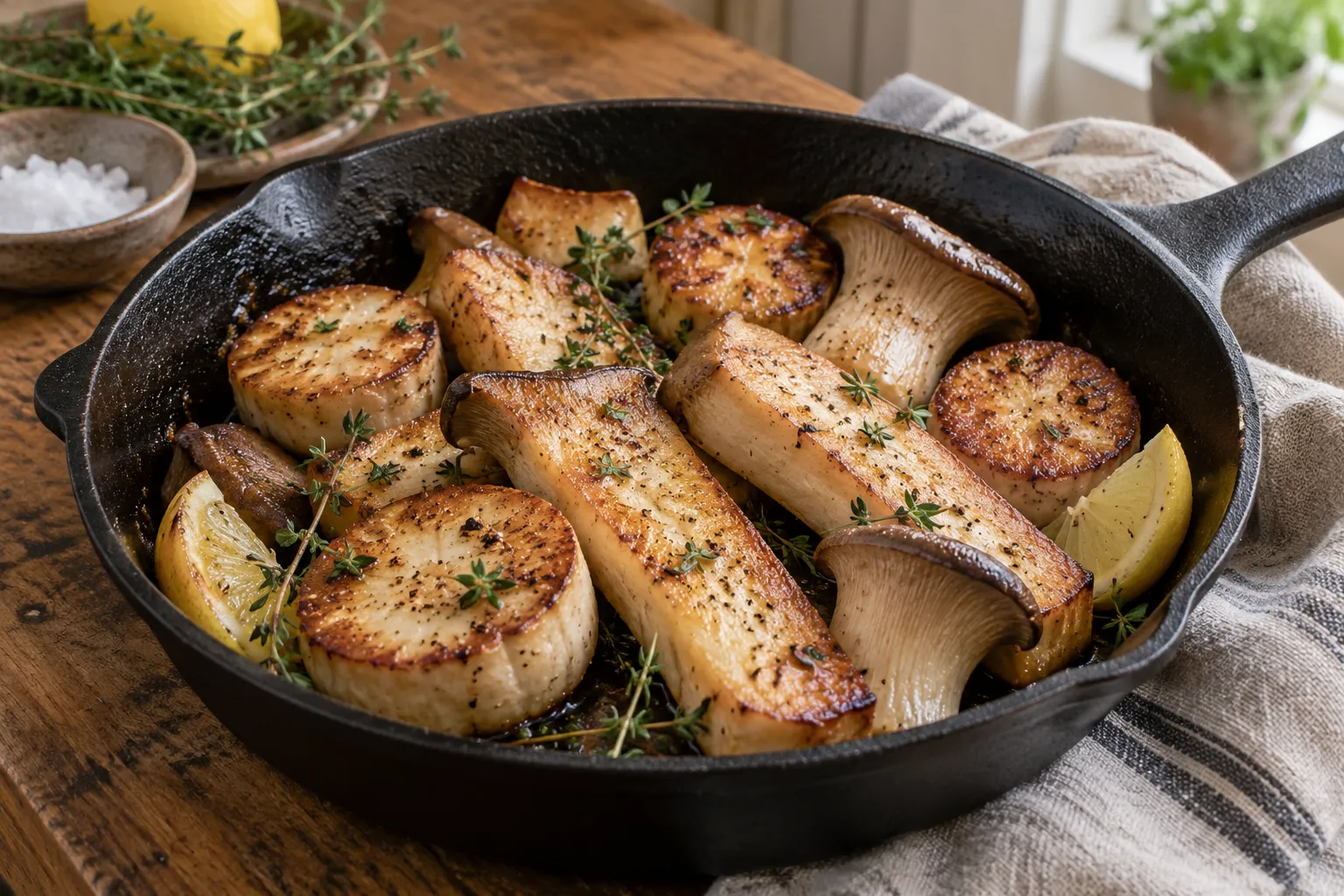
Recipe details
- Prep time
- PT15M
- Cook time
- PT18M
- Yield
- 4 side-dish servings
- Calories
- 110 calories per serving
Ingredients
- 450 g cultivated king oyster mushrooms
- 2 tablespoons olive oil, divided
- 1/2 teaspoon kosher salt
- 1/4 teaspoon black pepper
- 1 teaspoon fresh thyme leaves
- 1 garlic clove, finely grated
- 2 teaspoons lemon juice
Instructions
- Choose firm cultivated king oyster mushrooms sold for food; refrigerate until preparation and keep separate from raw animal foods.
- Trim dry stem ends. Wipe or briefly rinse, dry thoroughly, then cut stems into 2 cm rounds or lengthwise slabs of even thickness.
- Heat a 30 cm / 12 inch skillet over medium-high heat. Add half the oil and one loose layer of mushrooms.
- Cook without moving until the first faces are deep gold, 3 to 5 minutes. Turn, salt lightly, and brown the second faces.
- Lower heat to medium. If centers remain firm, add 1 tablespoon water and cover for 60 to 90 seconds; uncover and evaporate all water.
- Repeat with the remaining mushrooms. Return all pieces, add garlic and thyme for 30 seconds, remove from heat, and finish with pepper and lemon.
The short answer
Cut cultivated king oyster mushrooms into 2 cm / 3/4 inch rounds or even lengthwise slabs, brown them in uncrowded batches, and use a brief low-heat finish when the centers remain firm. The wide ivory stem is dense enough to take a dark crust without collapsing, but it needs more time through the center than a thin oyster-mushroom fan. This recipe is deliberately about that stem structure; it is not a generic sauté with a different mushroom name.
Use only mushrooms sold as food by a reputable supplier. A cooking page cannot confirm a wild mushroom, and heat does not make a poisonous lookalike safe. Wash hands and utensils, keep produce away from raw animal foods, and discard packages with slime, mold, or an unsafe storage history.
Choose mushrooms for even cooking
Look for firm stems with a dry, intact surface and caps that are tan to brown rather than wet or collapsing. A light natural fissure at the base is not the same as soft decay. Packages containing similar stem diameters are easiest to portion because every medallion can be cut to roughly the same thickness.
The cap is edible and useful, but it cooks faster than the center of a thick stem. Leave small caps attached to lengthwise slabs. For rounds, separate large caps and add them late in a batch so their thin edges do not burn. Trim only the dry basal surface; peeling away the whole stem wastes the part that makes this species especially suited to searing.
Briefly rinse visible substrate away under running water or wipe it with a damp cloth, then dry the surface. FDA produce guidance advises running water rather than soap or detergent. Surface water is not dangerous in the pan, but it consumes heat and delays the moment when the mushroom touches hot oil closely enough to brown.
Two cuts, two textures
Thick medallions
Crosswise rounds expose a broad field of tightly packed stem fibers. Cut them about 2 cm thick. Thinner coins cook quickly but can become leathery; much thicker rounds need a longer covered finish and are harder to season evenly. A shallow 2–3 mm crosshatch is optional. It creates extra edges but should not cut halfway through the piece.
Medallions are sometimes called mushroom “scallops.” That describes presentation, not nutritional equivalence or seafood flavor. Their useful feature is mechanical: the circular faces sit flat against a skillet and develop an even crust while the interior stays springy.
Lengthwise slabs
Slice the whole mushroom from cap through stem into slabs of similar thickness. These pieces show the natural transition from cap to dense stem and produce crisp cap margins plus a substantial center. They are less uniform than rounds, so position the thickest stem face over the hottest pan zone and watch the cap edge.
Do not mix very thin strips, thick rounds, and whole caps in one batch. A pan full of different geometry guarantees that some pieces are pale when others are dry. Consistent cuts are more important than an exact minute count.
Pan-searing method
Preheat a wide heavy skillet over medium-high heat for one to two minutes. Add enough oil to form a thin mobile film, not a pool. Place one layer of mushrooms with space between pieces. For a 30 cm / 12 inch skillet, half of a 450 g package is a sensible first load; a smaller skillet needs three batches.
Leave the first face undisturbed for three minutes, then lift one test piece. A useful endpoint is an even amber-to-deep-gold field with darker edges, not isolated black freckles on a pale surface. If the face is pale, replace it and wait. If oil is smoking or pepper is scorching, lower the heat.
Turn every piece, add a portion of the salt, and brown the second face. Pressing hard with a spatula does not speed tenderization; it squeezes moisture onto the pan and can tear scored pieces. Let weight and heat create contact.
Test a thick center with the tip of a knife. If the surfaces are brown but the center still feels raw-firm, lower to medium, add one tablespoon of water, and cover for 60 to 90 seconds. The small steam pulse transfers heat inward. Uncover and cook until the pan is dry again so the crust does not leave the skillet soggy.
Transfer the batch to a plate and repeat. When all pieces are cooked, return them to medium heat for only 30 seconds with grated garlic and thyme. Garlic added at the beginning would spend the entire browning period against hot iron and may become bitter. Finish off heat with pepper and lemon juice.
Read the pan instead of the clock
King oyster packages vary in stem diameter, water content, refrigerator exposure, and cut size. These change cooking time more than a rigid recipe timer suggests. Record three transitions: when the first face releases from the skillet, when visible water stops pooling, and when a knife enters the center with gentle resistance.
A wet simmering sound means moisture is still occupying the pan. Do not solve it by pouring in more oil. Maintain controlled heat until the water evaporates, then allow direct contact to resume. A sharper sizzle marks the return of surface frying. At that point, watch the fond closely; pale brown residue is useful, while black residue tastes acrid.
If the first batch stays pale, reduce the load rather than making the next batch hotter. If it browns too quickly, lower the burner and cut subsequent pieces a little thinner. The first batch is a calibration for your skillet, not a failure to hide.
Season without masking the mushroom
Salt in measured portions across batches. Soy sauce, miso, stock concentrates, cheese, and salted butter all add sodium, so additions should replace—not automatically accompany—the recipe salt. Lemon brightens the browned stem without turning the skillet into a sauce; add it after the heat is off so its fresh aroma remains.
Thyme and garlic are a neutral starting point. For a grain bowl, finish with scallion and a small amount of sesame oil. For toast, add parsley and a spoonful of unsalted stock to loosen the fond. For tacos, use cumin and oregano only after the watery phase, because dry spices scorch on bare iron.
The same pan principles appear in the general sautéed mushroom method, while thinner fan-shaped mushrooms need the timing in the garlic-butter oyster mushroom recipe. For species context rather than cooking instruction, see the king oyster mushroom guide.
Troubleshooting by symptom
Pale and watery: too many pieces shared too little surface area, or the mushrooms entered with water clinging to them. Finish evaporation, then let the faces sit undisturbed. Split the next load.
Dark outside, tough inside: the pieces were thick and the heat remained high. Use the measured water-and-cover finish, or reduce future rounds to 2 cm.
Rubbery throughout: thin pieces cooked long after their water had evaporated. Remove a batch when the center is tender and the contact faces are brown; do not wait for every side to become crisp.
Greasy: oil was repeatedly added while water was still pooling. Let evaporation finish. Dense king oyster stems need a surface film, not deep frying.
Bitter garlic: it entered before browning was complete. Clean scorched fragments from the pan and add fresh garlic only during the final low-heat toss.
Serving, cooling, and reheating
Serve immediately, when the contact faces are driest. Pair the mushrooms with beans, eggs, tofu, grains, or another appropriate component instead of assuming they replace the protein of a main dish. USDA FoodData Central can be used for food-specific nutrient records, but composition depends on product, water loss, oil uptake, and serving size.
Cool leftovers promptly in a shallow covered container. USDA FSIS recommends refrigerating perishable leftovers within two hours, or one hour above 90°F / 32°C, at 40°F / 4°C or below. Use refrigerated leftovers within three to four days. Reheat only the portion needed in a wide skillet; a teaspoon of water can warm the center, followed by an uncovered minute to restore the surface. Discard food with mold, slime, an off odor, or uncertain holding history rather than tasting it to decide.
Frequently asked questions
Should king oyster mushrooms be sliced lengthwise or into rounds?
Both work. Rounds produce uniform broad faces; slabs retain cap texture. Keep a batch consistent so every piece reaches its endpoint together.
Why are my king oyster mushrooms rubbery?
They may have been thin and overcooked, or thick and browned without an inward heat finish. Use 2 cm pieces and the brief covered step when needed.
Do king oyster mushrooms need to be scored?
No. Shallow scoring is a presentation and surface-area choice, not a safety or doneness requirement.
Can I use wild king oyster mushrooms?
This recipe assumes cultivated, labeled food. It cannot authenticate a wild specimen from a name or photograph.
How should leftovers be stored?
Refrigerate promptly in a shallow covered container at 40°F / 4°C or below and follow the USDA three-to-four-day window.
References
- U.S. Food and Drug Administration. Selecting and Serving Produce Safely. Produce washing and cross-contamination boundaries.
- USDA Food Safety and Inspection Service. Leftovers and Food Safety. Cooling and refrigerated-use windows.
- USDA Food Safety and Inspection Service. Refrigeration and Food Safety. Refrigerator temperature and storage context.
- USDA Agricultural Research Service. FoodData Central. Food-composition records and serving-basis context.
Source quality notes
MushroomScope cites sources that match the page scope, such as taxonomic databases, extension guidance, food-safety agencies, food-composition databases, and peer-reviewed or institutional health references. Sources support context and uncertainty; they do not turn an online page into specimen identification, medical advice, or a tested recipe record.
Frequently asked questions
Should king oyster mushrooms be sliced lengthwise or into rounds?
Both work. Thick rounds maximize broad browned faces, while lengthwise slabs preserve the cap and give a more varied bite; keep each batch one shape and thickness for predictable cooking.
Why are my king oyster mushrooms rubbery?
Very thick pieces cooked only over high heat may brown before their centers tenderize. Brown both faces, then lower the heat and briefly cover or add a spoonful of water to finish the center.
Do king oyster mushrooms need to be scored?
Scoring is optional. Shallow cuts increase surface area for browning, but deep crosshatches can weaken a medallion and trap seasoning.
Can I use wild king oyster mushrooms?
Use cultivated mushrooms sold as food by a reputable supplier. A recipe and photograph cannot authenticate a wild specimen.
How should leftovers be stored?
Cool promptly in a shallow covered container, refrigerate at 40°F (4°C) or below, and follow USDA guidance to use refrigerated leftovers within 3 to 4 days.
Related guides
mushrooms
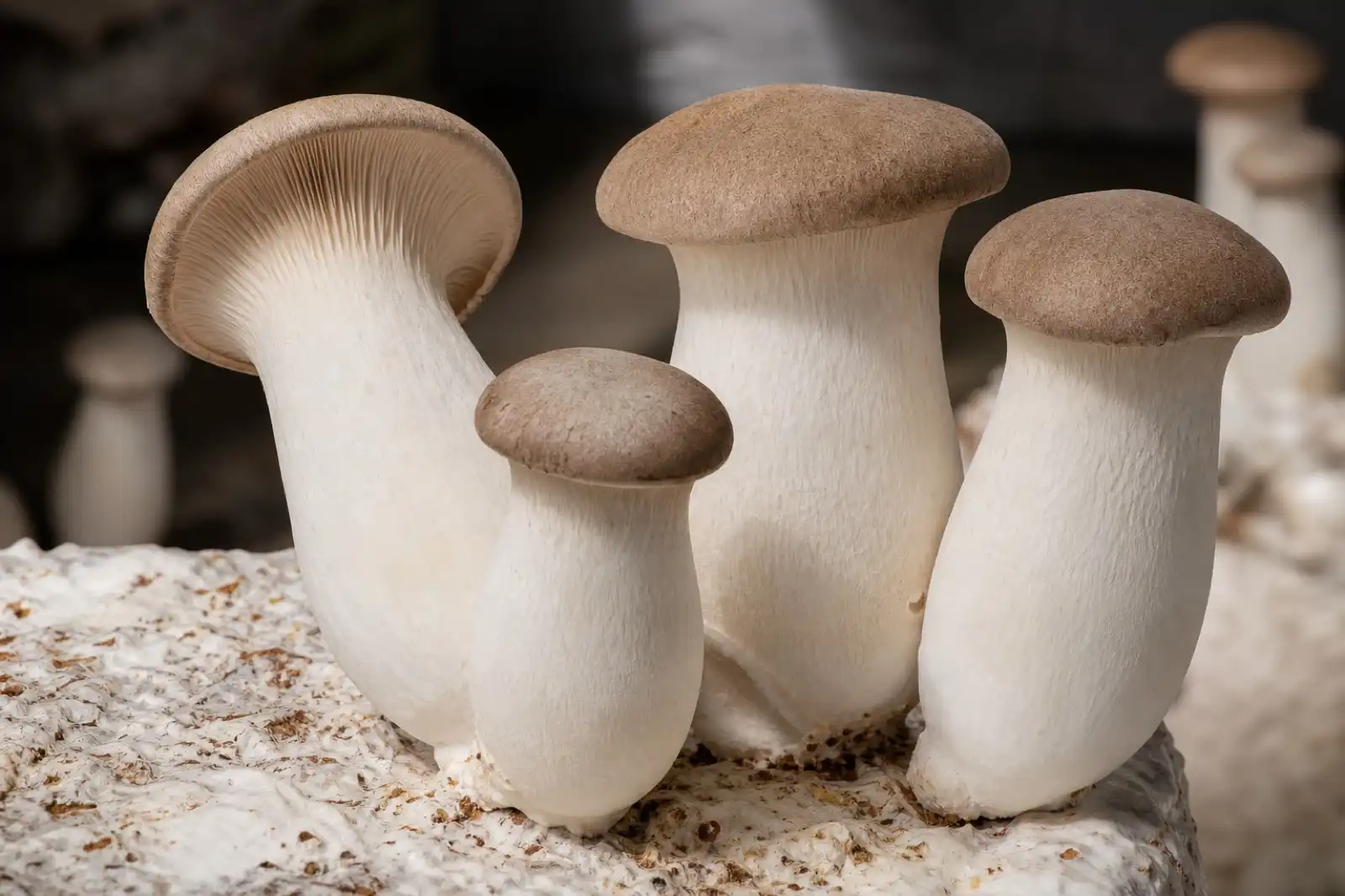
King Oyster Mushroom: Pleurotus eryngii Ecology and Cultivation
Understand king oyster morphology, Mediterranean plant associations, controlled crop shaping, dense-stem cooking, food evidence, and wild-identification limits.
recipes
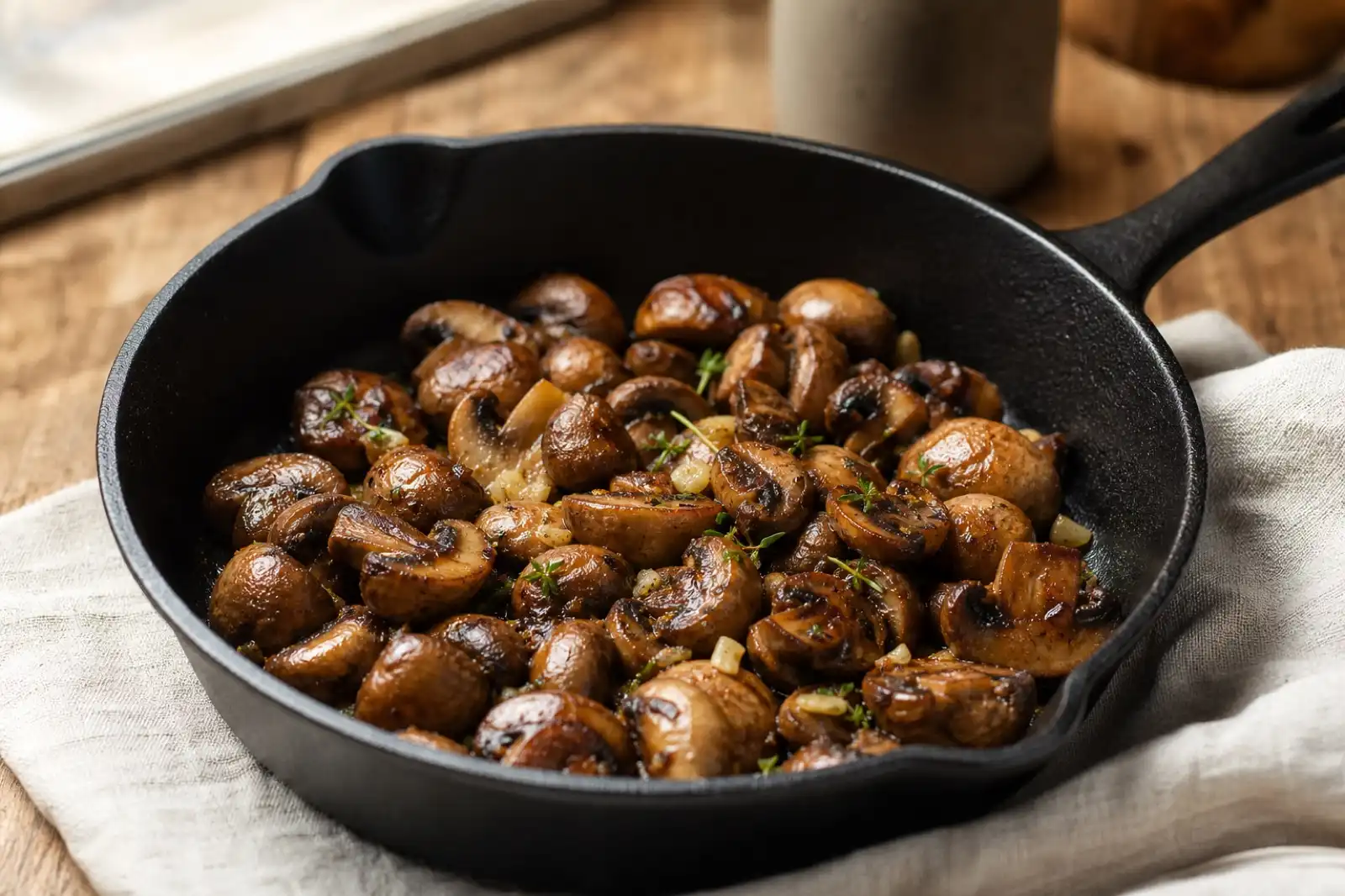
Easy Sautéed Mushrooms with Garlic and Herbs
Sauté cremini mushrooms with garlic and herbs using a wide-pan method, clear batch sizes, realistic timing, and safe storage advice.
recipes
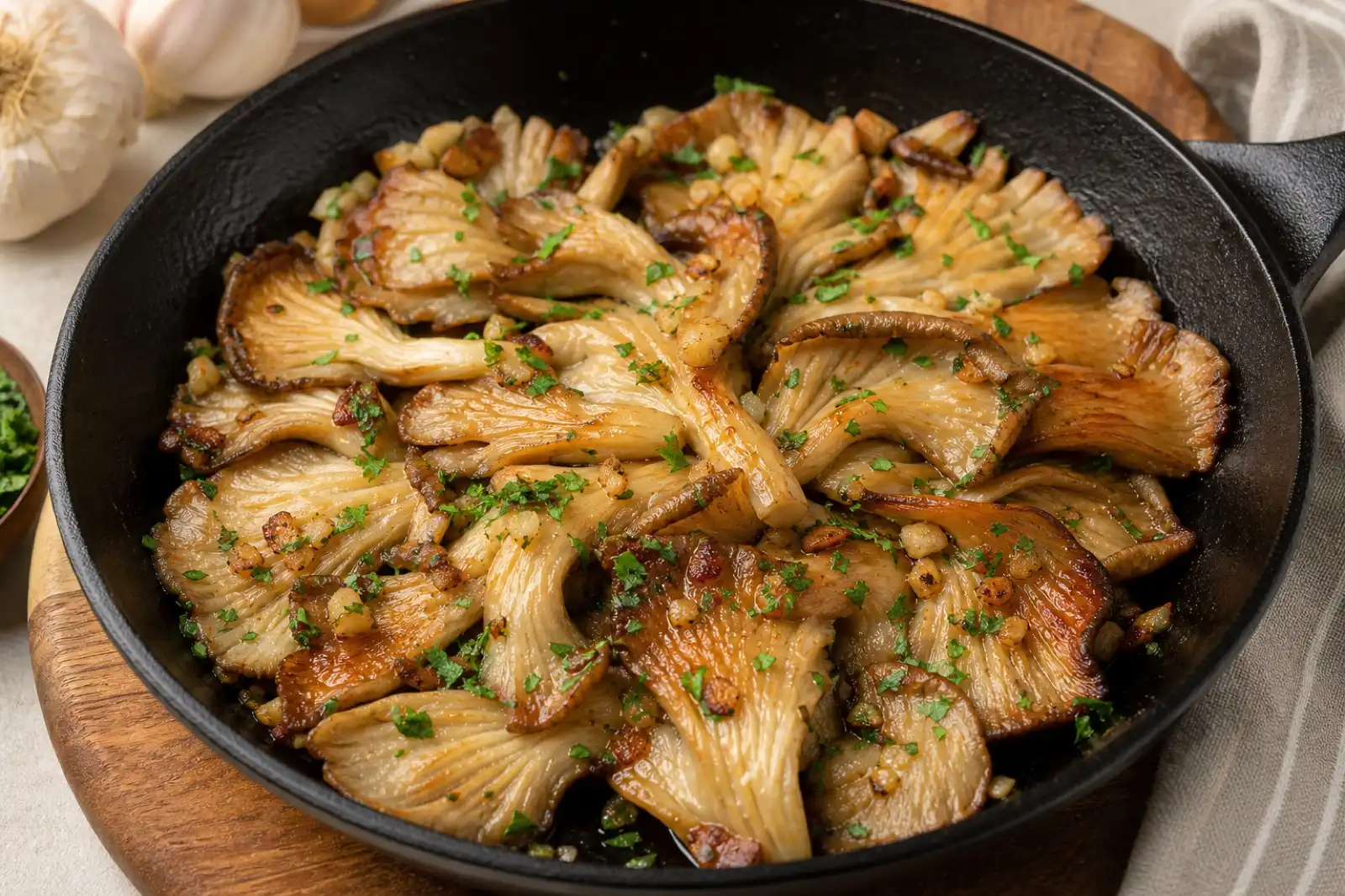
Garlic Butter Oyster Mushrooms
Make garlic butter oyster mushrooms with cultivated oyster mushrooms, clear steps, practical substitutions, and conservative food-safety guidance.
Continue exploring
Browse more practical guides in Recipes or visit the mushroom encyclopedia.