Growing
Mushroom Substrate Hydration: Moisture Without Lost Airspace
Measure and adjust mushroom substrate hydration by material, water-holding capacity, drainage, sterilization method, and colonization observations.
By MushroomScope Editorial Team · · Updated
Growing method
Start with authenticated culture
Use supplier-identified spawn or blocks and record substrate, stage, temperature, humidity, and visible changes.
Open the beginner growing hub →Food safety
Discard suspect batches
Unusual colors, slime, insects, or abnormal odor should be treated as a safety concern, not a climate tweak.
Review contamination guidance →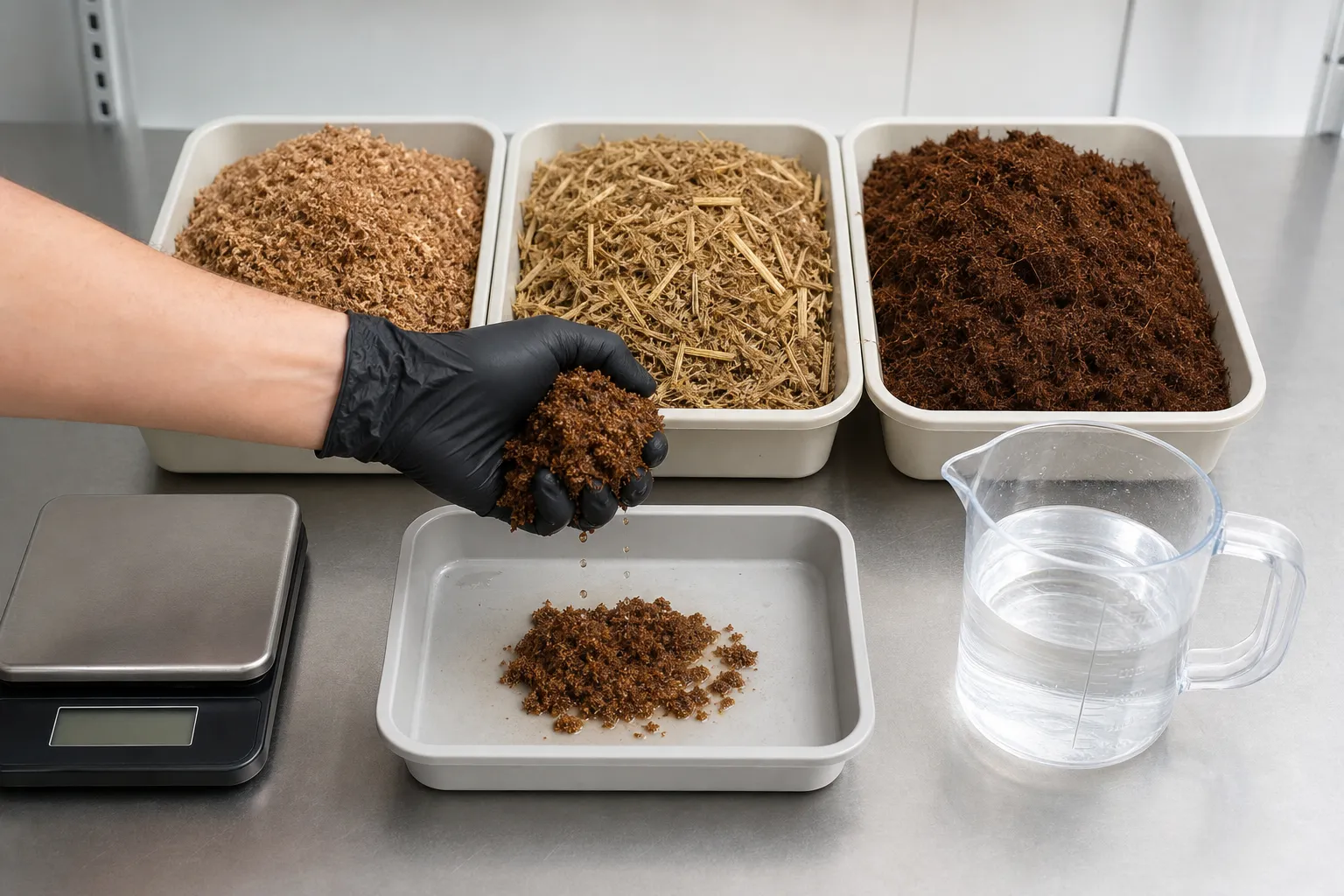
Hydration is a water-and-air balance
A productive substrate must hold water while preserving pore space for gas exchange. Too little available water can slow colonization and limit fruit-body expansion; too much free water collapses airspace and favors uneven, anaerobic, or bacterial conditions. Hydration is therefore not a universal squeeze-test target. It depends on material, particle size, compaction, supplementation, treatment, container, species, and equipment.
Moisture percentage needs a named denominator
On a wet basis, moisture percentage is water mass divided by final wet mass. On a dry basis, growers may instead report water relative to dry solids. Those numbers are not interchangeable. A batch made from 1,000 g dry material plus 1,500 g water is 60% water on a wet basis but has a 150% water-to-dry-material ratio. Write the formula beside every record so a future operator cannot apply the right number with the wrong denominator.
Why one field-capacity number fails
The phrase field capacity is borrowed from soil science and used loosely by growers. A handful that releases only a few drops can be a rough workshop observation, but hand strength and particle structure vary. Coir, chopped straw, hardwood pellets, loose sawdust, and peat casing can feel equally damp while holding different water fractions. Use weight and batch observations alongside touch.
The squeeze test is a screening tool, not a specification
Use the same person, sample mass, rest time, and hand pressure if a squeeze test is part of the workflow. Sample the top, middle, and bottom of the mixer rather than a convenient handful. A stream of water or a glossy puddle is a clear rejection signal, but “one or two drops” is too operator-dependent to serve as the only release criterion. Pair touch with measured inputs and the observed results of previous batches.
Weigh dry material and added water
Start with a known dry mass and measure every water addition. A simple wet-basis calculation is water mass divided by total wet mass; dry-basis conventions use a different denominator, so label the method. Retain a sample if possible. The calculation does not tell whether water is bound or pooled, but it makes batches comparable and lets results inform the next adjustment.
Correct for moisture already present in ingredients
Pellets and bran are rarely absolutely dry. If precision matters, dry a representative sample with an appropriate validated method or use supplier moisture data as an explicitly labeled estimate. The water already in a damp ingredient belongs in the numerator. Supplier changes, open storage, and humid weather can therefore alter a familiar recipe even when the added-water jug has not changed.
Straw, sawdust, coir, and casing differ
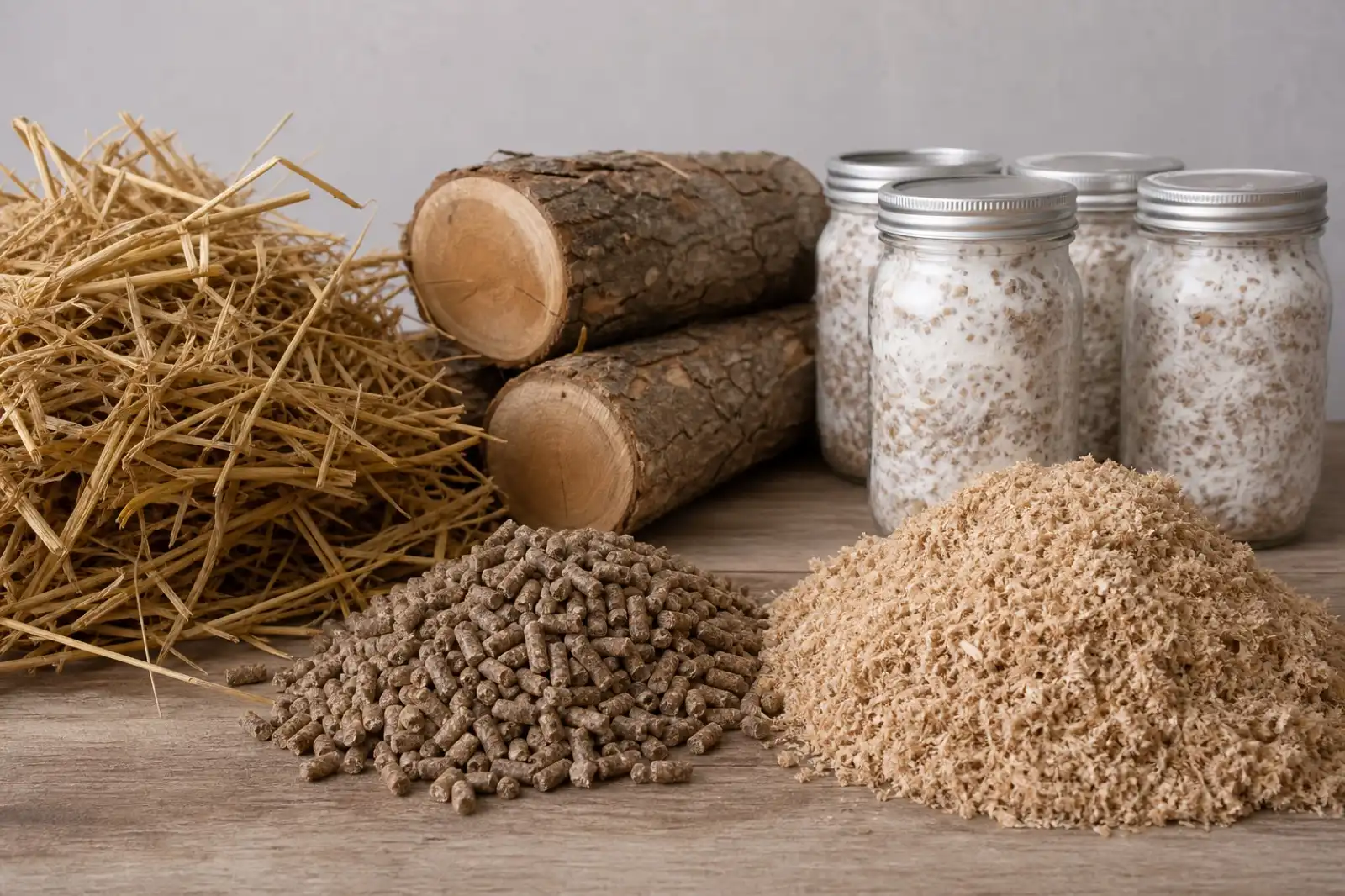
Pellets absorb and expand predictably until brand, density, or storage changes. Straw has large pores but variable stem length and drainage. Fine sawdust compacts readily; chips create structure. Coir quality and salt content vary. Casing is managed as a moisture reservoir rather than the primary nutrient substrate. Recipe percentages cannot cross these materials without testing.
Particle geometry controls where air remains
Fine sawdust packs tightly and can leave a wet, low-oxygen core; chips add channels but distribute unevenly if mixing is poor. Chopped straw drains through large voids yet may hide dry nodes inside stems. Coir expands dramatically and varies by grade. A casing layer is judged partly by its ability to accept and release water at the crop surface, not by the same rule used for a supplemented production block. Record particle-size changes as process changes.
Account for soaking, draining, and treatment
Soaking and hot-water or lime treatment leave water that must drain; sterilization can redistribute moisture and create condensation. Bag filters and seals also affect loss. Weighing before and after treatment can reveal the system effect. Never add unmeasured water to a sterile nutrient-rich bag after processing merely to correct a guess, because the intervention introduces contamination risk.
Heat treatment moves water inside the container
Steam can condense on cooler surfaces, bags may lose mass through filters, and dense loads may develop a wetter base. Weigh several representative units before and after the validated cycle rather than assuming the recipe equals the processed block. Let hot bags cool without compressing filters or creating suction pathways, then inspect sealed units under good light. The substrate sterilization guide separates hydration decisions from pressure-equipment safety.
Recognize overhydration before inoculation
Puddles, waterlogged bottom zones, sour odor, greasy uncolonized grain, and slow irregular growth can accompany excessive moisture, although none identifies the cause alone. Inspect distribution: a dry top and saturated base may result from poor mixing or drainage rather than an excessive batch average. Do not squeeze or open suspect bags in the clean work area.
Separate a wet recipe from a wet zone
A uniform batch average can conceal stratification. Mark bags by mixer position and shelf position, then compare bottom pooling, colonization front, odor without opening, filter condition, and core temperature. If failures cluster at the mixer outlet or lower rack, distribution and cooling may explain more than the nominal percentage. Quarantine abnormal units; do not open them over clean cultures.
Recognize drying during colonization
Dry substrate may pull away from the bag, colonize thinly, or stall at exposed edges, but heat, genetics, insufficient spawn, or poor gas exchange can look similar. During fruiting, low room humidity is not fixed by saturating the block. Separate substrate water from surface humidity and fresh-air management using the beginner growing hub.
Diagnose water, heat, and gas exchange separately
A stalled pale edge may reflect a dry interface, but it can also reflect overheated substrate, damaged culture, low inoculum density, a blocked filter, or contamination. Compare the pattern across matched bags and measure rather than infer room and core temperature. During fruiting, condensation on plastic shows a temperature relationship, not necessarily adequate substrate water or room humidity.
Run a small calibration batch
Calibrate one material in small labeled batches that differ by a controlled water increment. Keep spawn rate, bag mass, compression, treatment, culture, and incubation conditions constant. Compare colonization time, contamination, block integrity, yield, and residual moisture. A successful number belongs to that material and workflow until verified after a supplier or equipment change.
Build a local response curve
Use at least three nearby hydration treatments rather than comparing one guess with one old batch. Randomize labeled bags across shelf positions and keep dry ingredients, supplementation, spawn lot and rate, bag fill, compression, treatment, cooling, and fruiting conditions matched. Predefine observations: time to visible recovery, time to full colonization, rejected units, first-flush wet mass, harvestable mass, and spent-block mass. A higher yield is not persuasive if contamination also rises or the denominator changes.
Record moisture as a repeatable process
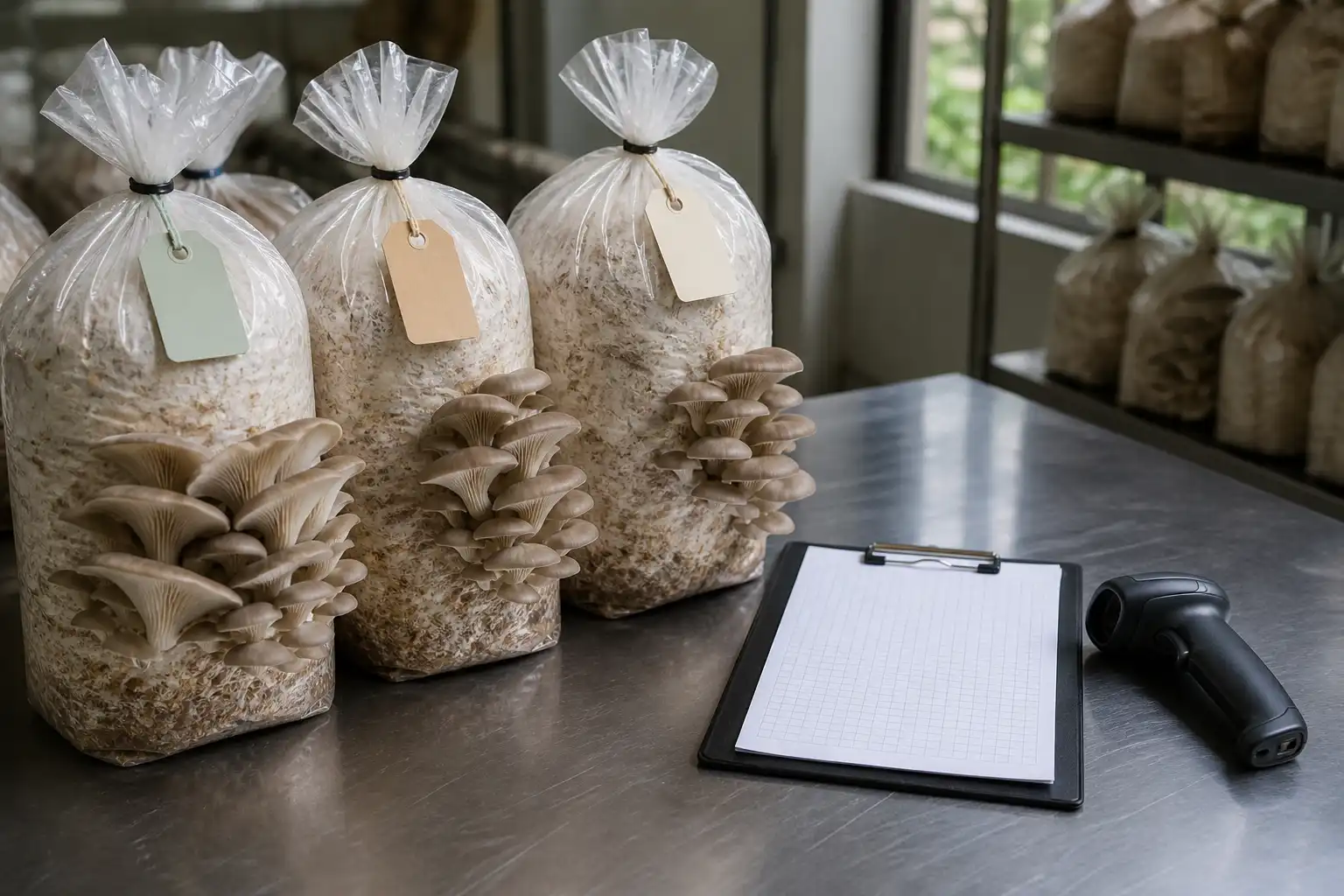
A useful batch record includes dry ingredient lots and masses, water source and mass, soak and drain times, final wet mass, bag mass, treatment cycle, inoculation date, room conditions, and outcomes by flush. This record replaces folklore with a local response curve and helps distinguish a hydration problem from the contamination patterns guide.
Use a release record before inoculation
Record ingredient lot, estimated starting moisture, dry and added-water mass, mixer identity, start and finish time, rest or drain interval, sample locations, bag mass range, treatment cycle, post-treatment mass, and operator. Define a release range from successful local trials, not a copied internet recipe. Link every fruiting observation back to this lot through the batch-record method.
A worked comparison without a universal recipe
Suppose two hardwood batches begin with the same dry mass and added-water mass. Batch A uses fine material packed firmly; Batch B contains a measured coarse fraction and is filled less densely. Their calculated moisture percentage may match while their air-filled pore space does not. If Batch A develops a hot, slow center and Batch B colonizes evenly, the lesson is not simply “use less water.” Repeat with fill density controlled, then alter only coarse fraction or water. This sequence distinguishes structure from hydration.
The same caution applies to yield. Report harvested mass relative to the original dry substrate mass when using biological efficiency, and state whether aborted or unmarketable fruit bodies were excluded. Report contamination per inoculated unit. Without those denominators, a visually impressive flush cannot establish a better hydration setting.
Correction rules for the next batch
Do not rescue a sealed nutrient-rich bag by opening it to add water. For the next batch, adjust one measured increment and preserve a control. If straw remains wet after a fixed drain, change chop distribution, loading depth, or drain time before changing multiple recipe ingredients. If pellet blocks remain dry in the center, verify absorption time and mixing uniformity before raising the total water target.
Document supplier and season changes. A new pellet lot, differently milled bran, or coir brick can shift absorption. Re-run a small calibration after a meaningful material or equipment change, and retain the former treatment as a comparison. This is slower than adopting a single field-capacity number but faster than diagnosing an entire contaminated production run.
Calculate wet basis and water-to-dry-solids separately
Suppose 1,000 grams of an ingredient arrives at 10 percent moisture on a wet basis. It contains 900 grams of dry solids and 100 grams of water. Adding 1,350 grams of water produces 1,450 grams total water in a 2,350-gram mix. The resulting wet-basis moisture is 1,450 divided by 2,350, or about 61.7 percent. The water-to-dry-solids ratio is 1,450 divided by 900, or about 1.61 to 1. These two numbers describe the same mix with different denominators.
If the ingredient’s starting moisture is ignored, the calculation would use 1,350 grams of water and report about 57.4 percent. That four-point difference is not a biological mystery; it is a bookkeeping error. Record whether supplier moisture is measured, lot-specific, or estimated, and retain the unrounded masses so the calculation can be corrected later.
Sample the mixer as a spatial process
Uniform total inputs do not guarantee a uniform bag. After the planned mixing and absorption interval, take equal-mass samples from predefined top, center, edge, and bottom positions before filling. Use the same sampling tool and avoid selecting only visually convenient material. Compare wet mass, appearance, squeeze observation, and—when the operation supports it—a documented dry-matter result.
If the bottom sample is consistently wetter, investigate addition sequence, mixing time, particle segregation, mixer geometry, resting, and drainage before changing the whole-batch recipe. Extra dry material thrown into one wet corner creates another uncontrolled gradient. Rework only under a validated process; otherwise hold the batch and correct the next controlled mix.
Reconcile mass through heat treatment
Weigh representative sealed units before and after pasteurization or sterilization using the same cooled, externally dry condition. A gain can indicate water entry or condensation retained by the container; a loss can indicate venting, leakage, or evaporation. Location within the treatment load may matter, so sample more than one position and preserve the load map.
Do not infer internal moisture uniformity from total bag mass alone. Water can migrate and collect at a cool surface while the center remains different. Pair mass change with seal integrity, filter condition, visible pooling, and later colonization observations. Opening a processed nutrient bag to take a casual moisture sample changes its contamination risk and is not an acceptable rescue method.
Write a release decision before inoculation
A release record should state ingredient lots, starting moisture assumption, dry solids, added water, mixing and rest times, sample positions, bag mass tolerance, visible free-water rule, heat-treatment mass change, and the person making the decision. Define hold and reject conditions before the batch is processed. This prevents a schedule deadline from turning an unusual wet zone into an accepted normal condition.
After harvest, connect hydration to biological efficiency, contamination, colonization time, and residual block mass without changing several variables at once. The yield and biological-efficiency guide supplies the dry-mass denominator, while batch records preserve the lot and unit history needed to interpret the result.
Frequently asked questions
What is field capacity for mushroom substrate?
It is a practical description of water held after drainage, not one universal percentage for every material.
Is the squeeze test accurate?
It is a rough observation; weighing ingredients and tracking outcomes is more repeatable.
Why is the bottom of a bag wetter?
Gravity, incomplete mixing, condensation, particle grading, or poor drainage can create a moisture gradient.
Can I add water after sterilization?
Opening or injecting a processed nutrient substrate adds contamination risk and should not be an improvised correction.
Does higher fruiting humidity fix a dry block?
Not necessarily. Room humidity limits surface drying but does not restore internal substrate water uniformly.
References
Source quality notes
MushroomScope cites sources that match the page scope, such as taxonomic databases, extension guidance, food-safety agencies, food-composition databases, and peer-reviewed or institutional health references. Sources support context and uncertainty; they do not turn an online page into specimen identification, medical advice, or a tested recipe record.
Frequently asked questions
What is field capacity for mushroom substrate?
It is a practical description of water held after drainage, not one universal percentage for every material.
Is the squeeze test accurate?
It is a rough observation; weighing ingredients and tracking outcomes is more repeatable.
Why is the bottom of a bag wetter?
Gravity, incomplete mixing, condensation, particle grading, or poor drainage can create a moisture gradient.
Can I add water after sterilization?
Opening or injecting a processed nutrient substrate adds contamination risk and should not be an improvised correction.
Does higher fruiting humidity fix a dry block?
Not necessarily. Room humidity limits surface drying but does not restore internal substrate water uniformly.
Related guides
growing
Mushroom Substrate Guide: Match Species to Method
Choose a mushroom-growing substrate by matching a labeled culture to a documented production method, site, and food-safety boundary.
growing
Mushroom Batch Records: Build Traceability From Culture to Harvest
Build mushroom batch records that connect culture, substrate, rooms, observations, harvests, deviations, and corrective actions without false precision.
growing
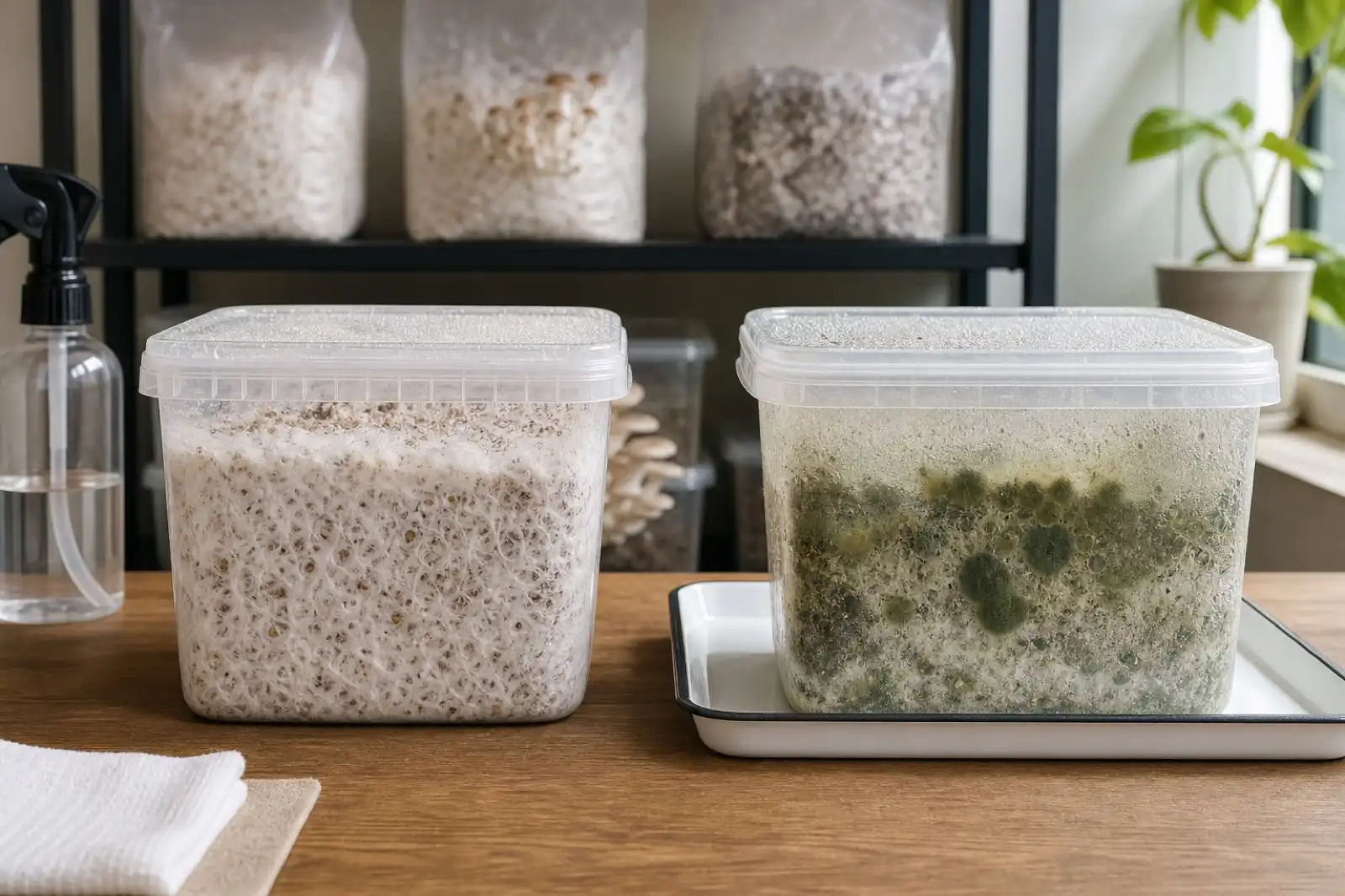
Mushroom Contamination: Isolate, Record, and Prevent Repeat Problems
Recognize mushroom contamination without relying on color alone; isolate suspect batches, avoid food salvage, document the workflow, and prevent repeat issues.
Continue exploring
Browse more practical guides in Growing or visit the mushroom encyclopedia.