Growing
Mushroom Yield and Biological Efficiency: Calculate Comparable Batches
Calculate mushroom yield and biological efficiency with dry-substrate mass, harvest boundaries, flush records, quality grades, losses, and honest comparisons.
By MushroomScope Editorial Team · · Updated
Growing method
Start with authenticated culture
Use supplier-identified spawn or blocks and record substrate, stage, temperature, humidity, and visible changes.
Open the beginner growing hub →Food safety
Discard suspect batches
Unusual colors, slime, insects, or abnormal odor should be treated as a safety concern, not a climate tweak.
Review contamination guidance →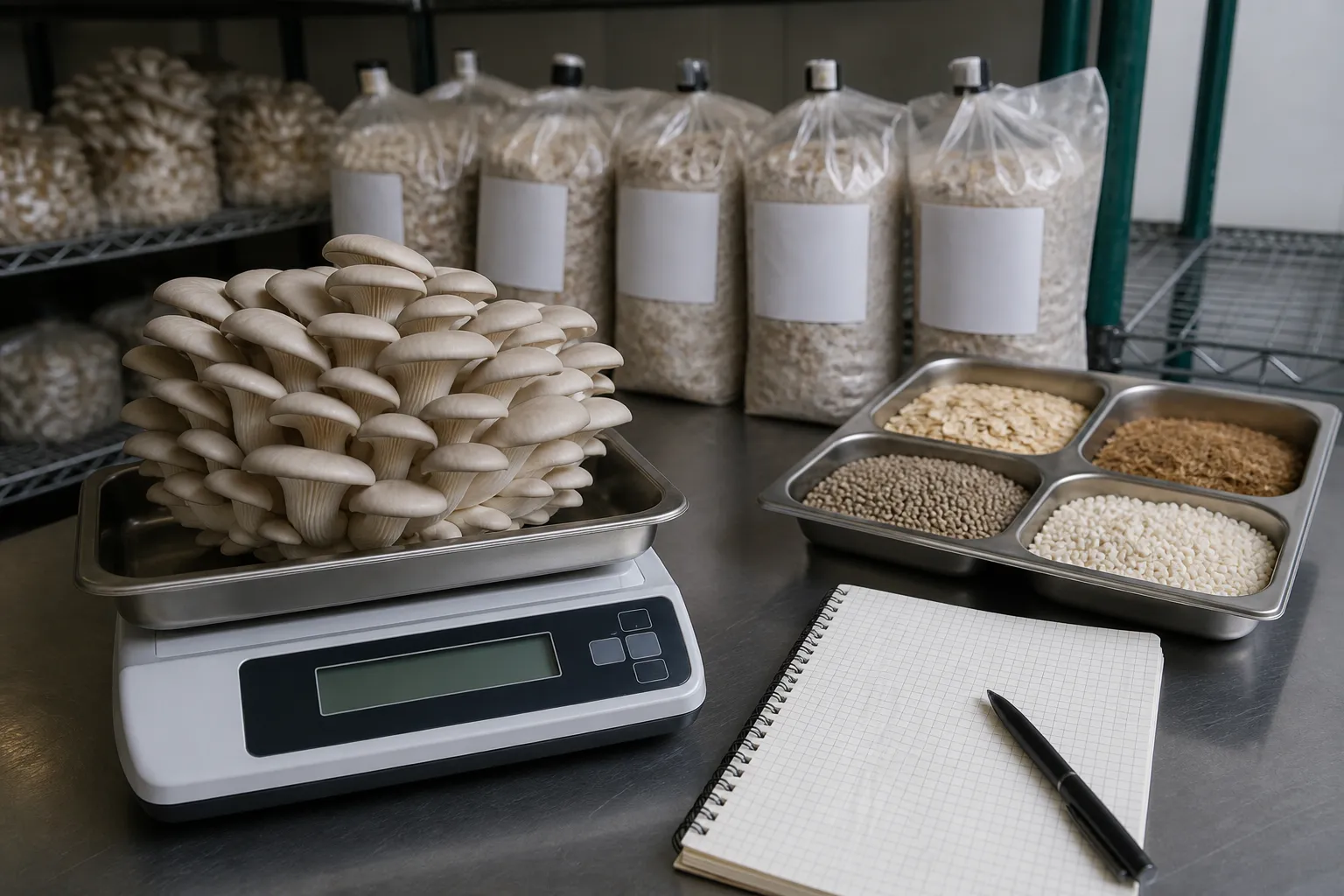
Biological efficiency (BE) is a production ratio, not a promise printed on a spawn label. It compares fresh mushrooms harvested with the dry mass of the substrate used to grow them. The calculation is simple; obtaining a denominator and numerator that mean the same thing across batches is the difficult part.
This guide builds a record that another grower can audit. It separates water from dry ingredients, gross growth from saleable product, flush totals from room occupancy, and biological performance from profit. Use the batch-record guide alongside it when designing the actual worksheet.
The biological-efficiency formula
Use:
BE (%) = fresh mushroom harvest mass ÷ dry substrate mass × 100
If 824 grams of fresh mushrooms are harvested from 916 grams of dry substrate ingredients, BE is 89.96 percent, normally reported as 90 percent with the unrounded values retained in the record. A value above 100 percent is possible because fresh mushrooms contain substantial water; it does not mean the system created matter or recovered every nutrient.
BE is most useful for cultivated saprotrophs grown on defined materials. Fresh mass per bed area, usable yield per labor hour, crop value per room-day, or dry mushroom yield may answer other operational questions. State the metric instead of using “yield” as though it had one universal denominator.
Establish the dry-substrate denominator
Added hydration water does not belong in the denominator. Dry hardwood pellets, straw, bran, hulls, gypsum, and other solids do. The ambiguous inputs are spawn and ingredients that already contain moisture. Decide before the trial whether dry spawn solids are included, then apply the same convention to every batch being compared.
A supplier’s nominal bag or pellet weight is not automatically dry mass. If an ingredient contains 8 percent moisture, its dry-matter fraction is 0.92. Multiply wet ingredient mass by that fraction. For a mixed recipe, calculate each ingredient separately and add the dry contributions. The substrate-hydration guide explains why wet-basis and dry-basis percentages should never be mixed silently.
For careful work, determine moisture with a documented method or use a current supplier specification tied to the lot. Record sample mass, drying endpoint, instrument resolution, lot, and date. A handheld moisture reading without the material-specific calibration may be a process indicator, but it should not be presented as a reference dry-matter result.
Define the harvest numerator before fruiting
“Fresh harvest mass” needs its own boundary. Specify whether mushrooms are weighed before or after trimming, whether attached substrate is removed, whether damaged fruit bodies count, and when the scale reading occurs. Cooling and open-air holding change water mass, so a harvest-room weight cannot be compared casually with a packed weight recorded hours later.
Use separate fields for gross fruit-body mass, clean trim, quality rejects, retained samples, contamination-related discard, and saleable mass. Never market material suspected of contamination merely to improve a yield figure. A useful record can show high gross BE and a low saleable yield; concealing that difference prevents diagnosis.
Check the scale on the measurement day, use the same tared containers, and choose a capacity and resolution appropriate to the load. Record the original unit. Converting pounds and ounces from memory later creates avoidable transcription errors.
A moisture-corrected worked example
Suppose a batch uses 800 grams of pellets documented at 8 percent moisture and 200 grams of supplement at 10 percent moisture. The dry contributions are 736 grams and 180 grams, for 916 grams total before any consistently defined dry spawn contribution. If the agreed harvest window produces 824 grams of fresh mushrooms, BE is 824 divided by 916, multiplied by 100: about 90 percent. Report the unrounded inputs and denominator convention, not only the result.
Now separate operational outcomes. If 40 grams were trimmed with substrate, 60 grams were damaged, and 724 grams met the chosen saleable grade, gross fresh yield, trim, discard, and saleable yield should occupy different fields. The saleable-yield ratio is 724 ÷ 916, or about 79 percent. That is not a replacement for BE; it is a second, explicitly named result.
If a third flush adds 70 grams but holds the room for twelve more days, cumulative BE rises while yield per room-day may fall. Both results are true. Record the decision to end a crop before seeing the result; otherwise one treatment can be granted extra time simply because its early yield was disappointing.
Flush records reveal timing costs
Record every harvest by batch, bag, flush number, date, and mass. Also retain inoculation, full colonization, fruiting initiation, first pin, first harvest, and room-exit dates. Cumulative BE alone hides speed: two strains can finish with the same ratio while one occupies controlled space much longer.
Useful companion measures include grams per bag-day, kilograms per square meter of shelving per week, labor minutes per saleable kilogram, and energy per crop. Define exactly when occupancy begins and ends. These measures are facility-specific, but they expose costs that a single biological ratio cannot.
Flush labels also need a rule. A continuous trickle of mushrooms after a main harvest can be recorded by date rather than forced into an arbitrary flush. If blocks are rehydrated, note the method and water gain because the intervention separates production stages even though hydration water remains outside the BE denominator.
Compare matched systems, not isolated headline numbers
Species, strain, substrate formula, ingredient lots, dry matter, spawn rate, bag geometry, heat treatment, incubation, fruiting interface, environment, harvest standard, and flush window all affect the result. A published research value from an optimized climate room is context, not a guaranteed target for a household tent.
Use replicate units. Report the number started, the number fruited, failures, mean or median, and spread. Reporting only the best bag creates selection bias. If contamination removes a unit, keep it in the batch history and explain whether the yield summary is per unit started or only per successful unit.
When comparing recipes, randomize bag positions if practical and avoid putting every treatment on a single shelf. Position can confound temperature, airflow, humidity, light, and handling. The strain-trial guide provides a fuller matched-trial structure.
Biological efficiency is not profitability
A higher BE can accompany weaker texture, oversized clusters, more trim, longer room use, or a less valuable grade. Track cap or tooth condition, cluster uniformity, shelf-life rejects, packaging loss, and actual saleable weight. The postharvest storage guide covers handling after a verified harvest.
Substrate and spawn cost, labor, utilities, packaging, and disposal belong in an enterprise calculation. Cornell’s farm-planning resources place yield beside price and cost instead of treating it as the whole business result. Likewise, BE alone is not a life-cycle or sustainability score: it does not account for the origin of inputs, energy, water, transport, or spent-substrate outcome.
Diagnose a result without rewriting the trial
Before production begins, name the primary outcome and acceptance rule. If the question is whether a hydration change improves first-flush saleable yield, do not switch to total three-flush BE after seeing an unfavorable first result. Secondary measures can still be reported when labeled as such.
Change one major variable at a time when possible. If hydration, supplement rate, spawn rate, bag mass, fruiting cut, and temperature all change together, the result describes a package but cannot attribute cause. Retain as-found environment and contamination observations rather than “cleaning” anomalous records.
An apparent gain may also be a denominator error. Audit dry-matter assumptions, ingredient weights, spawn convention, scale units, tare, and missing harvests before developing a biological explanation. Then examine colonization, pin set, cluster morphology, and environmental records.
If water content is the suspected cause, return to the measured additions, ingredient moisture, mixer samples, and heat-treatment mass change in the substrate-hydration guide rather than inferring hydration from yield alone.
Minimum publication record
When publishing a result, include species and strain, culture source, number of units started, failures, recipe and lots, dry-matter method, spawn convention, bag mass and geometry, heat treatment, fruiting conditions, harvest boundary, flush window, mean, variation, and quality definition. Include raw per-unit results or a usable table where possible. These details let another grower decide whether the comparison applies instead of copying a percentage without its production boundary.
The cover image is an original AI-assisted editorial scene of oyster clusters, production bags, ingredients, a scale, and a blank batch notebook. It was visually checked against the site’s substrate and batch-record photography for natural light, restrained color, realistic work surfaces, clear crop, and absence of text or watermarks. It illustrates measurement; it is not evidence of a sterile facility, authenticated strain, calibrated scale, or achieved yield.
Audit the denominator at unit level
A batch-level recipe is not enough when bags differ in fill weight or when one ingredient lot changes midway through production. Give each unit its actual wet fill mass and the dry-matter fraction assigned to each solid component. If every bag was filled from one homogeneous mixer, document that assumption and the start and end weights; if supplement or water was added in stages, preserve the stage record. The denominator should be traceable from ingredient lot to individual unit or to a clearly defined pooled batch.
Use a reconciliation check: total dry solids assigned to finished units plus documented mixer residue, spills, samples, and unused mix should be plausible against dry solids loaded. A large unexplained gap is a process error, not biological performance. Similarly, a bag removed before fruiting remains in the started-unit record even if it contributes zero harvest. Reporting yield only for survivors answers a different question and should be labeled explicitly.
Report variation, not false precision
For replicated units, publish the unit count, the center of the distribution, and a measure of spread. A mean BE of 90 percent from values clustered between 86 and 94 describes a different process from the same mean produced by several failures and a few exceptional bags. Median and range can be more legible for a small operational batch; larger experiments may justify standard deviation, confidence intervals, and a prespecified analysis.
Round the displayed percentage only after calculating with the recorded masses. Scale resolution, moisture uncertainty, trim decisions, and missing harvests set a practical limit on precision. Reporting 89.9637 percent does not make an uncertain denominator exact. Note estimated or missing values, and run a sensitivity check when the moisture fraction could materially change the ranking between treatments.
Frequently asked questions
What is biological efficiency?
Fresh mushroom mass divided by dry substrate mass, multiplied by 100 percent.
Why use dry substrate mass?
It removes added water from the denominator so hydrated batches can be compared more consistently.
Do all flushes count?
Count the flush window defined before the comparison and report it explicitly.
Should contaminated mushrooms count as yield?
Track gross growth and discarded or saleable mass separately; never market suspect product.
Is higher BE always better?
No. Time, labor, energy, contamination, quality, and saleable yield also matter.
For comparisons across rooms or strains, retain both the wet harvest log and the original dry-substrate calculation. A percentage copied without those two records cannot be audited, and changing the denominator between batches can create an apparent improvement even when the actual fresh harvest is unchanged.
References
Source quality notes
MushroomScope cites sources that match the page scope, such as taxonomic databases, extension guidance, food-safety agencies, food-composition databases, and peer-reviewed or institutional health references. Sources support context and uncertainty; they do not turn an online page into specimen identification, medical advice, or a tested recipe record.
Frequently asked questions
What is biological efficiency?
Fresh mushroom mass divided by dry substrate mass, multiplied by 100 percent.
Why use dry substrate mass?
It removes added water from the denominator so hydrated batches can be compared more consistently.
Do all flushes count?
Count the flush window defined before the comparison and report it explicitly.
Should contaminated mushrooms count as yield?
Track gross growth and discarded or saleable mass separately; never market suspect product.
Is higher BE always better?
No. Time, labor, energy, contamination, quality, and saleable yield also matter.
Related guides
growing
Mushroom Batch Records: Build Traceability From Culture to Harvest
Build mushroom batch records that connect culture, substrate, rooms, observations, harvests, deviations, and corrective actions without false precision.
growing
Mushroom Strain Trial Design: Compare Cultures Without Fooling Yourself
Design a mushroom strain trial with a defined question, replicated blocks, controlled variables, blind grading, complete failures, and cautious conclusions.
growing
Mushroom Substrate Hydration: Moisture Without Lost Airspace
Measure and adjust mushroom substrate hydration by material, water-holding capacity, drainage, sterilization method, and colonization observations.
Continue exploring
Browse more practical guides in Growing or visit the mushroom encyclopedia.