Mushroom Encyclopedia
Blackening Waxcap: Conical Caps, Darkening, and Grassland Records
Document blackening waxcaps by conical yellow-red caps, waxy gills, progressive blackening, grassland habitat, lookalikes, and safe field methods.
By MushroomScope Editorial Team · · Updated
Species context
Treat profiles as reference material
Species profiles summarize documented traits, taxonomy, and lookalikes, but natural variation can be substantial.
Use the safety checklist →Decision limit
A profile cannot authenticate a specimen
Do not eat a wild mushroom from an online match, single feature, or generated image.
Read the safety disclaimer →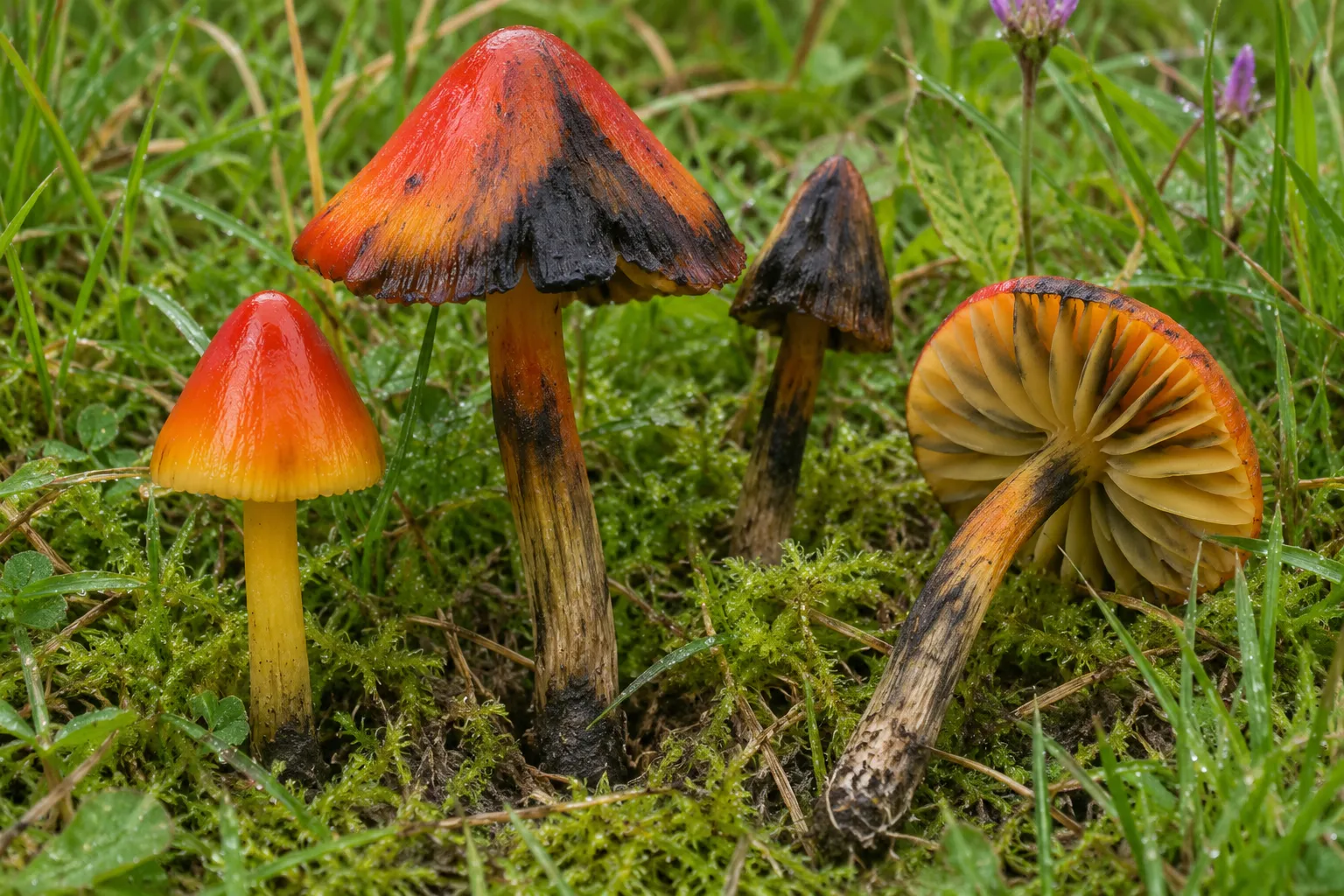
Quick facts
- Scientific name
- Hygrocybe conica
- Common names
- Blackening waxcap, Witch's hat, Conical waxcap
- Taxonomy
- Hygrocybe · Hygrophoraceae
- Edibility context
- Inedible: Not recommended for food; remote identification is insufficient and collection may damage conservation-value grassland fungi.
- Spore print
- White; microscopic characters and a current regional key may be needed within the conica complex.
- Toxicity context
- Unknown: Do not infer safety from color or genus; seek local poison-control or medical advice after symptomatic ingestion.
- Season
- June, July, August, September, October, November
- Growing difficulty
- Expert
- Regions
- Europe, North America, other regions supported by verified records
Safety limit: These labels summarize documented context; they never authenticate a wild specimen. Cooking does not make a poisonous species safe.
The blackening waxcap, Hygrocybe conica, is best understood as a sequence rather than a color. A fresh fruit body may be lemon yellow, orange, or scarlet; a handled or aging one can become smoky gray and finally charcoal black. If only the last stage is photographed, the most diagnostic transition has already disappeared.
This guide focuses on how to record that transition, how to separate a conical waxcap from superficially similar grassland mushrooms, and how to document sensitive waxcap habitat without turning a web page into food clearance. The name covers variable material across a broad range, so microscopy and regional literature may be necessary.
Start with the undisturbed color and conical profile
Photograph each fruit body before touching it. Young caps are typically conical and may end in a sharp or rounded point. Their starting colors range from yellow through orange to vivid red, sometimes in bands on one cap. A ruler beside, not on, the mushroom establishes scale without bruising the tissue.
Record whether the surface is glossy, tacky, or already dry. Moist caps can be slightly viscid; drying reveals radial fibers and may split or lob the margin. Those changes are developmental evidence, not separate species by themselves. Use neutral daylight and a gray card because phone saturation can turn orange tissue falsely scarlet.
Time the blackening reaction instead of reporting it once
Choose one legal specimen only when collection is appropriate. Make a small pressure mark on the cap margin and stem, then photograph the same marked areas immediately and after five, fifteen, and thirty minutes. Note whether the tissue passes through olive, brown, or gray before becoming black.
Blackening also develops without deliberate damage, often beginning at the cap tip, margin, stem base, or weathered patches. Keep natural aging separate from a controlled bruise. The bruising reactions guide explains why elapsed time, moisture, and exact tissue location belong in every color-change claim.
Read the waxy gills as structure, not decoration
Turn one mushroom carefully enough to show the underside while keeping its base intact. The gills are thick and waxy rather than thin and papery. They are usually narrowly attached or nearly free, and begin whitish, pale lemon, or yellow-orange before bruised and old areas darken.
Photograph attachment in profile. A torn cap can create an artificial gap, while a steeply ascending gill can look free from one camera angle. The gill-types guide provides consistent vocabulary for attachment and spacing. Record shorter gills and any cross-veins rather than selecting only the cleanest view.
Preserve the full stem and buried base
The stem is slender, often hollow, and colored yellow to orange or red before it blackens. It may be smooth when young and increasingly fibrous or grooved with age. Moisture can make the surface feel slightly sticky, but cap and stem viscosity vary among collections placed in the broader conica group.
Photograph the point where the stem meets soil. Plantlife notes that waxcaps can occur in mossy, shaded grassland and banks; a buried base can be missed in a clipped lawn. There is no ring or volva expected. If either structure appears genuine, reopen the identification instead of forcing it into a waxcap label.
Make a white spore deposit without losing provenance
A mature cap can produce a white deposit. Place it across dark and clear surfaces, cover it against drafts, and label collection number, time, and which photographs belong to it. A faint pale dusting on grass is not a controlled print.
White spores exclude many dark-spored grassland mushrooms but do not identify H. conica. Within waxcaps, cap cuticle, spores, basidia, gill trama, and clamp connections can matter. Preserve a dried voucher when regulations allow, especially when a collection does not blacken consistently or comes from an unusual habitat.
Describe the grassland management, not just “in grass”
Waxcap habitat is information-rich. Record sward height, moss cover, slope, shade, grazing or mowing, soil disturbance, fertilizer history if known, and nearby trees. A roadside verge that has remained nutrient-poor for decades differs ecologically from recently laid, irrigated turf even if both appear green.
Plantlife lists banks, grasslands, lawns, and meadows, while the Burke Herbarium also notes woodland settings in western North America. These accounts are not contradictory: range-wide habitat use can vary. Apply local floras and verified specimens rather than importing a British grassland rule unchanged to another continent.
Separate blackening waxcap from persistent waxcaps
Persistent or acute waxcaps can share a sharply conical yellow-to-orange cap. The central question is not whether one dark spot exists, but whether cap, gills, flesh, and stem develop the characteristic spreading gray-black response. Photograph an initially clean area and its timed outcome.
Do not force a negative result from a dry, frost-damaged, or already senescent specimen. Regional names around Hygrocybe acutoconica, H. persistens, and related taxa have changed. When macroscopic evidence is mixed, report “conical waxcap” and retain microscopic material rather than converting uncertainty into a species claim.
Keep scarlet waxcap in a different shape-and-reaction class
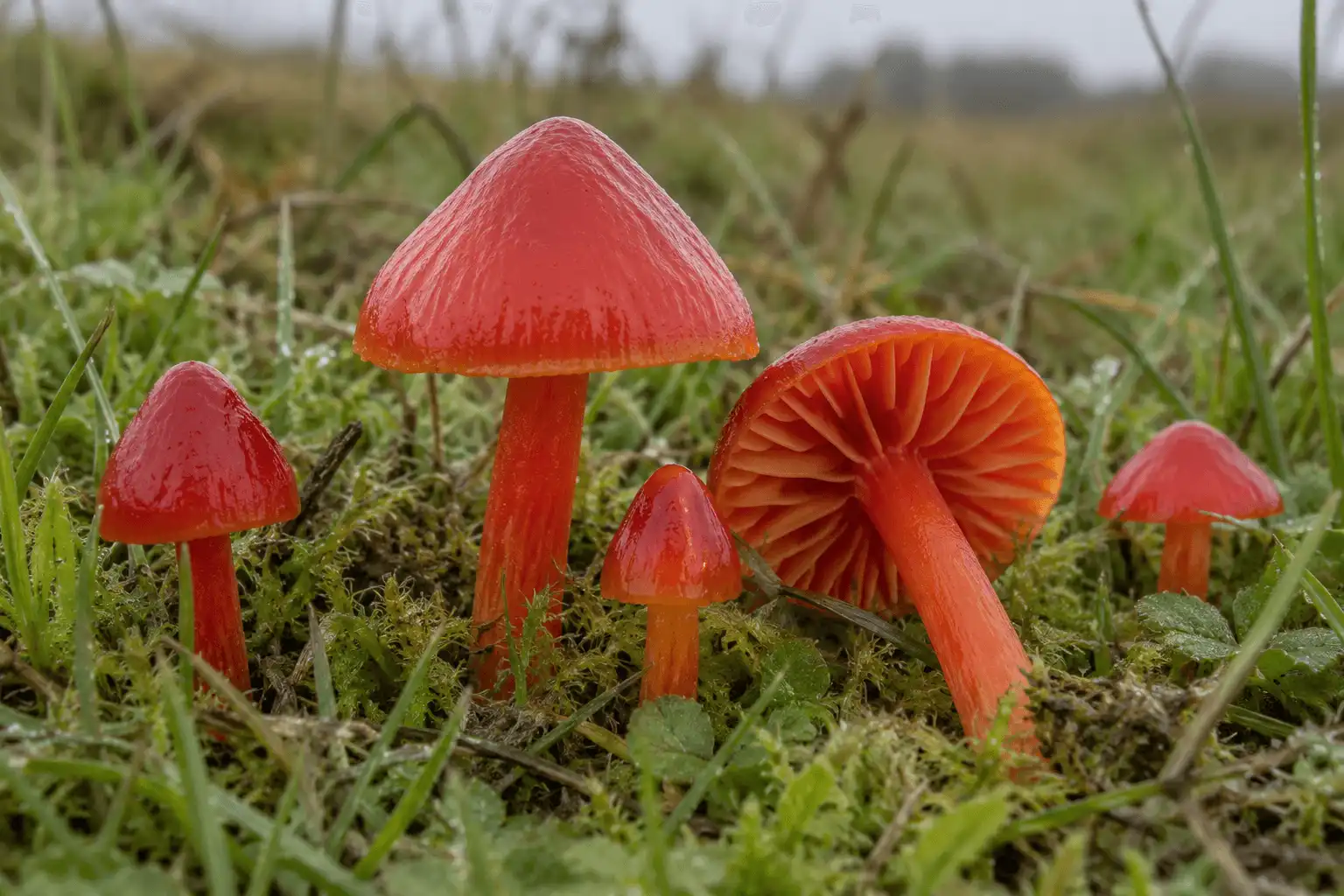
Scarlet waxcap is usually broadly convex, becoming flatter, rather than persistently pointed. It does not show the same pervasive blackening sequence. Its gill attachment and stem proportions also need comparison. The scarlet waxcap guide documents that whole profile.
Color overlap is substantial. A yellow-orange blackening waxcap may never look scarlet, while a rain-darkened scarlet waxcap can appear dull. Use cap development, timed tissue reaction, gills, stem, spores, and habitat together. One saturated overhead image is insufficient for either name.
Distinguish meadow waxcap by its decurrent gills
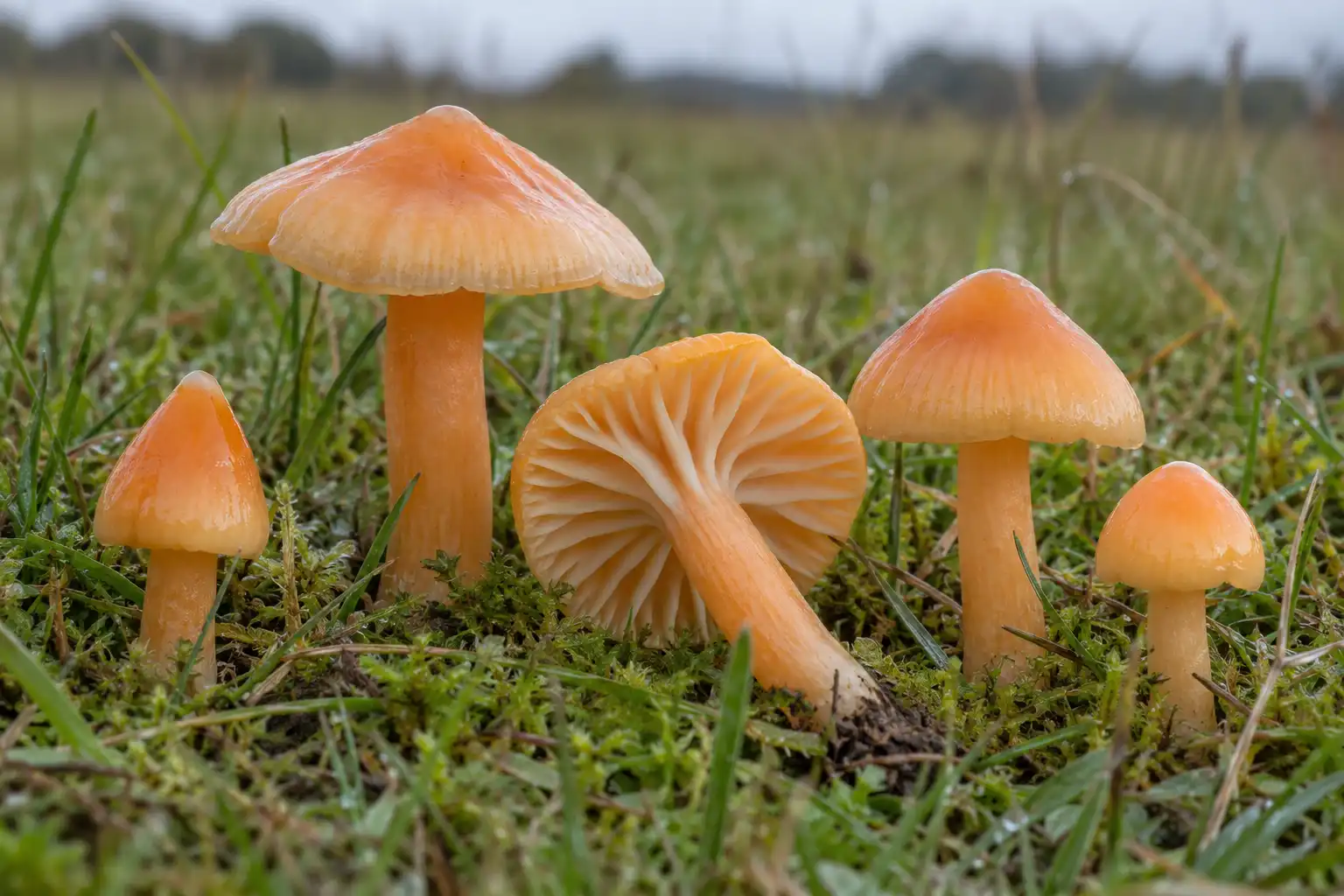
The meadow waxcap is generally stouter, buff to apricot, and carries thick gills running conspicuously down the stem. Its cap becomes convex or irregular rather than sharply conical, and it lacks the blackening response. The meadow waxcap guide addresses that separate field intent.
Measure gill descent rather than relying on the word “decurrent.” A side photograph can show how far several full-length gills travel below the cap-stem junction. That evidence remains useful after colors fade in rain or herbarium drying.
Treat distribution maps as hypotheses
GBIF accepts Hygrocybe conica and aggregates records from many institutions and observation systems. Before using a point as proof of local presence, inspect its basis of record, coordinate uncertainty, identification date, and whether a specimen or diagnostic image exists.
The Burke Herbarium describes broad distribution and variable habitat in Washington material. Plantlife and the Natural History Society of Northumbria provide focused British morphology and season. Together they define questions to check locally; they do not remove the need for a regional key when cryptic or historical species concepts are involved.
Protect waxcap habitat during documentation
Many waxcap assemblages are valued as indicators of long-continuity, low-nutrient grassland. Do not uproot a group merely to complete a photo set. Begin with non-destructive images, limit any permitted collection to the minimum needed for a voucher, and replace disturbed turf.
Avoid broadcasting exact coordinates for a vulnerable site without land-manager consent. Record management changes such as fertilizer, reseeding, drainage, heavy trampling, or cessation of grazing because they can matter more to future interpretation than the number of fruit bodies seen on one visit.
Keep food and poisoning decisions conservative
This page treats blackening waxcap as not for food. The starting color, dramatic blackening, or a match to the lead image cannot establish identity or safety. A sensitive grassland fungus also should not be collected casually for culinary experimentation.
If symptoms follow mushroom ingestion, contact local poison control, emergency services, or a medical professional promptly. Preserve uncooked material, leftovers, photographs, location, quantity, and timing. Do not wait for an internet identification and do not induce vomiting unless a clinician instructs you.
Build an auditable blackening-waxcap record
- Photograph untouched caps, stems, and habitat under neutral light.
- Record starting color, cap profile, moisture, and radial fibers.
- Time one small cap and stem bruise at fixed intervals.
- Show thick gills and their real attachment without tearing them.
- Preserve the whole stem base and note absence of ring and volva.
- Make a labeled white spore deposit from a mature cap.
- Describe turf management, moss, slope, shade, and disturbance.
- Compare persistent, scarlet, and meadow waxcaps feature by feature.
When essential evidence is missing, the identification safety checklist provides a clear stopping rule.
Image and evidence limits
The 1536 × 1024 cover is an original AI editorial image. It was opened and reviewed beside the site’s scarlet waxcap and purple brittlegill natural-light covers. It passes for restrained field light, coherent conical caps, visible waxy gills, complete bases, progressive rather than soot-like blackening, natural grass and moss texture, sharpness, and absence of text, watermark, logo, stretching, or obvious fused anatomy. It is not a voucher photograph and must not be used to confirm a real specimen.
Measure blackening as a tissue-by-tissue timeline
Number intact fruit bodies before touching them. Photograph cap center, margin, gill edge, upper stem, and base at fixed intervals after natural damage and after one standardized light bruise on a separate specimen. Record elapsed minutes rather than saying that the mushroom “quickly turns black.” The cap margin may darken before the center, while compressed gills and stem fibers can follow different paths. Rain-soaked tissue, frost, and age also alter the rate.
Use the same exposure and neutral reference in every frame. A phone’s automatic contrast can turn olive-gray bruising into jet black and erase the intermediate stage. Map each region on a simple outline and retain unedited files. Progressive blackening tied to yellow-orange or red developmental colors is useful evidence; surface soot, adhering soil, or a single already-black cap is not the same sequence.
Tie the record to grassland continuity
Waxcap habitat is more than “grass.” Record turf height, moss cover, bare soil, slope, aspect, drainage, shade, livestock or mowing regime, fertilizer history if known, and visible soil disturbance within a fixed plot. Photograph neighboring waxcaps and grassland fungi without assuming they share one mycelium. Revisit after mowing and after rain to separate persistent habitat structure from a single flush.
This ecological ledger helps reviewers interpret a record and can support conservation monitoring, but one blackening waxcap does not by itself prove an ancient or unimproved grassland. Avoid trampling a colony to obtain every angle. Where a site is sensitive, limit collection, obscure public coordinates appropriately, and coordinate voucher work with the relevant land manager or recording group.
References
- Global Biodiversity Information Facility. Hygrocybe conica. Accepted-name and occurrence checkpoint.
- Plantlife. Blackening Waxcap. British measurements, habitat, season, and visible blackening sequence.
- Burke Herbarium, University of Washington. Hygrocybe conica. Herbarium-linked distribution, habitat, and identification notes.
- Natural History Society of Northumbria. Blackening Waxcap. Developmental appearance and similar-species context.
Editorial review: November 21, 2026. No named mycologist, clinician, or toxicologist reviewed this page.
Source quality notes
MushroomScope cites sources that match the page scope, such as taxonomic databases, extension guidance, food-safety agencies, food-composition databases, and peer-reviewed or institutional health references. Sources support context and uncertainty; they do not turn an online page into specimen identification, medical advice, or a tested recipe record.
Frequently asked questions
Why does a blackening waxcap turn black?
Its tissues progressively darken after bruising and during aging. Record where the change starts and how it spreads; a black cap by itself is less informative than a timed sequence linked to an initially yellow, orange, or red fruit body.
Is every blackening waxcap red when young?
No. Fresh caps can be yellow, orange, scarlet, or intermediate shades. The conical profile, waxy gills, stem, habitat, and progressive blackening matter more than one starting color.
How is it separated from the persistent waxcap?
Persistent or acute waxcaps can share a pointed yellow-orange cap but do not show the same pervasive blackening response. Regional species concepts and microscopy may still be required.
Where does Hygrocybe conica grow?
It is recorded broadly in mossy, nutrient-poor grasslands, lawns, banks, dunes, roadsides, and in some regions woodland settings. Local ecology should be checked against verified records.
Is the blackening waxcap edible?
This page does not recommend it for food. A remote guide cannot confirm a specimen, and waxcap grasslands can be sensitive habitats where collecting is inappropriate or restricted.
Related guides
mushrooms
Scarlet Waxcap: Grassland Ecology and Identification
Document scarlet waxcaps by waxy red caps, thick spaced gills, slender stems, unimproved grassland ecology, regional limits, and close lookalikes.
mushrooms
Meadow Waxcap: Cuphophyllus pratensis Grassland Guide
Identify meadow waxcap through dry apricot caps, thick decurrent gills, old-grassland ecology, regional lookalikes, recording methods, and safety limits.
identification
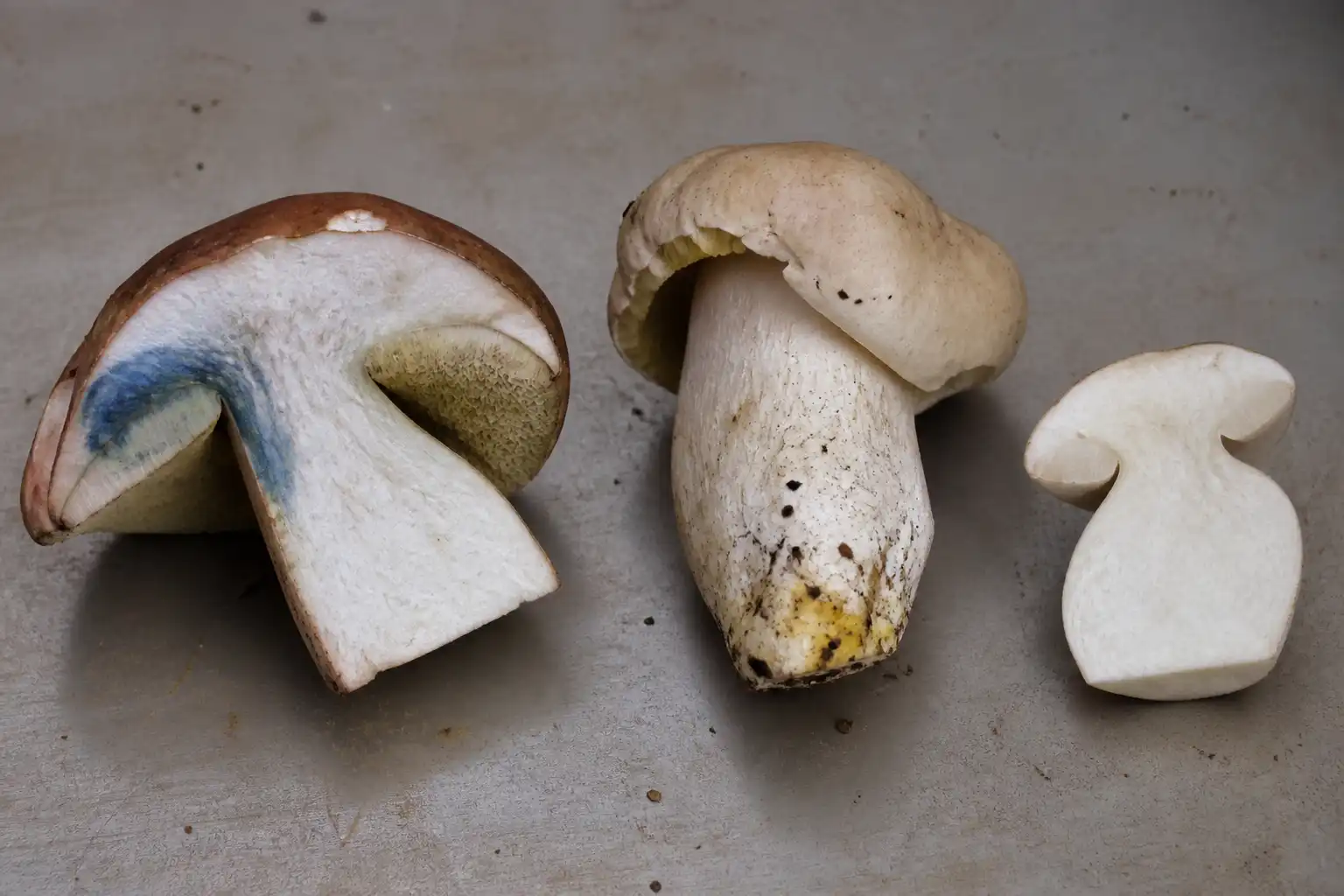
Mushroom Bruising and Color Changes Explained
Document mushroom bruising by location, trigger, timing, and color while separating oxidation from age, spores, latex, and damage.
Continue exploring
Browse more practical guides in Mushroom Encyclopedia or visit the mushroom encyclopedia.