Mushroom Encyclopedia
Scarlet Waxcap: Grassland Ecology and Identification
Document scarlet waxcaps by waxy red caps, thick spaced gills, slender stems, unimproved grassland ecology, regional limits, and close lookalikes.
By MushroomScope Editorial Team · · Updated
Species context
Treat profiles as reference material
Species profiles summarize documented traits, taxonomy, and lookalikes, but natural variation can be substantial.
Use the safety checklist →Decision limit
A profile cannot authenticate a specimen
Do not eat a wild mushroom from an online match, single feature, or generated image.
Read the safety disclaimer →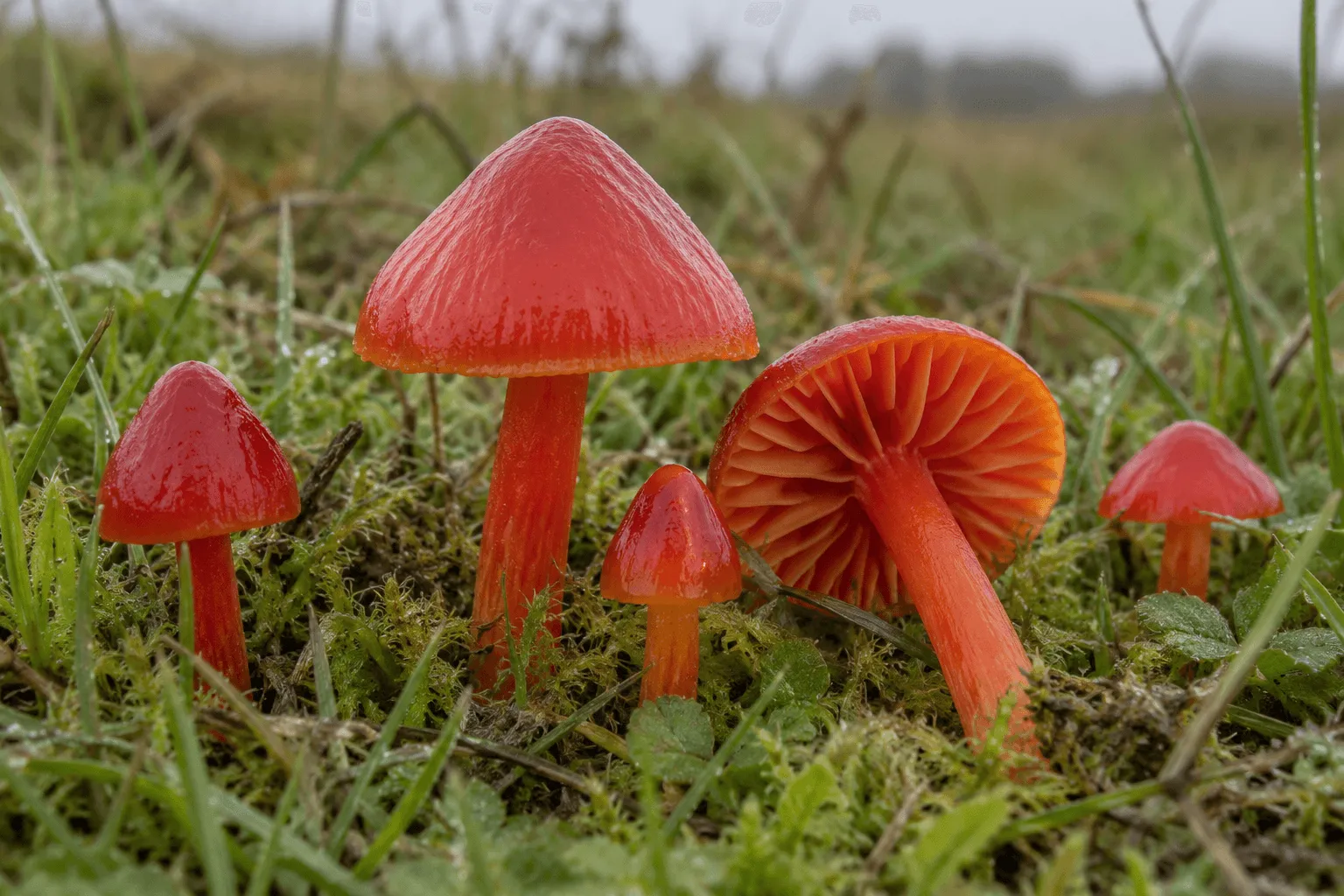
Quick facts
- Scientific name
- Hygrocybe coccinea
- Common names
- Scarlet waxcap, Scarlet hood
- Taxonomy
- Hygrocybe · Hygrophoraceae
- Edibility context
- Unknown: This page does not recommend eating wild waxcaps; identification uncertainty, individual reactions, and habitat conservation outweigh casual culinary claims.
- Spore print
- White to pale cream.
- Toxicity context
- Unknown: Absence of a prominent poisoning record is not evidence that an unidentified red waxcap is safe.
- Season
- August, September, October, November
- Growing difficulty
- Expert
- Regions
- Europe, temperate North America under regionally checked concepts, other temperate records requiring verification
Safety limit: These labels summarize documented context; they never authenticate a wild specimen. Cooking does not make a poisonous species safe.
The scarlet waxcap, Hygrocybe coccinea, is a small red mushroom whose real story is as much about grassland as color. A useful record combines a smooth cap, thick waxy gills, a ringless stem, pale spores, measurements, development, weather, and land-management history. “Bright red mushroom in grass” is only the beginning; several waxcaps share that description, and camera saturation can erase the distinctions a key needs.
This guide is for documentation and habitat interpretation. It cannot confirm a specimen from a photograph or authorize eating it. Waxcap-rich turf can also be locally important habitat, so observation should not become indiscriminate collecting.
Start with the whole grassland record
Photograph the fruiting before touching it. Include a wide view showing turf height, moss, slope, nearby trees, paths, dung, irrigation, and disturbed soil. Record whether the site is an old pasture, churchyard, cemetery, lawn, dune grassland, road verge, or recently created sward. Ask, where possible, about fertilizer, lime, herbicide, reseeding, plowing, drainage, and mowing.
Those notes matter because waxcap fruiting is strongly associated in many European surveys with long-established, low-nutrient grassland. The relationship is not a simplistic soil test: fruit bodies appear intermittently, management histories are incomplete, and fungi may persist unseen. Still, an assemblage of waxcaps, earthtongues, clubs, and pinkgills across repeated visits is more informative than one red cap after rain. The habitat identification guide explains how to keep ecology attached to the specimen record.
Measure cap development instead of matching color
Measure several caps in millimeters. Young caps are convex; mature ones spread and may become broadly convex or nearly flat. Note whether the center is depressed, gently domed, or papillate. Photograph the same cap wet and after brief air drying if conditions allow. A moist surface can look lacquered, while an older dry cap may appear duller and paler.
Describe the color as a gradient: center, mid-zone, margin, and any yellow-orange fading. Do not sample colors from a phone screen as if they were chemical readings. Automatic white balance, shade, flash, and editing can turn orange-red into crimson. Surface structure is more stable: a typical scarlet waxcap is smooth rather than covered in persistent granular scales.
Inspect the margin for translucency and radial striation. These can increase when tissue is wet or thin. Record damage separately from normal structure; slug feeding, frost, and abrasion expose paler flesh and can imitate a patterned cap.
Read the waxy gills carefully
Turn one specimen without breaking the stem base and photograph the underside square-on. The gills should appear relatively thick and spaced rather than thin and crowded. Record their attachment to the stem: broadly attached, narrowly attached, notched, or running slightly down. Use the gill-types guide to describe what is visible rather than forcing the mushroom into a remembered diagram.
Count full-length gills across one quarter of the cap and note shorter tiers between them. Record color near the stem, middle, and margin. Scarlet waxcap gills are commonly yellow-orange to red-orange and can be paler than the cap. Reflected light from a vivid cap can falsely tint pale surfaces, so use diffuse daylight and a neutral reference card.
“Waxy” describes the thick, somewhat soft appearance and feel of the gills; it is not permission to squeeze every specimen. A macro photograph and one legally collected representative usually provide more repeatable evidence than handling an entire fruiting.
Document the stem from top to base
Measure stem length and width at top, middle, and base. Note whether it is equal, tapered, compressed, curved, hollow, or split. A scarlet waxcap stem is generally slender and smooth, colored red to orange above and often yellower toward the base. There should be no ring and no enclosing volva.
Excavate the base gently if collection is appropriate, then photograph adhering soil and vegetation before cleaning. A broken stem loses information about basal color and attachment. Also record whether two stems merely touch below ground or truly share tissue; crowded fruiting can make separate mushrooms look clustered.
Cut one specimen lengthwise. Note flesh thickness, internal color, cavities, odor without tasting, and any change at one, five, and fifteen minutes. A lack of blackening supports separation from blackening waxcaps, but it does not prove H. coccinea.
Separate the red waxcap lookalikes
Begin with characters that can falsify the scarlet-waxcap hypothesis. A sharply conical cap plus progressive gray or black discoloration points toward the Hygrocybe conica complex. A finely scaly cap suggests members of the vermilion-waxcap group rather than a smooth scarlet cap. A much larger, robust mushroom with different stem fibrils may fit crimson waxcap or another red species.
The names used for red waxcaps have changed with modern taxonomy, and regional species sets differ. Size ranges overlap. Weather can flatten caps and wash colors. Some separations depend on spores, pileipellis structure, clamps, DNA, or literature written for a particular country. A responsible report can therefore end at “red Hygrocybe species” when the evidence cannot support more.
Do not import a European key uncritically into North America or another region. Check whether its species concept, synonyms, and microscopy apply locally. GBIF occurrence points help frame geography but are not identification instructions; records vary in age and verification.
Make a pale spore deposit without wasting the specimen
Where collecting is legal, place a mature cap across white and dark nonabsorbent surfaces and cover it against drafts. Label it with the same specimen number used for habitat photographs. A white to pale cream deposit is compatible with a waxcap but shared by many unrelated mushrooms.
If no deposit forms, report that failure. An immature, dry, cold, or damaged cap may release few spores. Do not call bare paper a white print. Preserve a small dried portion only when a local recorder, herbarium, or mycological group can use it, with date, coordinates at an appropriate privacy level, habitat, collector, and photographs.
Treat waxcaps as habitat evidence with limits
Waxcaps are often used in grassland-fungi surveys because diverse assemblages can signal continuity and low nutrient input. One fruiting cannot date a lawn, prove it has never been fertilized, or establish legal protection. Survey timing, rainfall, mowing, recorder effort, and year-to-year variability all affect counts.
A stronger survey revisits the same mapped plots through the season, records all relevant fungal groups, and stores negative visits as well as positive ones. It separates a management observation—such as clippings removed after mowing—from an inference about nutrient status. That structure turns an attractive photograph into evidence that land managers can compare.
Avoid broadcasting precise locations for vulnerable sites without considering trampling and collection pressure. Follow landowner permissions and local conservation guidance. If management is being planned, consult a qualified grassland ecologist or county recorder rather than treating this page as a prescription.
Keep food claims separate from identification
Scarlet waxcaps are sometimes described in culinary lists, but that does not make a remotely identified collection suitable for food. Names may be applied inconsistently, small red mushrooms are easy to mix in a basket, habitat may be contaminated, and local conservation priorities may argue against collection. No taste test is an identification method.
If anyone develops symptoms after eating an unidentified wild mushroom, contact local emergency or poison-control services promptly. Keep uncooked specimens, trimmings, photographs, packaging, and meal timing. Do not wait for an online identification or induce vomiting unless a medical professional instructs it.
A repeatable field worksheet
Use one row per fruiting group and keep these fields together:
- Site type, management history, recent weather, turf height, moss cover, and disturbance.
- Cap diameter, profile, moisture, surface texture, color zones, and fading.
- Gill thickness, spacing, attachment, short-gill tiers, and color.
- Stem dimensions, surface, color gradient, internal structure, ring or volva absence.
- Cut response at fixed times, odor, spore-deposit outcome, and photograph numbers.
- Regional key used, unresolved alternatives, microscopy or voucher details, and confidence.
This format makes uncertainty visible. It also prevents a later observer from treating a vivid cover image as stronger evidence than the measured collection.
Preserve uncertainty in community records
When uploading a record, distinguish observed characters from the proposed name. A useful observation can remain “red waxcap” if photographs show the cap, gills, stem, base, scale, and habitat. Add the key consulted, alternatives excluded, alternatives still possible, and whether microscopy was performed. Do not select a species merely because a platform requests a narrow label.
Repeated records from a marked patch can reveal changes through the season. Photograph from the same direction, avoid trampling, and record mowing between visits. If a verifier revises the name, retain the original evidence and revision history. That audit trail is more useful for conservation than false certainty.
Use a paired blackening control in mixed waxcap turf
A red waxcap that merely darkens as it dries is not demonstrating the tissue reaction used for the blackening waxcap. When both hypotheses are locally plausible, select two comparable, legally collected specimens and photograph them under the same light. Apply one small pressure mark to cap margin and stem, then repeat the frame at zero, five, fifteen, and thirty minutes. Keep exposure and white balance fixed.
In H. coccinea, an old bruise may dull or become water-soaked, but the cap, gills, flesh, and stem should not progress together toward the pervasive charcoal state described in the blackening waxcap guide. A positive control is useful only when each specimen remains separately labeled; never mix tissue or infer the scarlet identity solely from a negative reaction.
Measure grassland continuity without inventing a soil diagnosis
Record a 2 m radius around each fruiting point: moss cover, sward height, bare soil, slope, shade, mowing or grazing, drainage, and visible enrichment. Repeat the same quadrat after rain and across seasons. This creates a habitat record without pretending that one waxcap can reveal exact soil chemistry or land-use history.
Map scarlet, meadow, and blackening waxcaps as separate points rather than a single colorful assemblage. Co-occurrence can strengthen the case that a site supports waxcap grassland, but it cannot identify an individual fruit body. Preserve uncertainty in both directions: a maintained lawn can hold old fungal continuity, while a species-rich-looking photograph may cover only a small transient flush.
Audit gill attachment across cap expansion
Photograph one young, one expanding, and one mature cap from the same population. At each stage, measure the angle of the gills near the stem and record whether attachment is adnate, notched, or slightly decurrent. Cap expansion can change the apparent angle; a torn junction can manufacture a false free gill.
Pair those measurements with gill thickness, spacing, cap profile, stem texture, and the timed bruise series. This developmental matrix adds more value than another red-cap description and leaves a later reviewer enough evidence to revisit the name when regional waxcap taxonomy changes.
For a smaller yellow grassland species, the butter waxcap guide shows how cap hydration, thick gill spacing, measured stature, and low-nutrient turf context separate evidence from a color match.
References
For a pale member of the same grassland family, the snowy waxcap guide documents ivory caps, thick descending white gills, complete bases, and white-spored lookalikes rather than treating loss of red color as sufficient evidence.
For a robust dry buff-apricot grassland comparison, use the meadow waxcap guide, which separates thick decurrent gills and site-history evidence from scarlet color.
Record grass height and the fruit body’s exposed height in the same frame. A cap hidden in tall wet turf can retain moisture and appear darker than one a few centimeters away in open grass. That microhabitat contrast is worth preserving, but it should not be promoted into a taxonomic character without broader, matched observations.
- Global Biodiversity Information Facility. Hygrocybe coccinea species record. Taxonomy and occurrence context.
- NCBI. Taxonomy Browser: Hygrocybe coccinea. Independent nomenclatural checkpoint.
- Natural England. Grassland fungi and waxcap habitat resources. Survey and habitat context.
- North American Mycological Association. Mushroom poisoning syndromes. Poisoning response context.
- Poison Control. Wild mushroom safety. Immediate exposure guidance.
Editorial review: October 14, 2026. This page has no named expert or clinical reviewer and should be checked against current regional taxonomy and conservation guidance.
Source quality notes
MushroomScope cites sources that match the page scope, such as taxonomic databases, extension guidance, food-safety agencies, food-composition databases, and peer-reviewed or institutional health references. Sources support context and uncertainty; they do not turn an online page into specimen identification, medical advice, or a tested recipe record.
Frequently asked questions
What does a scarlet waxcap look like?
It is a small grassland mushroom with a smooth scarlet to orange-red cap, thick relatively distant waxy gills, a slender similarly colored stem, pale spores, and no ring or volva. The entire character set and local key are required.
Where do scarlet waxcaps grow?
They are associated especially with long-established, nutrient-poor grassland and mossy turf. Management history, soil, recent fertilizer use, season, and the complete waxcap community give more context than grass alone.
Does a red waxy cap prove Hygrocybe coccinea?
No. Several Hygrocybe and related genera are red or orange. Gill attachment, gill spacing, surface texture, stem, blackening, size, ecology, microscopy, and regional literature may be needed.
Is scarlet waxcap edible?
This guide does not clear wild waxcaps for food. Small red grassland mushrooms can be confused, local conservation concerns matter, and an online image cannot establish identity or condition.
Should scarlet waxcaps be picked for identification?
Begin with photographs and habitat notes. Where collecting is legal, one representative specimen may support a local expert record; avoid removing a whole fruiting and respect protected or surveyed sites.
Related guides
identification
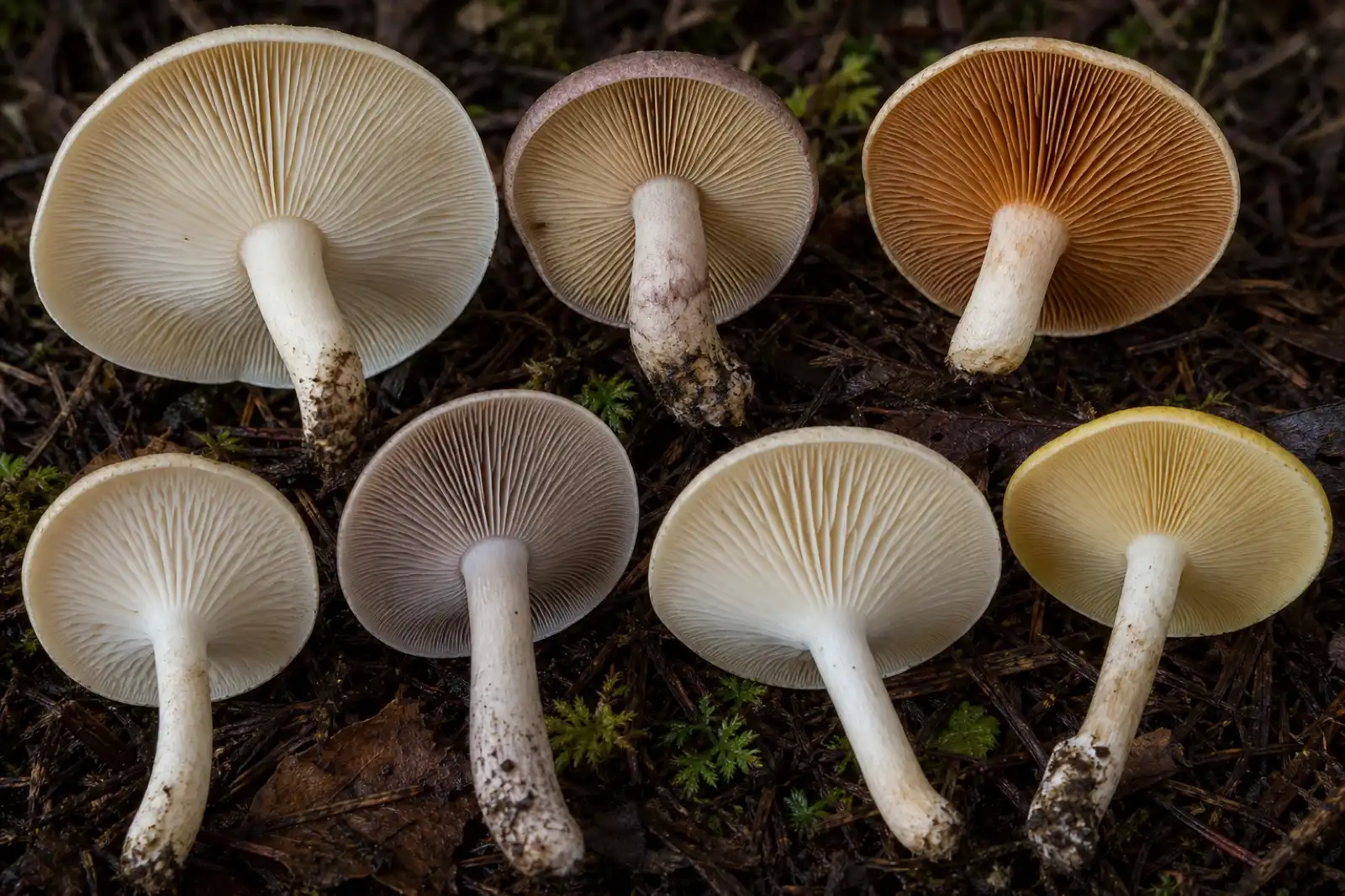
Mushroom Gill Types: Attachment, Spacing, and Color
Compare free, attached, notched, adnate, and decurrent mushroom gills while recording spacing, short gills, edge details, bruising, and color changes.
identification
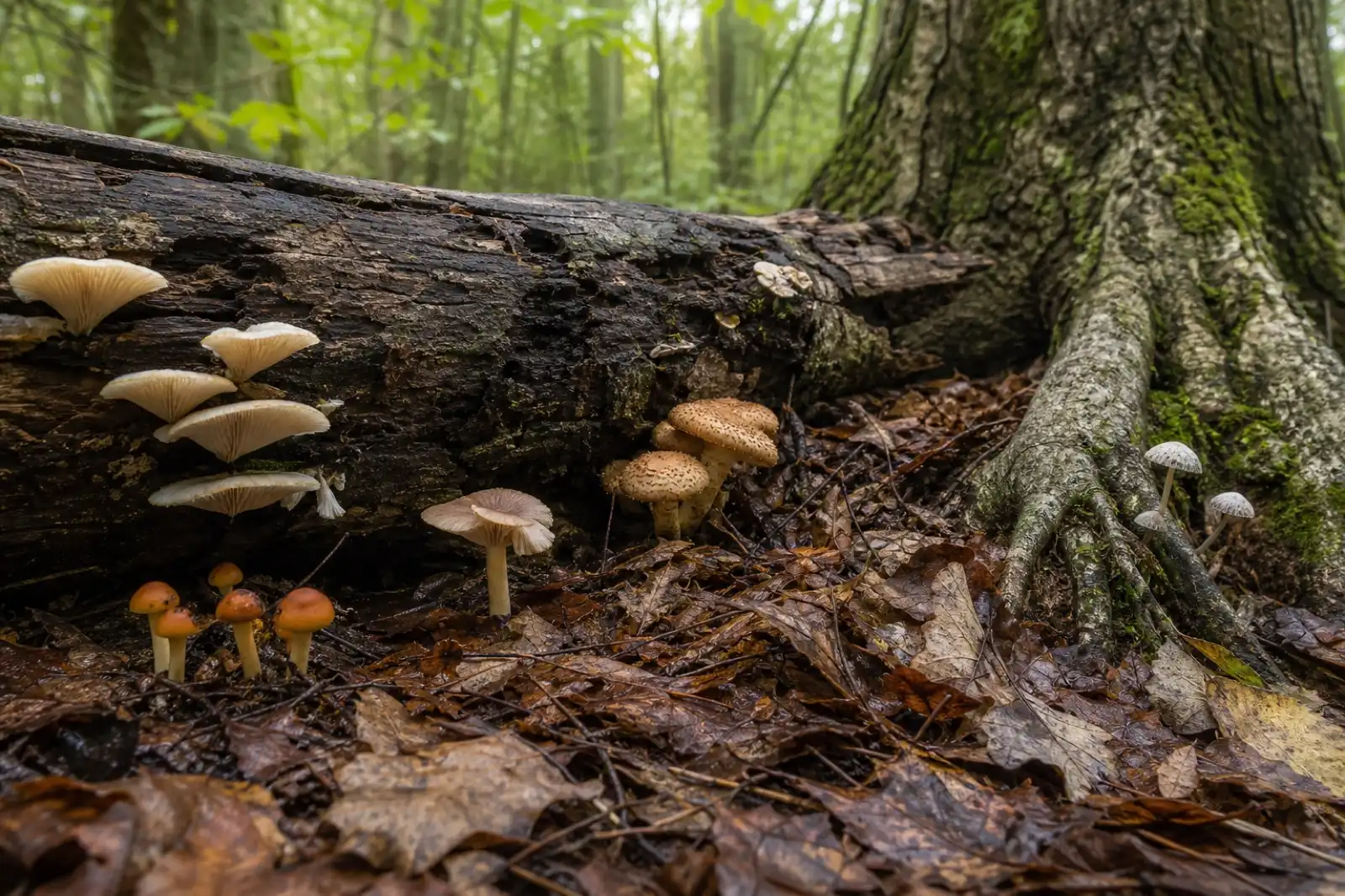
Using Habitat to Identify Mushrooms
Record substrate, associated plants, soil, wood type, moisture, elevation, and fruiting pattern as identification evidence.
identification
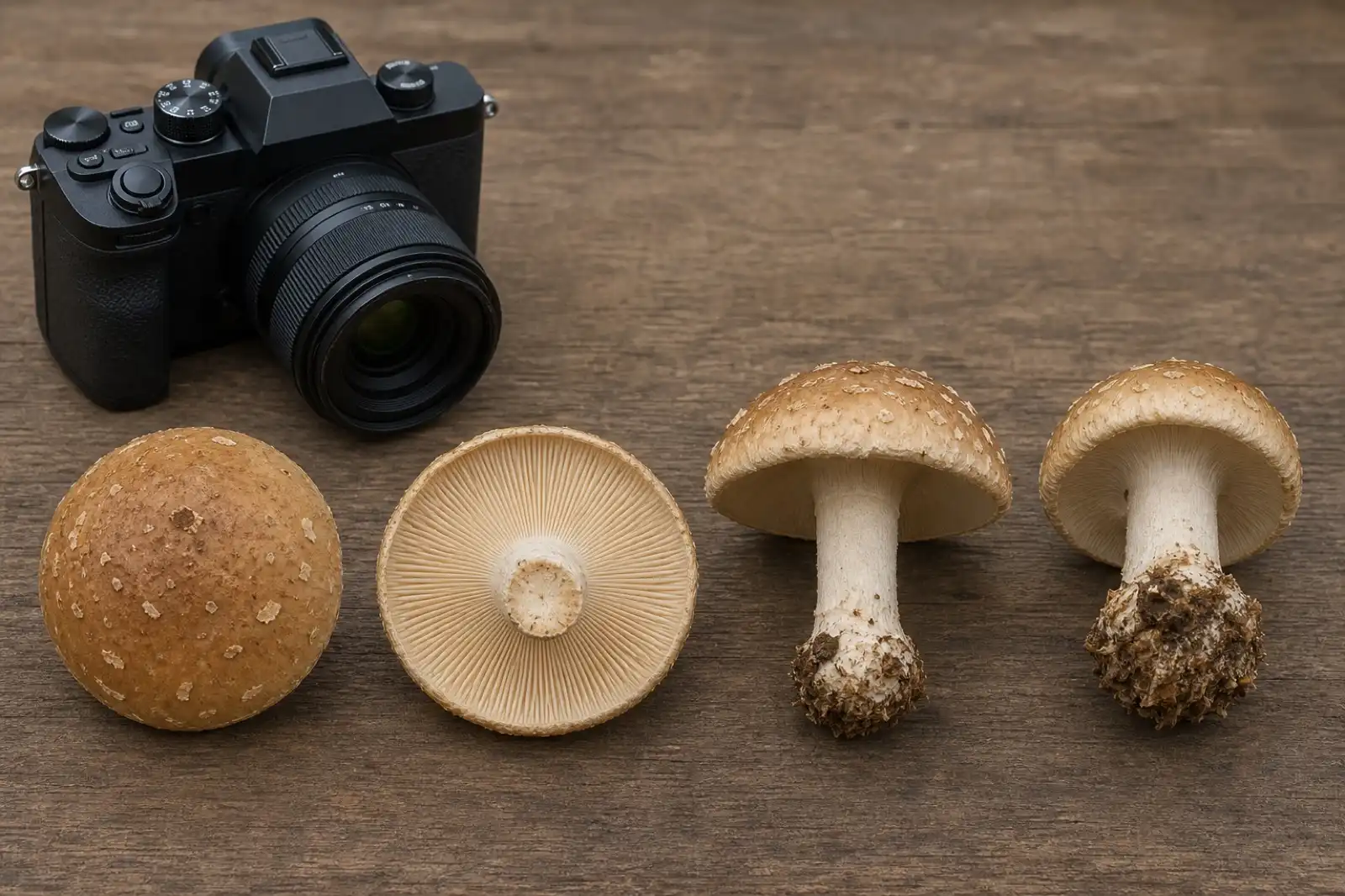
Mushroom Photography Checklist for Identification
Capture the cap, underside, complete stem base, habitat, scale, and specimens at different ages before asking for identification help.
Continue exploring
Browse more practical guides in Mushroom Encyclopedia or visit the mushroom encyclopedia.