Mushroom Encyclopedia
Brick Cap Mushroom: Wood Habitat, Gills, and Lookalikes
Document brick caps by hardwood clusters, brick-red caps, changing gills, purple-brown spores, ringless stems, and sulfur tuft or Galerina differences.
By MushroomScope Editorial Team · · Updated
Species context
Treat profiles as reference material
Species profiles summarize documented traits, taxonomy, and lookalikes, but natural variation can be substantial.
Use the safety checklist →Decision limit
A profile cannot authenticate a specimen
Do not eat a wild mushroom from an online match, single feature, or generated image.
Read the safety disclaimer →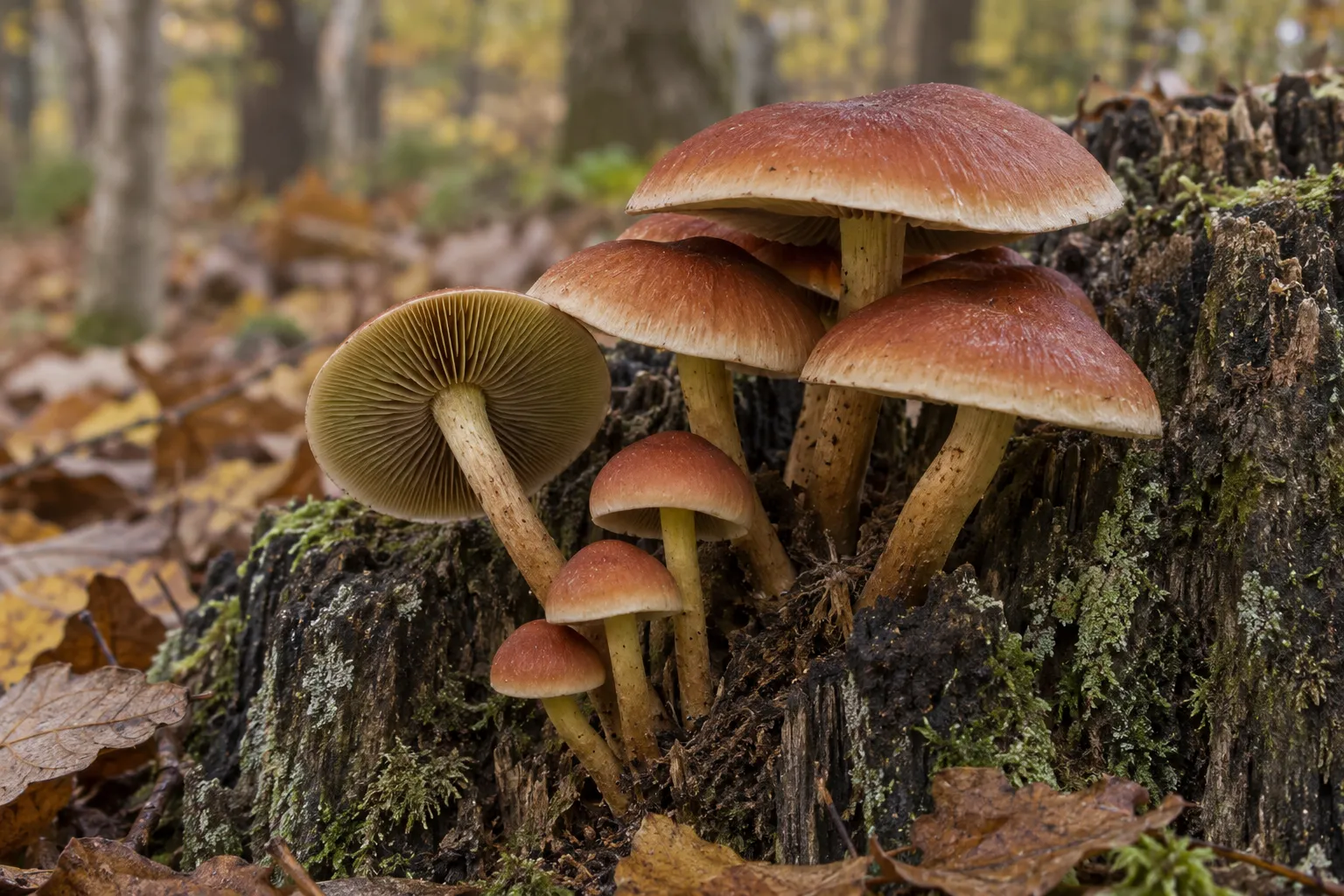
Quick facts
- Scientific name
- Hypholoma lateritium
- Common names
- Brick cap, Brick top, Chestnut mushroom
- Taxonomy
- Hypholoma · Strophariaceae
- Edibility context
- Unknown: Regional accounts differ, and food use should never be inferred without certain identity and local expert guidance.
- Spore print
- Purple-brown to dark purplish brown.
- Toxicity context
- Unknown: Wood-growing clusters include dangerous species; remote photographs and cooking do not resolve a mistaken identification.
- Season
- August, September, October, November, December
- Growing difficulty
- Expert
- Regions
- Europe, North America, temperate Northern Hemisphere records
Safety limit: These labels summarize documented context; they never authenticate a wild specimen. Cooking does not make a poisonous species safe.
The brick cap mushroom is best approached as a wood-decay evidence problem, not as a cap-color match. The name usually refers to Hypholoma lateritium, a ringless mushroom that forms groups on hardwood and develops dark purple-brown spores. Its cap often carries a brick-red center with a paler margin, but rain, age, shade, and camera processing can move that palette from chestnut through orange-brown.
The strongest record combines substrate, developmental changes, gill attachment and color, stem anatomy, spore deposit, season, region, and a deliberate comparison with dangerous wood-growing mushrooms. This page organizes that record. It cannot confirm a specimen for eating.
Prove the woody attachment first
Photograph the whole stump, log, or tree base before touching the mushrooms. Show bark, exposed wood, decay, cluster position, and surrounding trees. A group that appears to rise from soil may connect to a buried root or branch, so trace one stem base carefully instead of labeling the collection terrestrial from the surface view.
Brick cap is saprotrophic: its mycelium uses dead woody tissue. In many accounts hardwood is the expected substrate. Record a host only when bark, leaves, buds, branching, or other evidence supports it. “Hardwood” is more honest than an invented oak identification, and “buried wood unknown” is more useful than “soil.”
Map the cluster. Note whether stems share a tight base, form several adjacent groups, or run along one buried root. Dense growth is common but not exclusive to Hypholoma. The habitat identification guide helps separate visible surface from the actual nutrient source.
Build a cap series instead of matching one color
Young caps are convex, often with a pale cream to yellowish margin and a warmer orange-red or brick-red center. Fine whitish veil remnants may cling near the margin. Expanded caps become broadly convex or almost flat, and rain can wash the surface while sun and age deepen or dull the center.
Measure several caps and photograph them in the same neutral light. Include a young cap, a mid-stage cap, and a mature cap. Record whether the surface is dry, moist, or recently rained on. A phone’s automatic saturation can make red-brown appear diagnostic when the real collection is much subtler.
Do not reject a plausible group because every cap is not red. Development, exposure, and hydration create variation within one cluster. Conversely, do not accept a mushroom because its center looks exactly like a brick; many unrelated wood fungi use the same autumn palette.
Follow gills from pale to smoky purple-brown
Turn caps at different stages and photograph the gill-to-stem junction. The gills are attached rather than free. Young gills may look pale gray, cream-gray, or faintly yellowish. As spores mature, they become smoky gray and eventually darken with a purplish-brown cast.
That progression is more useful than one old underside. Greenish-yellow young gills can push the comparison toward sulfur tuft, while rusty cinnamon spores redirect it toward Galerina or Pholiota. Lighting can distort these differences, so pair photographs with a real deposit.
The gill-types guide explains how to record attached, notched, free, and decurrent junctions. Photograph naturally attached gills before cutting; tearing a cap from its stem can create a false gap.
Make a labeled spore deposit
Use a mature cap across white and dark nonabsorbent surfaces, cover it against drafts, and label it with the collection number. A sufficiently heavy brick cap deposit should be purple-brown to dark purplish brown. A few reflected gill colors or a wet stain are not a print.
The spore-print method gives a repeatable setup. Spore color is particularly important in stump clusters because it separates several high-risk pathways: white-spored Armillaria, rusty-brown Galerina and many Pholiota, and purple-brown Hypholoma.
The new sulfur tuft guide documents the yellow-to-olive gill sequence that must be compared before treating a brick-colored cluster as H. lateritium.
A purple-brown print supports the genus-level direction but does not prove H. lateritium. Keep it attached to notes about cap development, gill color, ring absence, host, and region.
Document the stem and fleeting veil evidence
Stems are often yellowish above and deepen to brown toward the base. Photograph the full length and every side. Brick cap lacks a persistent ring, but young caps may carry fine partial-veil remnants around the margin or an inconspicuous fibrillose zone on the upper stem.
Weather can erase veil traces. Ring absence on one soaked old mushroom is therefore weaker than a series across ages. At the same time, a distinct membranous ring should trigger comparisons with Galerina, Armillaria, and Pholiota rather than being explained away.
Cut one representative stem lengthwise. Record whether it is hollow or stuffed, whether colors change from apex to base, and whether the base joins wood directly. Do not use bitterness as a field test: tasting an unresolved wood-growing mushroom adds risk without replacing anatomy or spores.
Separate the critical lookalikes
Sulfur tuft
Hypholoma fasciculare can share dense stump clusters and purple-brown spores. It is usually more vividly sulfur-yellow, with young gills that may show yellow-green or olive tones before darkening. Brick cap tends toward a brick-red center and less intensely yellow flesh. These are tendencies, not a two-color switch; weathered material and regional variation require a current key.
Deadly Galerina
The Galerina marginata complex is the safety-critical comparison. It also fruits on wood and may occur in groups. A rusty-brown spore deposit, ring or ring zone, and different microscopic characters distinguish it, but old rain-worn fruit bodies can lose obvious veil structures. Mixed collections can occur on one log. Evaluate each fruit body and never treat “same stump” as “same species.”
Honey fungus
Armillaria can form large clusters from roots, stumps, and tree bases. Its spore deposit is white rather than purple-brown, and many species have a visible ring. The honey fungus guide also explains why tree-health context and underground roots matter.
Pholiota and other scaly wood fungi
Many Pholiota have rusty-brown spores, conspicuous cap or stem scales, and stronger veil structures. Rain can remove scales, so spore color and microscopic features still matter. A clean smooth cap after a storm is not proof that scales were never present.
Use microscopy when a species name matters
For a formal record, measure mature spores from a deposit and document mount medium, number measured, and range. Examine cystidia on gill faces and edges, cap-cuticle construction, and veil tissues. Compare these observations with a current key for the collection’s continent.
Taxonomic sources may use the synonym Hypholoma sublateritium. Preserve the exact name supplied by a database or voucher and record when it was checked. A well-archived observation can survive nomenclatural change; an unlabeled photograph cannot.
Dry a lawful representative voucher with collection number, date, generalized location, substrate evidence, photographs, print, and notes. Microscopy or DNA should remain connected to that voucher rather than to a loose image of the cluster.
Interpret fruiting as decay evidence, not a structural diagnosis
Mushrooms show that a fungus has enough established mycelium and suitable conditions to reproduce. They do not reveal the complete boundary or strength of decay inside a stump, root, or tree. Moisture, temperature, and competing organisms can produce fruiting in one year and none in the next.
On natural logs, decomposition returns nutrients and creates habitat. At a living tree base or near structures, species identification does not replace assessment by a qualified arborist or building professional. Record whether wood is dead, attached, buried, or load-bearing, and keep ecological identification separate from hazard evaluation.
Keep food claims outside the identification shortcut
Regional field guides differ in their treatment of brick cap edibility, and common names can be applied inconsistently. Even a correctly identified collection raises separate questions about freshness, pollution, mixed species, individual intolerance, legality, and preparation. This guide does not answer those questions for a real specimen.
Never assume that prolonged cooking repairs uncertainty. It cannot turn Galerina into food, remove environmental contamination, or separate mixed caps after they have been chopped. For symptoms after mushroom exposure, contact emergency services or Poison Control promptly and preserve uncooked material, cooked leftovers, photographs, location, and timing.
Field record checklist
Build a maturity matrix before comparing color
Select at least three intact fruit bodies that share one woody attachment: a closed or young cap, an expanding cap, and a fully sporulating cap. Give each a specimen suffix and record cap diameter, margin veil remnants, gill color, ring evidence, stem-base color, and spore deposition. Photograph all three under the same light and white balance.
The matrix makes the expected pale-gray to smoky-purple gill transition visible without borrowing stages from unrelated clusters. It also reveals mixed fruiting, which is common enough on a stump to deserve an explicit check. If one cap produces rusty spores while the others produce purple-brown spores, isolate every specimen and reopen the Galerina or Pholiota comparison.
Test the substrate claim with a wood-unit map
Draw the visible stump, log, or root as a single wood unit and mark each cluster’s position. For apparently terrestrial stems, trace only enough loose litter to show whether a buried root or chip continues beneath the base; do not excavate structural roots. Record bark type, decay class, moisture, and whether the wood is attached to a living tree.
Revisit after rain and again later in the season. New clusters aligned on the same buried unit strengthen the substrate interpretation, while a nearby but separate cluster should keep its own collection number. The map separates “near hardwood” from “attached to documented hardwood,” a distinction that ordinary habitat captions often erase.
Use a stop-rule comparison for lethal Galerina
Create a release checklist that must be complete before retaining the brick-cap hypothesis: a heavy purple-brown deposit from the exact cap, no rusty deposit in any collected neighbor, ring and veil anatomy documented across ages, attached gills shown intact, hardwood connection recorded, and microscopy consistent with a current regional key when the record matters. A missing item is not a negative character; it is a stop condition.
Do not use cap redness, cluster size, cooking, or a taste test to override the stop rule. The purpose is not to clear food use but to prevent a familiar-looking stump cluster from skipping the dangerous comparison.
- Cluster photographed in place with the actual stump, log, root, or buried wood
- Host evidence and living/dead status recorded without guessing
- Caps measured across young, expanding, and mature stages
- Brick-red center, paler margin, moisture, and veil remnants documented
- Gill attachment and progression from pale gray to smoky purple-brown shown
- Full ringless stem and woody base photographed
- Heavy purple-brown spore deposit linked to the collection
- Sulfur tuft, deadly Galerina, honey fungus, and Pholiota considered explicitly
- Region, date, recent weather, and microscopy limits stated
Frequently asked questions
Can brick caps grow from apparently bare ground?
Yes, when roots, chips, or wood are buried. Trace the base gently and describe the actual attachment. Surface soil does not prove a soil-feeding ecology.
Is the cap always brick red?
No. Young margins may be pale, rain can wash color, and old caps can darken or fade. Use a developmental series and multiple characters.
Does a purple-brown print rule out deadly Galerina?
It argues against a rusty-spored Galerina for the printed cap, but it does not prove that every cap in a mixed cluster is the same. Keep specimens separated and examine each one.
Why avoid tasting for bitterness?
Taste is subjective and unnecessary for resolving a potentially dangerous wood-growing collection. Substrate, gills, spores, veil anatomy, microscopy, and regional keys provide safer evidence.
What should be archived with photographs?
Keep measurements, substrate and host evidence, developmental-stage notes, spore deposit, region, weather, key used, and a voucher number when lawful.
References
The linked GBIF and NCBI resources provide taxonomic checkpoints; USDA Forest Service material supports wood-decay context; NAMA and Poison Control support conservative exposure guidance. Species-level decisions should use a current regional key and microscopy where necessary.
Editorial review updated November 3, 2026. No named mycologist, arborist, clinician, or toxicologist reviewed this page.
Source quality notes
MushroomScope cites sources that match the page scope, such as taxonomic databases, extension guidance, food-safety agencies, food-composition databases, and peer-reviewed or institutional health references. Sources support context and uncertainty; they do not turn an online page into specimen identification, medical advice, or a tested recipe record.
Frequently asked questions
What field combination suggests a brick cap mushroom?
Look for ringless mushrooms clustered on hardwood, with brick-red cap centers, paler margins, gills that darken from pale gray to smoky purple-brown, and a purple-brown spore deposit.
Does clustered growth identify Hypholoma lateritium?
No. Galerina, Armillaria, Pholiota, sulfur tuft, and many other fungi cluster on wood; gills, spores, veil structures, substrate, region, and microscopy must agree.
Why should several maturity stages be photographed?
Young and mature brick caps can have very different gill colors and cap margins. A developmental series shows the expected transition instead of confusing age with species difference.
Is brick cap safe to eat?
This page cannot clear a wild collection for food. Published edibility assessments vary by region, and dangerous wood-growing lookalikes require in-person expert confirmation.
What separates brick cap from sulfur tuft?
Brick cap generally has a brick-red center and less intensely sulfur-yellow flesh and gills, but color is variable; mature gills, spores, taste-free comparison, ecology, and regional keys are needed.
Related guides
mushrooms
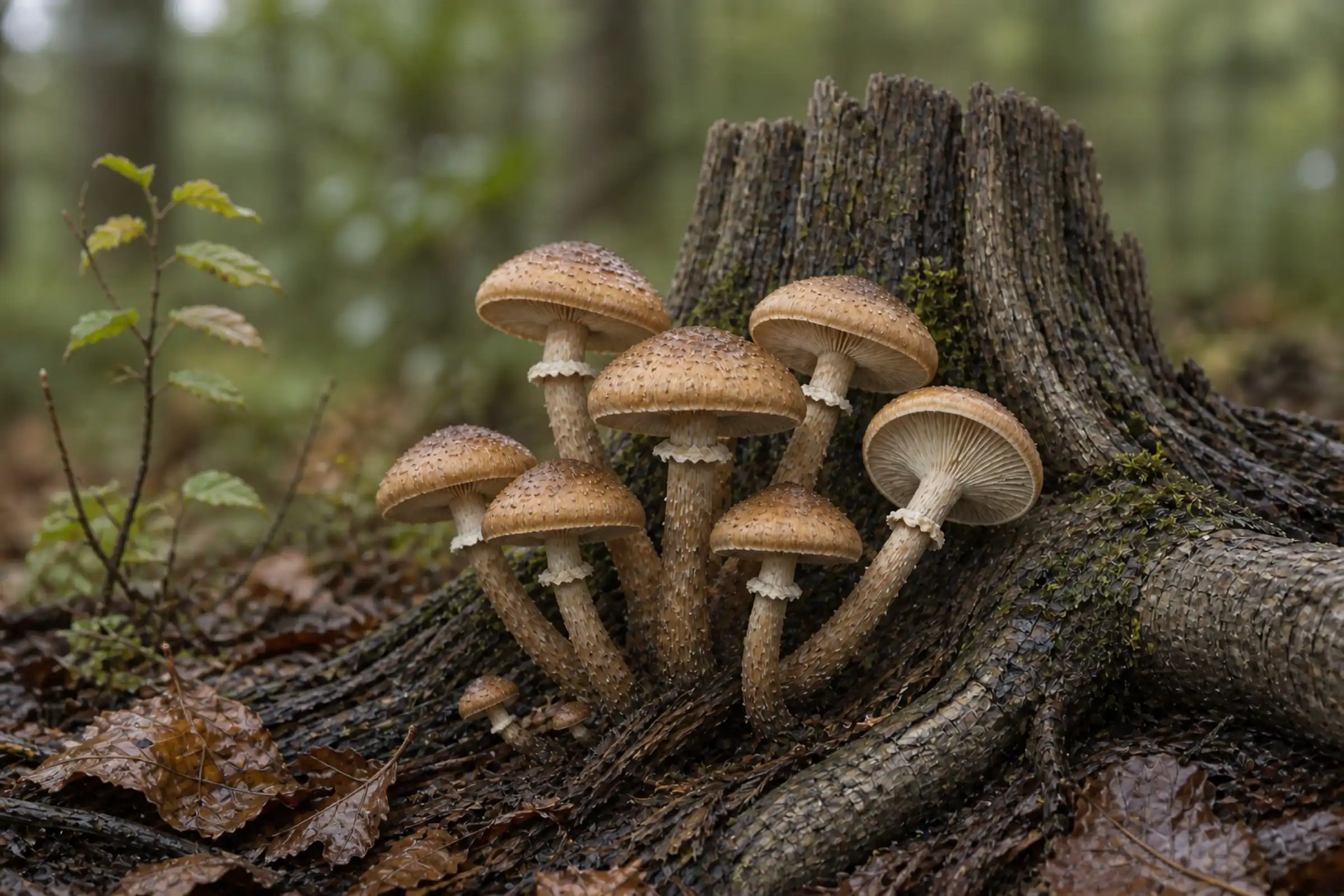
Honey Fungus: Armillaria mellea Identification and Tree Ecology
Identify honey fungus through clusters, rings, white spores, rhizomorphs, host evidence, regional Armillaria limits, and tree-risk boundaries.
mushrooms
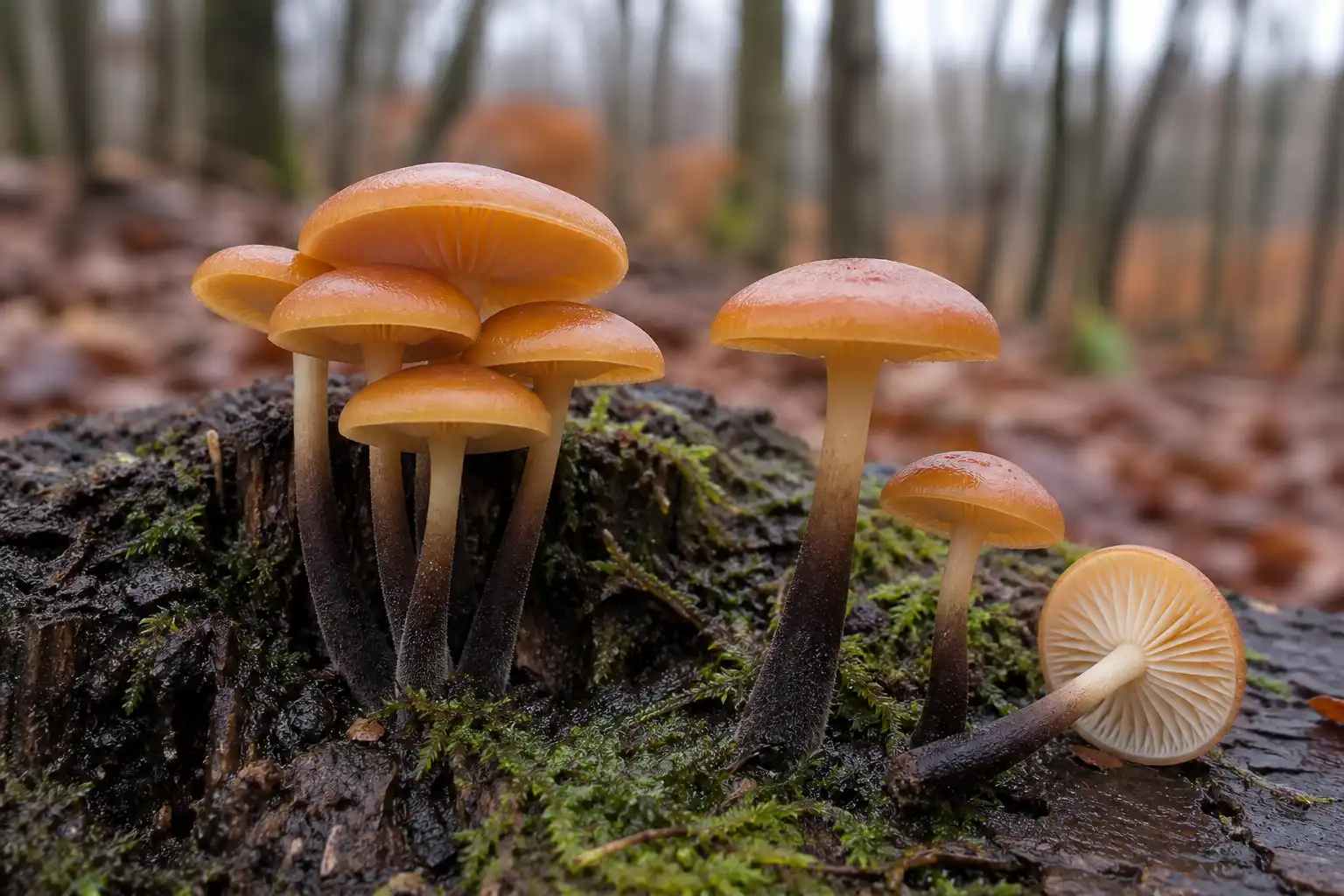
Velvet Shank (Flammulina velutipes): Identification and Safety Guide
Learn how to document wild velvet shank, distinguish it from dangerous wood-growing lookalikes, and separate it from cultivated enoki.
identification
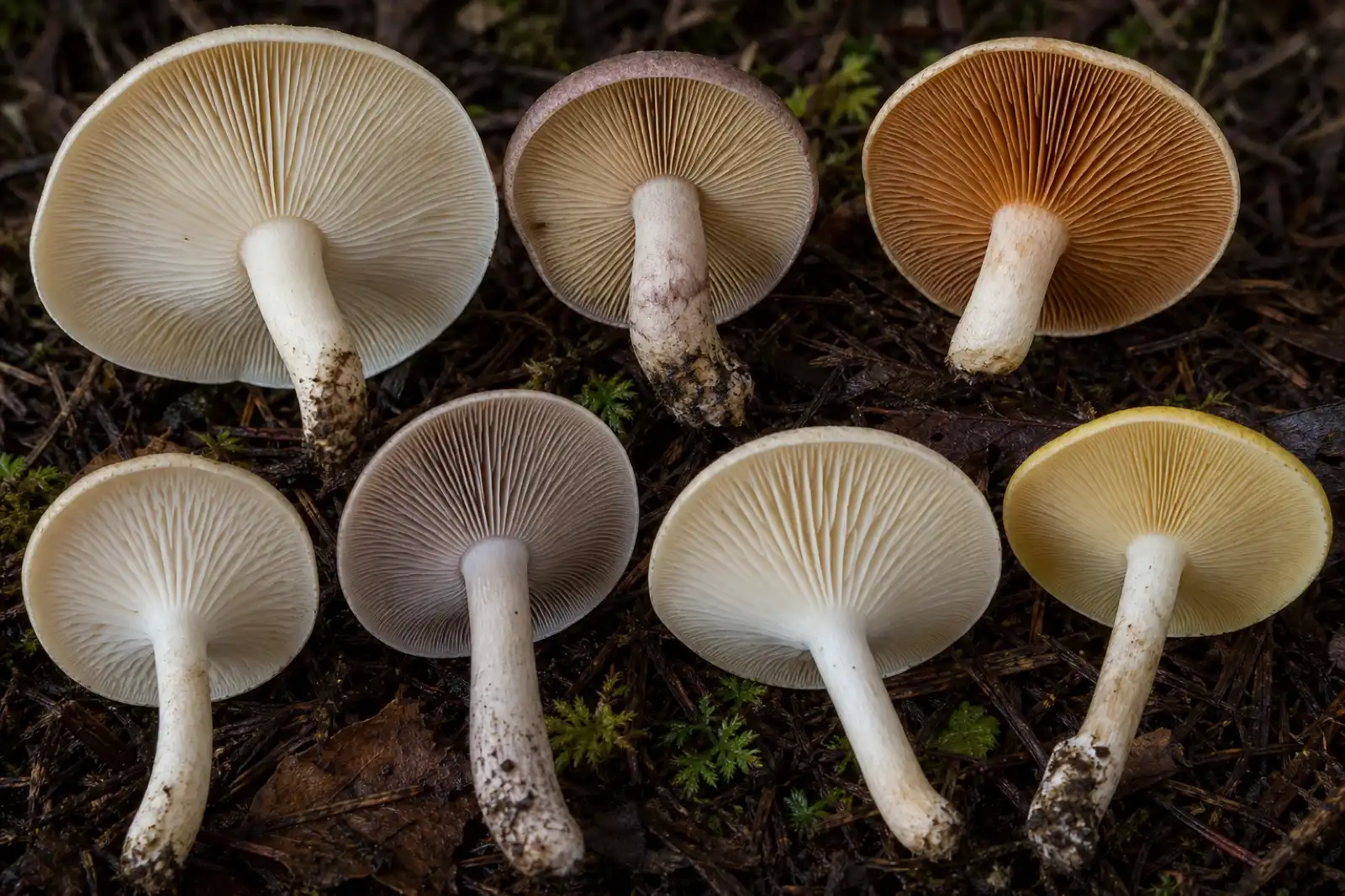
Mushroom Gill Types: Attachment, Spacing, and Color
Compare free, attached, notched, adnate, and decurrent mushroom gills while recording spacing, short gills, edge details, bruising, and color changes.
Continue exploring
Browse more practical guides in Mushroom Encyclopedia or visit the mushroom encyclopedia.