Mushroom Encyclopedia
Clustered Bonnet Mushroom: Mycena inclinata Field Guide
Document Mycena inclinata by its clustered oak-stump habit, striate bell caps, pale gills, two-toned stems, white spores, odor, microscopy, and lookalikes.
By MushroomScope Editorial Team · · Updated
Species context
Treat profiles as reference material
Species profiles summarize documented traits, taxonomy, and lookalikes, but natural variation can be substantial.
Use the safety checklist →Decision limit
A profile cannot authenticate a specimen
Do not eat a wild mushroom from an online match, single feature, or generated image.
Read the safety disclaimer →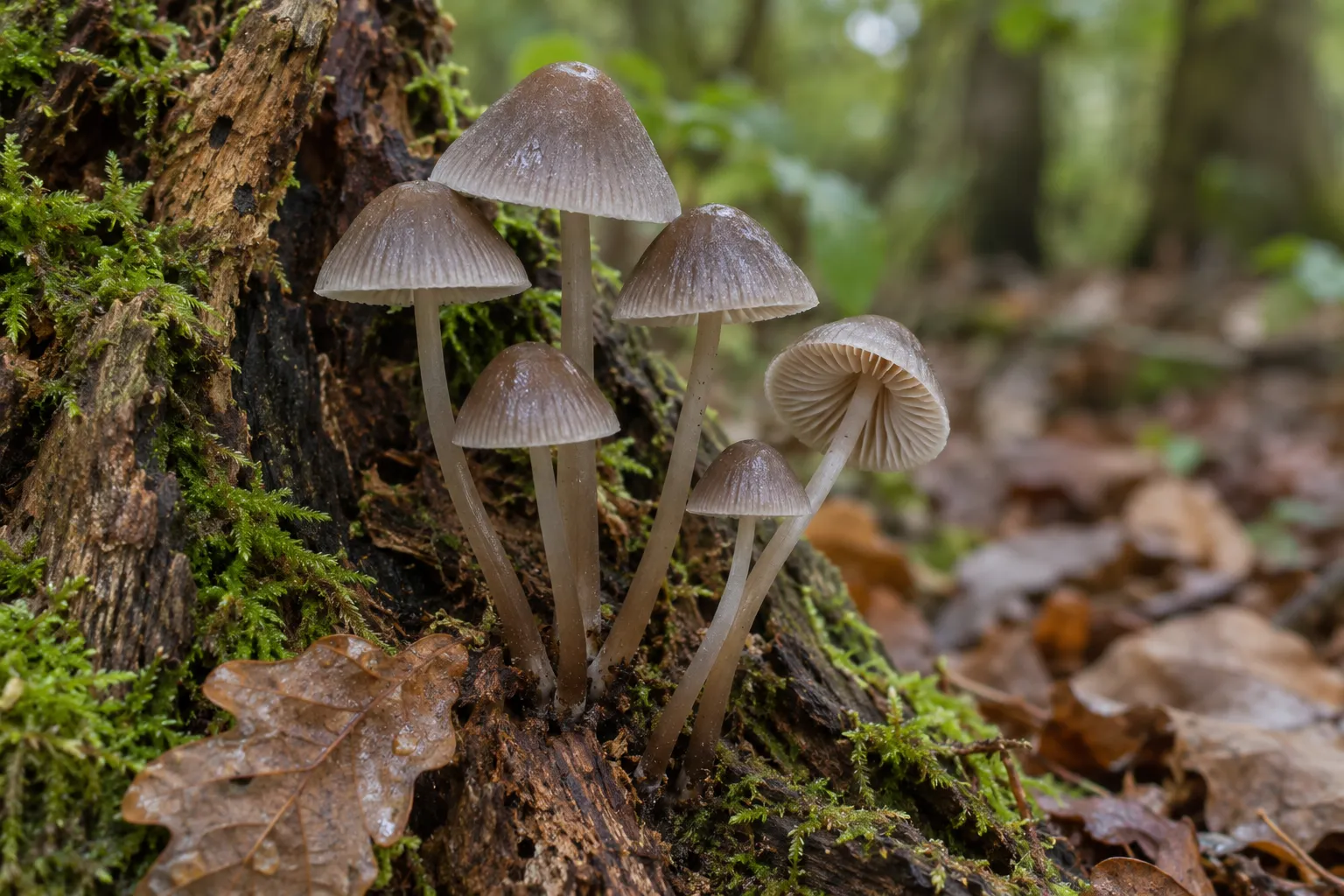
Quick facts
- Scientific name
- Mycena inclinata
- Common names
- Clustered bonnet, Oak-stump bonnet, Inclined bonnet
- Taxonomy
- Mycena · Mycenaceae
- Edibility context
- Inedible: Not recommended for food; small Mycena are difficult to identify and offer little culinary value.
- Spore print
- White to very pale; microscopic characters are needed to separate close Mycena.
- Toxicity context
- Unknown: Treat unidentified small bonnet mushrooms as non-food material; species-level risk cannot be inferred from cap shape.
- Season
- August, September, October, November
- Growing difficulty
- Expert
- Regions
- Europe, North America, temperate records elsewhere requiring regional verification
Safety limit: These labels summarize documented context; they never authenticate a wild specimen. Cooking does not make a poisonous species safe.
The clustered bonnet is a wood-decaying Mycena whose strongest field clue is not simply a grey-brown cap. It is the architecture of a whole tuft: many fragile stems rising from one decayed hardwood unit, each carrying a striate bell-shaped cap above pale gills. That combination creates a useful hypothesis, but the genus contains many small, variable species and a photograph cannot finish the identification.
This guide is designed for documentation rather than food clearance. Record the fruiting group, the actual wood attachment, several developmental stages, a spore deposit, odor under controlled conditions, and microscopic characters when an exact name matters. If the evidence stops at “small brown mushroom on a stump,” record Mycena rather than forcing M. inclinata.
Establish whether the mushrooms share one wood unit
Begin with a wide photograph showing the entire stump, log, or buried root. Count distinct tufts and note whether stems converge into separate bases or appear scattered. Gently trace one edge of the attachment without dismantling the colony. A mushroom beside an oak can arise from leaf litter, a buried branch, or a different tree’s root; proximity is not proof of substrate.
Record the wood as deciduous or coniferous only when bark, end grain, retained leaves, or a knowledgeable site record supports that conclusion. If oak is defensible, note how it was determined. The habitat identification guide provides a way to separate observed substrate from an inferred nearby host.
Follow cap form from button to flattened bell
Young caps are conical to sharply bell-shaped. With expansion they broaden, sometimes retaining a low central bump, while the thin margin may become wavy or split. Measure several caps rather than publishing a single ideal diameter. Photograph from above and at cap level so width, profile, surface texture, and the position of the margin remain reviewable.
Moisture changes the apparent color. Wet caps can look deeper grey-brown or date-brown and show translucent radial lines over the gills. Drying often pales the margin and reduces translucency. Number two or three caps and photograph them before and after natural drying in the same neutral light; do not wet specimens to manufacture a pattern.
Use the striate margin as supporting evidence
Radial striations arise because the thin moist cap transmits the pattern of the gills below. Record how far they extend toward the center and whether they disappear as the cap dries. Striation supports a bonnet-mushroom pathway but occurs across many Mycena and unrelated thin-capped fungi.
Surface particles, water droplets, and phone sharpening can create false lines. A side-lit macro image and an unprocessed reference frame are more useful than a heavily saturated close-up. Preserve the original file and write down whether the cap was wet, tacky, or already drying.
Photograph gill attachment without bending the stem
The gills are pale and attached near the stem, with shorter gills between those running from margin to stem. Photograph a naturally tilted cap or support a fallen specimen; do not twist a living stem merely to expose the underside. Record spacing, attachment, edge color, branching, and any cross-connections.
Use the gill-types guide to describe attachment consistently. Apparent attachment changes with camera angle and cap expansion, so obtain side-on views from more than one mature fruit body. Pale gills alone are weak evidence because numerous white-spored genera share them.
Record the stem’s color gradient and shared base
Stems are slender, hollow, and fragile. A useful collection often shows a paler upper stem and a progressively brown lower portion, sometimes with coarse-looking fibrils or pale basal growth. Capture complete stems from cap to wood. Cropped photographs lose both the color gradient and the tufted attachment that give the observation value.
Measure upper and lower stem width on several ages. Note whether stems curve away from crowding, fuse only visually, or truly share basal tissue. Do not interpret every leaning stem as an “inclined” diagnostic character; growth angle changes with light, obstacles, and collapse.
Assess odor as a recorded observation, not a verdict
Descriptions of mature M. inclinata often mention a rancid, farinaceous, or otherwise disagreeable smell. Odor vocabulary is subjective and can be altered by wet wood, bacteria, decay, and the container. Smell only intact material without tasting it, outdoors first and then briefly in a clean container if needed.
Record specimen age, elapsed time after collection, temperature, and the observer’s own words before consulting a guide. A missing odor does not exclude the species, and an unpleasant odor does not prove it. Avoid prompting several observers with the same comparison before they report independently.
Make a spore deposit and keep its source numbered
A white to very pale deposit is expected. Place a mature numbered cap across dark and transparent surfaces, protect it from drafts, and record time and humidity. The spore-print protocol explains how to distinguish a sparse pale deposit from condensation or cap tissue.
Spore color can reject a rusty-, pink-, or dark-spored alternative, but it cannot separate the many white-spored bonnets. Keep the print tied to the same cap used for underside photographs and microscopy. Mixed tufts can occur on one stump, so combining caps destroys that chain of evidence.
Use microscopy to test a regional key
Exact Mycena identification may use spore dimensions and shape, amyloid reactions, basidia, cheilocystidia, pleurocystidia, cap-surface cells, stem-surface features, and clamp connections. The relevant set depends on the key. Report mounting medium, reagent, calibration, magnification, sample count, and measured ranges rather than copying numbers from a website.
Choose mature but not collapsing tissue from a numbered specimen. A white deposit confirms that spores were released, while a gill mount shows where cells were sampled. If the characters conflict with the proposed species, retain the record at genus or section level and seek a local specialist.
Separate clustered bonnet from common bonnet
The common bonnet guide covers Mycena galericulata, another frequent wood-associated bonnet. It is often more robust, but size overlaps and weather changes both species. Compare tuft density, cap development, gill architecture, stem texture, odor, microscopic characters, and the current regional treatment.
Do not select a name because one cap resembles an online photograph. A reliable comparison table begins with specimens from the same region and preserves contradictory characters. DNA can clarify some difficult material, but a sequence still needs clean sampling, a voucher, and a defensible reference database match.
Keep reddish spotting and decay separate
Some related bonnets develop reddish or brownish spots as they age, while damaged gills can discolor through drying, bacteria, or handling. Photograph fresh tissue before transport, then record whether marks enlarge or appear on cap, gills, or stem. A stain that appears only after hours in a sealed box is not equivalent to a fresh field character.
When comparing Mycena maculata or other spotted taxa, use a current regional key and microscopy. “No spots” on a young collection is incomplete evidence; “spots present” on rotten material may be equally unhelpful.
Map decomposition rather than assigning a living host
Clustered bonnets are saprotrophs using dead woody material. Mark whether fruit bodies occur on bark, exposed sapwood, cut ends, buried roots, or soil immediately above wood. Estimate decay class: intact hard wood, softened fibers, or crumbly remains. This produces ecological information without claiming a mycorrhizal partnership.
On a large stump, map tuft positions and revisit after rain. Repeated fruiting from the same sectors may reveal moisture and remaining wood structure. Leave part of the colony intact, follow land rules, and avoid spreading fragments to new sites.
Treat range records as evidence with different strength
Databases aggregate preserved specimens, observations, literature, and sometimes records created under older taxonomic concepts. Use GBIF to locate source records, then examine identifier, date, coordinates, media, institution, and name history. NCBI provides a taxonomic and sequence-oriented route but does not validate every photograph carrying the name.
For a new regional claim, prefer a voucher reviewed with a current local key. State uncertainty when only a photograph exists. “Recorded in Europe and North America” is not the same as “native throughout both continents,” and a map point does not prove present abundance.
Keep the species out of the food basket
This page does not recommend clustered bonnets for food. Fruit bodies are small, fragile, difficult to identify, and liable to occur beside other small mushrooms. Culinary value is negligible, while a mixed collection can defeat later review. Never taste an unidentified bonnet as a diagnostic test.
If someone becomes ill after eating wild mushrooms, contact local emergency services or a poison center promptly. Retain uncooked material, meal leftovers, photographs, location, timing, and packaging. Do not wait for a social-media identification before seeking help.
Understand why routine cultivation is not the goal
As a wood decomposer, the fungus can be relevant to ecological culture work, but it is not a standard edible crop. Laboratory study requires authenticated culture, sterile transfers, controls, and containment. Fruiting an unknown stump isolate does not prove that it is M. inclinata.
Do not move colonized wood into parks or forests. A useful study might compare decomposition or document morphology under controlled conditions, but it should preserve strain provenance and avoid environmental release.
Run a shared-wood-unit cluster census
Dense fruiting is one of the useful clues, but “clustered” should be measured rather than inferred from a tight crop. Mark the outline of one stump or log on a sketch and divide its exposed surface into equal sectors. In each sector, count discrete tufts, stems per tuft, open caps, collapsed caps, and primordia. Trace basal stems with a mirror or oblique photograph instead of pulling the group apart.
Repeat the census after a defined rain interval. Report persistence as the proportion of numbered tufts still recognizable, not as a claim that every new cap belongs to the same individual. This distinguishes a concentrated colony on one wood unit from several unrelated bonnet species fruiting centimeters apart.
Pair stem color with a humidity record
The two-toned stem can change as tissue ages and dries. Photograph the same numbered stems at fixed white balance and exposure, then score color separately for the upper third, middle, and base. Log air temperature, relative humidity, time since rain, cap expansion, and whether the stem was sheltered inside the tuft.
Do not manufacture a gradient by wetting half a stem. A natural series can show whether basal darkening persists while the upper stem pales, or whether the whole apparent difference was lighting and crowding. Keep abrasion, reddish spotting, and true pigment as separate fields so damage is not rewritten as a taxonomic character.
Test odor descriptions for observer agreement
Odor terms such as rancid, farinaceous, or cucumber-like are vulnerable to suggestion. Use freshly broken material from one numbered mature specimen in a ventilated setting. Ask at least two observers to write an independent description before seeing a reference list, and include a blank container from the same site.
Record collection age and temperature because sealed transport can intensify or distort volatile notes. Agreement supports a reproducible observation; disagreement is also a result. Neither outcome overrides tufted hardwood growth, cap striation, gill attachment, stem anatomy, spores, and microscopy.
Audit the editorial image against field evidence
The cover is an original AI editorial asset. It was compared with the site’s Scarlet Waxcap and Purple Brittlegill natural-light baselines for restrained woodland color, visible substrate, complete attachments, plausible depth of field, fine surface texture, and absence of text or watermark. At 1536 by 1024 pixels it is sharp at the intended responsive sizes and has a unique source hash.
The image shows a plausible documentation scene, not a verified specimen. Exact cap count, gill attachment, stem color, oak identity, and scale remain illustrative. Its smoky grey-brown palette, soft overcast light, environmental framing, and controlled focus are consistent with the site; it must never be used to clear a wild mushroom for consumption.
Build a reviewable clustered-bonnet record
- Photograph the entire stump or log and each separate tuft.
- Number several developmental stages and measure caps and stems.
- Record natural wet-to-dry color change in neutral light.
- Capture gill attachment and complete basal wood connection.
- Describe odor independently without tasting.
- Make a pale spore deposit from one numbered mature cap.
- Apply a current regional key and document microscopy when needed.
- Preserve a lawful voucher and uncertainty level.
That workflow turns a striking cluster into evidence another observer can audit. It also preserves the most important boundary: a coherent Mycena inclinata hypothesis is not an edibility decision.
References
Sparse gray bonnets with sharply longitudinally lined stems may belong nearer the grooved bonnet identification guide than this densely clustered species. Compare colony form, complete stem surfaces, gill attachment, substrate, and microscopy instead of choosing by cap color.
- GBIF species search: Mycena inclinata — occurrence records and taxonomic source links.
- NCBI Taxonomy Browser: Mycena inclinata — taxonomic and sequence-linked context.
- First Nature: Mycena inclinata — field characters, habitat, and comparison notes.
- North American Mycological Association: poisoning syndromes — conservative response guidance for suspected mushroom poisoning.
Source quality notes
MushroomScope cites sources that match the page scope, such as taxonomic databases, extension guidance, food-safety agencies, food-composition databases, and peer-reviewed or institutional health references. Sources support context and uncertainty; they do not turn an online page into specimen identification, medical advice, or a tested recipe record.
Frequently asked questions
Where does the clustered bonnet grow?
It typically fruits in dense tufts from decaying hardwood, especially oak stumps, buried roots, and large woody remains. The actual wood connection should be documented rather than inferred from a nearby tree.
What separates Mycena inclinata from other bonnet mushrooms?
The working combination is tufted hardwood growth, bell-shaped striate grey-brown caps, pale gills, slender stems that become darker toward the base, a pale spore deposit, and supporting microscopic and regional evidence.
Does the clustered bonnet have a distinctive smell?
Mature collections are often described as having a rancid, farinaceous, or otherwise unpleasant odor, but odor varies with age and observer and cannot identify the species alone.
Is the clustered bonnet edible?
This guide does not recommend it as food. Small Mycena are difficult to identify, food value is negligible, and a webpage cannot exclude toxic lookalikes or assess a collection's condition.
Can a photograph confirm Mycena inclinata?
No. A photograph can record cap, gill, stem, and growth form, but exact identification may require the wood attachment, spore deposit, microscopy, a regional key, and a retained voucher.
Related guides
mushrooms
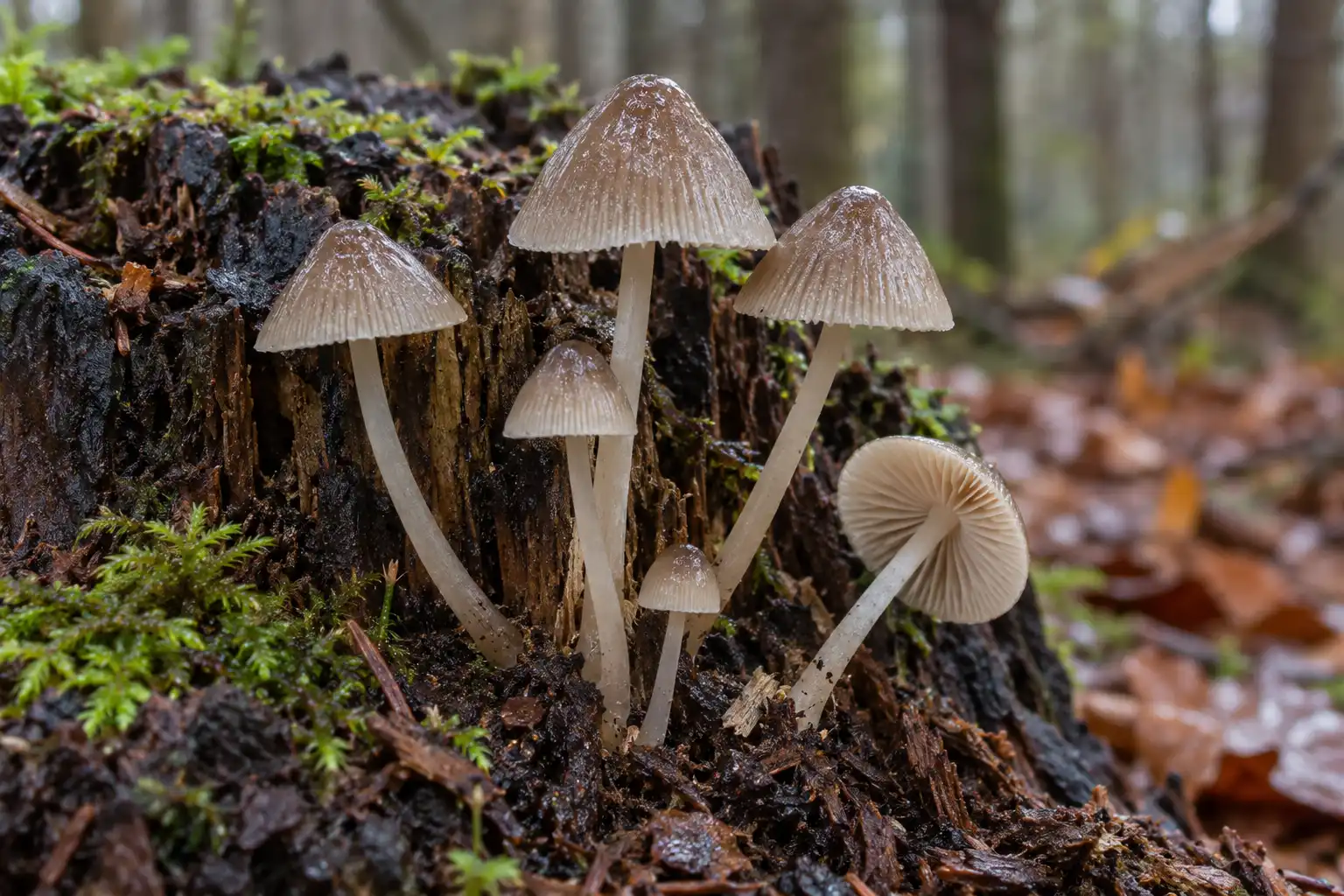
Common Bonnet Mushroom: Wood, Form, and Identification Limits
Identify the Common bonnet by its wood attachment, cap striations, gill development, clustered habit, microscopy limits, ecology, and close lookalikes.
identification
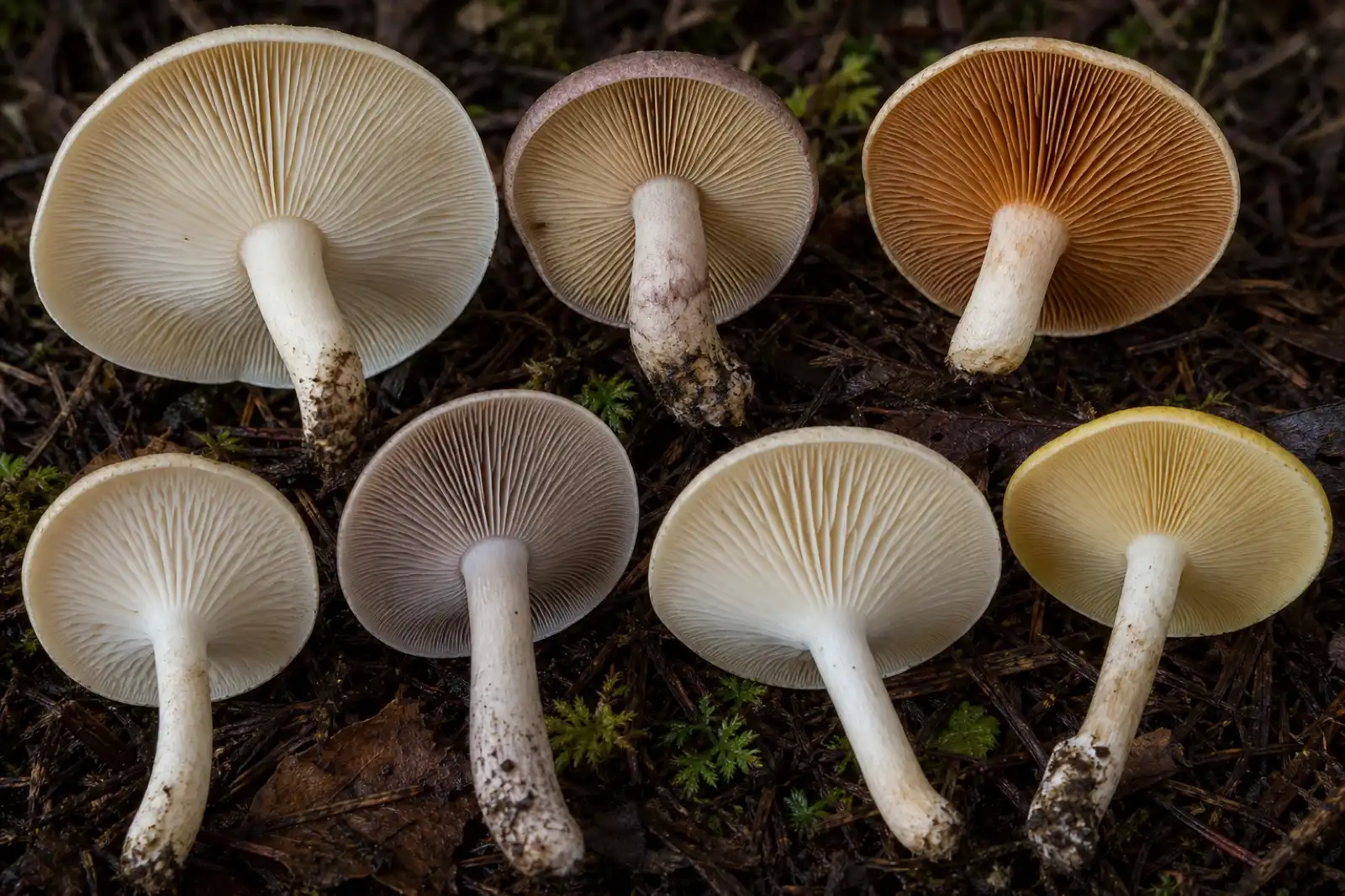
Mushroom Gill Types: Attachment, Spacing, and Color
Compare free, attached, notched, adnate, and decurrent mushroom gills while recording spacing, short gills, edge details, bruising, and color changes.
identification
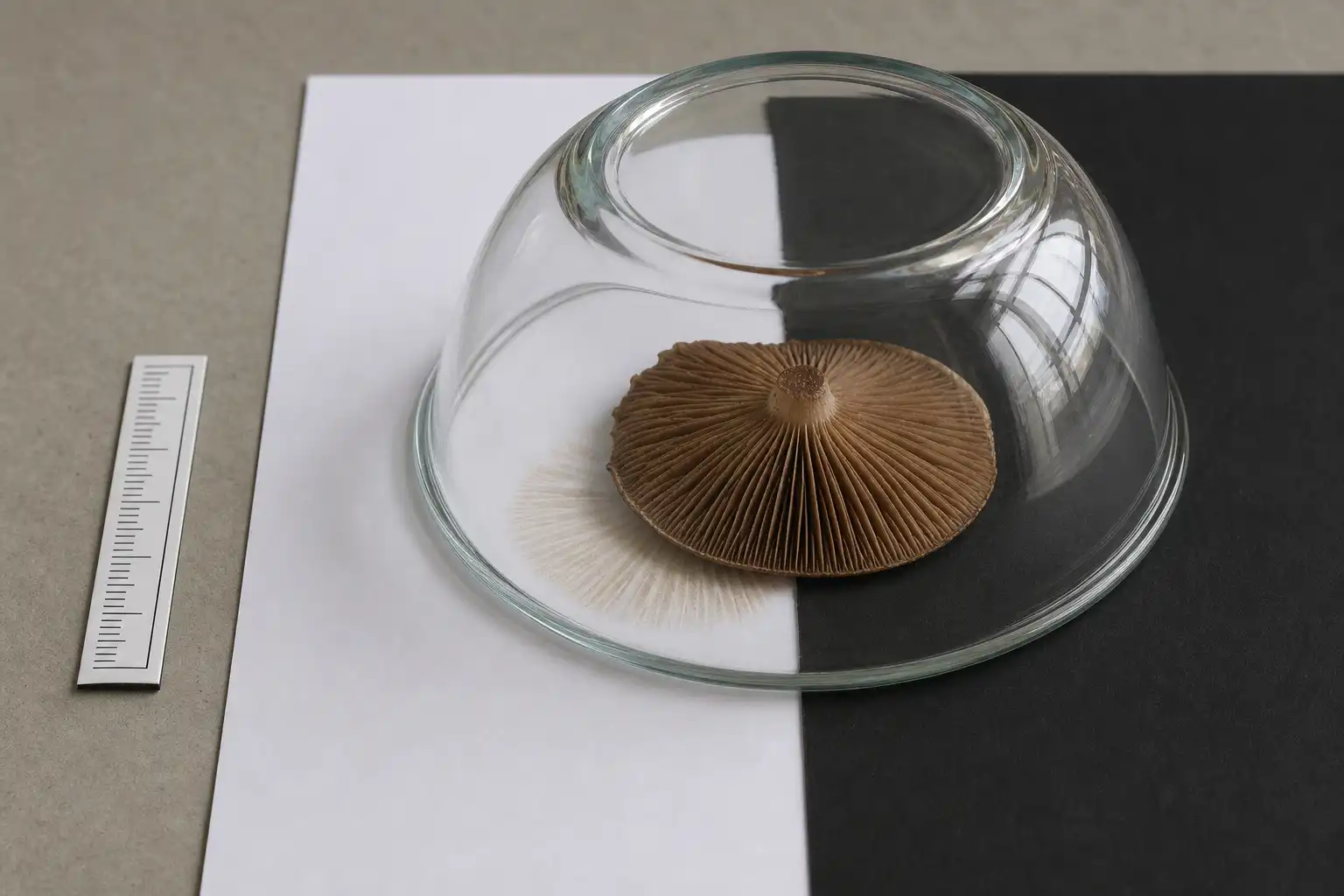
How to Make and Read a Mushroom Spore Print
Make a controlled mushroom spore print, record the result clearly, and understand why a print supports—but never proves—an identification.
Continue exploring
Browse more practical guides in Mushroom Encyclopedia or visit the mushroom encyclopedia.