Mushroom Encyclopedia
Collared Earthstar: Rays, Spore Sac, and Field Records
Document Geastrum triplex by its split outer rays, central spore sac, collar, apical pore, woodland litter, maturity changes, and earthstar lookalikes.
By MushroomScope Editorial Team · · Updated
Species context
Treat profiles as reference material
Species profiles summarize documented traits, taxonomy, and lookalikes, but natural variation can be substantial.
Use the safety checklist →Decision limit
A profile cannot authenticate a specimen
Do not eat a wild mushroom from an online match, single feature, or generated image.
Read the safety disclaimer →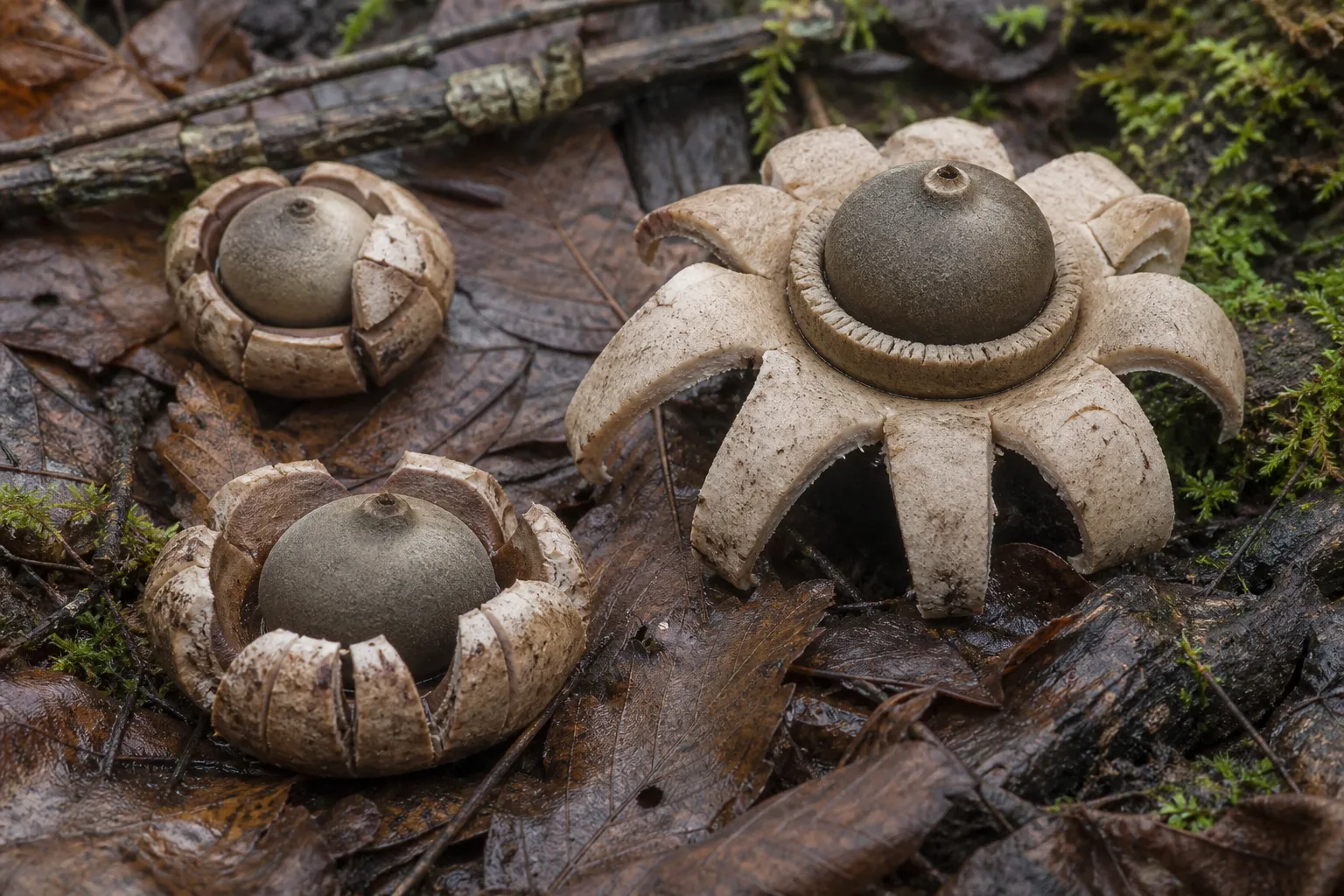
Quick facts
- Scientific name
- Geastrum triplex
- Common names
- Collared earthstar, Triple earthstar, Saucered earthstar
- Taxonomy
- Geastrum · Geastraceae
- Edibility context
- Inedible: Not recommended as food; mature texture is tough and powdery, and this page cannot establish an individual specimen's identity or condition.
- Spore print
- Brown powder released from the apical opening rather than a conventional cap print.
- Toxicity context
- Unknown: No ingestion safety conclusion should be inferred from an earthstar shape or the absence of a widely reported poisoning syndrome.
- Season
- August, September, October, November
- Growing difficulty
- Expert
- Regions
- widespread records in temperate and subtropical regions, local occurrence requires verification
Safety limit: These labels summarize documented context; they never authenticate a wild specimen. Cooking does not make a poisonous species safe.
An earthstar is not a cap-and-stem mushroom frozen into a decorative shape. It begins as a closed ball with layered walls. The outer wall splits and bends into rays, lifting or exposing an inner spore sac. In Geastrum triplex, part of that thick outer layer often forms a conspicuous collar around the sac, giving rise to the name collared earthstar.
The mechanism is easier to understand than the species identification. Several earthstars develop similar rays and central sacs, while collar expression changes with maturity and weather. This guide builds a record that can support G. triplex without pretending one photograph is decisive.
Find the unopened stage if possible
Search the same litter patch for closed or partly opening fruit bodies. Before expansion, an earthstar may resemble a buried or surface puffball. Photograph how deeply it sits, whether litter adheres to the outer wall, and how the first splits form.
Do not dig a wide area merely to stage a developmental sequence. A naturally mixed group can show closed, opening, mature, and weathered examples with less disturbance.
Count and describe rays without overvaluing the number
The outer wall usually divides into several thick pointed segments. Record ray count, width, cracking, curvature, and whether the tips lift the fruit body. Damage can remove a segment, while incomplete splitting can make the count appear lower.
Ray number overlaps among species. Treat it as a measured character, not a name. Photograph from directly above and at ground level so the relationship between rays, collar, and substrate remains visible.
Evaluate the collar as a developmental feature
In a classic mature G. triplex, the inner part of the outer wall splits around the spore sac, leaving a raised saucer or collar. The collar may be neat, ragged, incomplete, or eroded. Rain and repeated drying can obscure it.
Record whether the rim is genuinely formed from a broken layer or merely a fold caused by curled rays. Compare several specimens. An ideal collar on one image cannot compensate for missing information about the mouth, sac surface, or microscopy.
Inspect the central spore sac
The round inner sac sits above the rays without a conventional cap or stem. Describe its diameter, color, texture, and attachment. A mature sac develops a defined opening at the top through which spores escape.
Avoid squeezing it for a dramatic cloud. Uncontrolled pressure destroys structure and spreads spores toward the camera. Natural raindrop impact or a gentle documented tap on a permitted mature specimen is enough to demonstrate the release mechanism.
Describe the apical mouth precisely
The pore and surrounding mouth may be fibrillose, folded, delimited, or less sharply outlined depending on species. Use a macro image from above and from the side. Note whether a small cone or disc surrounds the opening.
This character matters when comparing Geastrum species, yet age erodes it. A torn old opening should not be interpreted as the original mouth architecture.
Understand the internal spore system
Earthstar spores mature inside the sac in a powdery gleba mixed with sterile threads called capillitium. They do not drop in a patterned print beneath gills. Mature brown powder can be mounted for microscopy to assess spore size, ornamentation, and capillitium.
Record the mounting medium, calibration, number measured, and whether the spores were mature. A phone photograph of brown dust cannot resolve those features.
Separate Geastrum from hygroscopic false earthstars
Species of Astraeus can open into a similar star, but their rays commonly respond strongly to humidity—opening when wet and closing around the sac when dry. Their rays may crack into a patterned surface. Taxonomically and microscopically they are not simply another Geastrum.
Observe the same specimen across weather only where it can be relocated without disturbance. One dry pose is not enough to establish hygroscopic behavior.
Compare other Geastrum species with a full key
G. saccatum and additional earthstars overlap in general size, habitat, and a central pore. Regional keys combine collar development, whether rays absorb debris, hygroscopic response, sac stalk, mouth form, surface texture, and spores.
The name G. triplex has also been applied broadly in older sources. Preserve the identification date and reference used, especially when comparing records from different continents.
Recognize multi-pored earthstars
Myriostoma has several pores and a sac elevated on multiple small supports, producing a saltshaker-like structure. A distant top view can hide the columns, so add a low side photograph. Multiple true openings should redirect the identification immediately.
Do not confuse insect holes or weather tears in an old sac with natural pores. Look for a repeated organized structure across fresh material.
Record litter, soil, and land use
Collared earthstars are reported from litter and humus in woodland as well as parks and gardens. Note leaf versus needle litter, dominant trees, mulch, irrigation, soil disturbance, slope, and drainage. “On soil” is too vague for a useful ecological record.
Landscape mulch can move fungal material beyond an expected natural range. Separate a managed bed from an undisturbed forest observation and avoid claiming native status from one occurrence.
Distinguish active fruiting from persistence
Fresh rays are thicker and more flexible, while old fruit bodies become papery, cracked, dirty, and faded. An opened earthstar can persist long after the weather that triggered development. Calendar records should indicate condition.
Late summer and autumn are common in many temperate datasets, but rain and temperature control local emergence. The season guide explains how to record phenology without turning a month into proof.
Test moisture response without forcing the rays
Earthstar comparisons often mention whether rays arch, remain flat, or respond to drying, but a single dry specimen cannot establish that behavior. Photograph the fruit body in place, note recent rain, and record the ray span and height above the litter. Revisit the same marked individual after a natural wetting or drying cycle. Do not soak a protected-site specimen or bend brittle rays by hand.
The observation should distinguish movement from damage. A split through living layered tissue, an old fracture, and a ray that changes curvature with humidity are different records. Measure from the same camera position and include a side view; an overhead photograph can make a strongly arched earthstar look flat. If the rays do not move during one short revisit, report that observation rather than assigning a permanent hygroscopic category.
This moisture record helps separate Geastrum structure from the strongly hygroscopic behavior associated with some false earthstars, but it is not a stand-alone name. Sac attachment, mouth construction, outer-layer texture, spores, region, and a current key still control the determination.
Build a complete observation sequence
- Photograph the patch and litter before moving anything.
- Record closed, opening, mature, and old stages if naturally present.
- Measure full diameter, sac diameter, ray number, and height.
- Photograph the collar, sac surface, mouth, and low side profile.
- Record substrate, trees, moisture, land use, and recent weather.
- Sample mature spore mass only where collection is legal.
- Compare microscopy and macroscopic features with a current regional key.
The spore color guide distinguishes the earthstar release system from a conventional cap print.
Avoid using earthstar shape as a food category
Mature collared earthstars are tough and filled with dry spore mass. This page does not recommend eating them or experimenting with immature closed forms. Closed earthstars can also be confused with other gasteroid fungi before rays develop.
Do not slice unknown balls as a casual culinary test. The puffball guide explains why internal development must be read conservatively, but it is not permission to eat an unresolved specimen.
Handle accidental exposure conservatively
If a wild fungus is swallowed and symptoms occur, contact local emergency services or a poison center. Preserve material and photographs, including a section of any closed specimen. Do not rely on an app’s “earthstar” result to dismiss risk.
Powder released near the face may also irritate sensitive people. Avoid deliberately inhaling spores and wash hands after handling old dusty fruit bodies.
Cultivation claims need authenticated evidence
Finding earthstars in mulch does not produce a replicable recipe. Litter chemistry, soil structure, microbial community, moisture cycling, temperature, and culture identity interact. A contained research culture would need verification before and after fruiting.
Because the species is not a normal food crop, publication should not convert an occurrence observation into a beginner grow guide or imply a commercial yield.
Protect persistent field features
Earthstars often invite handling because the rays remain visible. Leave representative specimens in place. Photograph rather than collecting a whole group, and avoid clearing litter to make a cleaner image. The litter is part of the organism’s ecological context.
Where a rare or sensitive species is possible, share precise coordinates with an appropriate recorder rather than broadcasting the patch publicly.
Evidence and image limits
GBIF and NCBI support taxonomic and occurrence checkpoints. GBIF genus records help frame diversity, but database maps include uneven sampling and historical determinations. NAMA supports a conservative poisoning-response boundary.
The AI editorial cover was checked for thick split rays, central sacs, a visible collar and apical pore, natural litter, clarity, restrained color, and no text or watermark. It intentionally shows a plausible field concept rather than a diagnostic specimen. No named mycologist or clinician reviewed this draft.
Frequently asked field questions
Why do the rays curl?
Layered tissues dry and expand differently as the outer wall splits. The degree and moisture response vary by taxon and condition.
Can the collar disappear?
Yes. It can be incomplete at opening or eroded by rain, animals, and age. Its absence in an old specimen requires caution rather than an automatic exclusion.
Is the central ball a separate mushroom?
No. The sac and rays are layers of one fruit body with different roles in protecting and dispersing spores.
Does touching the sac release spores?
A mature sac can puff spores when compressed or struck. Avoid destructive demonstrations and inhalation; document natural release where possible.
Can a dry specimen be identified later?
Often it can retain useful mouth, sac, ray, and microscopic characters, but weathering may erase key surfaces. Photograph fresh stages whenever available.
References
- Global Biodiversity Information Facility. Geastrum triplex species record. Current backbone name, classification, synonyms, and occurrence context.
- National Center for Biotechnology Information. NCBI Taxonomy Browser: Geastrum triplex. Independent lineage and nomenclature checkpoint.
- Global Biodiversity Information Facility. Geastrum genus record. Genus-level diversity and occurrence context used to avoid treating one earthstar form as species proof.
- North American Mycological Association. Mushroom Poisoning Syndromes. Conservative response guidance for an uncertain wild-fungus exposure.
Editorial review: September 3, 2026. Taxonomy, regional keys, source URLs, and poison-response guidance should be rechecked at every substantive update. No named mycologist or clinician reviewed this article.
Source quality notes
MushroomScope cites sources that match the page scope, such as taxonomic databases, extension guidance, food-safety agencies, food-composition databases, and peer-reviewed or institutional health references. Sources support context and uncertainty; they do not turn an online page into specimen identification, medical advice, or a tested recipe record.
Frequently asked questions
What makes an earthstar look like a star?
The outer wall of a closed fruit body splits into rays and bends outward, exposing a central spore sac that releases dry spores through an apical opening.
What is the collar on Geastrum triplex?
The thick outer layer may split and leave a raised cup- or collar-like rim around the spore sac, but the feature varies with age and weathering.
Does an earthstar have a conventional spore print?
No. Mature powdery spores leave through the pore when raindrops, debris, or pressure disturb the sac; microscopy samples that internal spore mass.
Can every large collared earthstar be called Geastrum triplex?
No. Size, collar development, ray behavior, mouth structure, surface texture, substrate, microscopy, and region must be combined with a current key.
Are collared earthstars edible?
This guide makes no food recommendation. Mature earthstars are tough and powdery, and web identification cannot establish species, condition, contamination, or safety.
Related guides
mushrooms
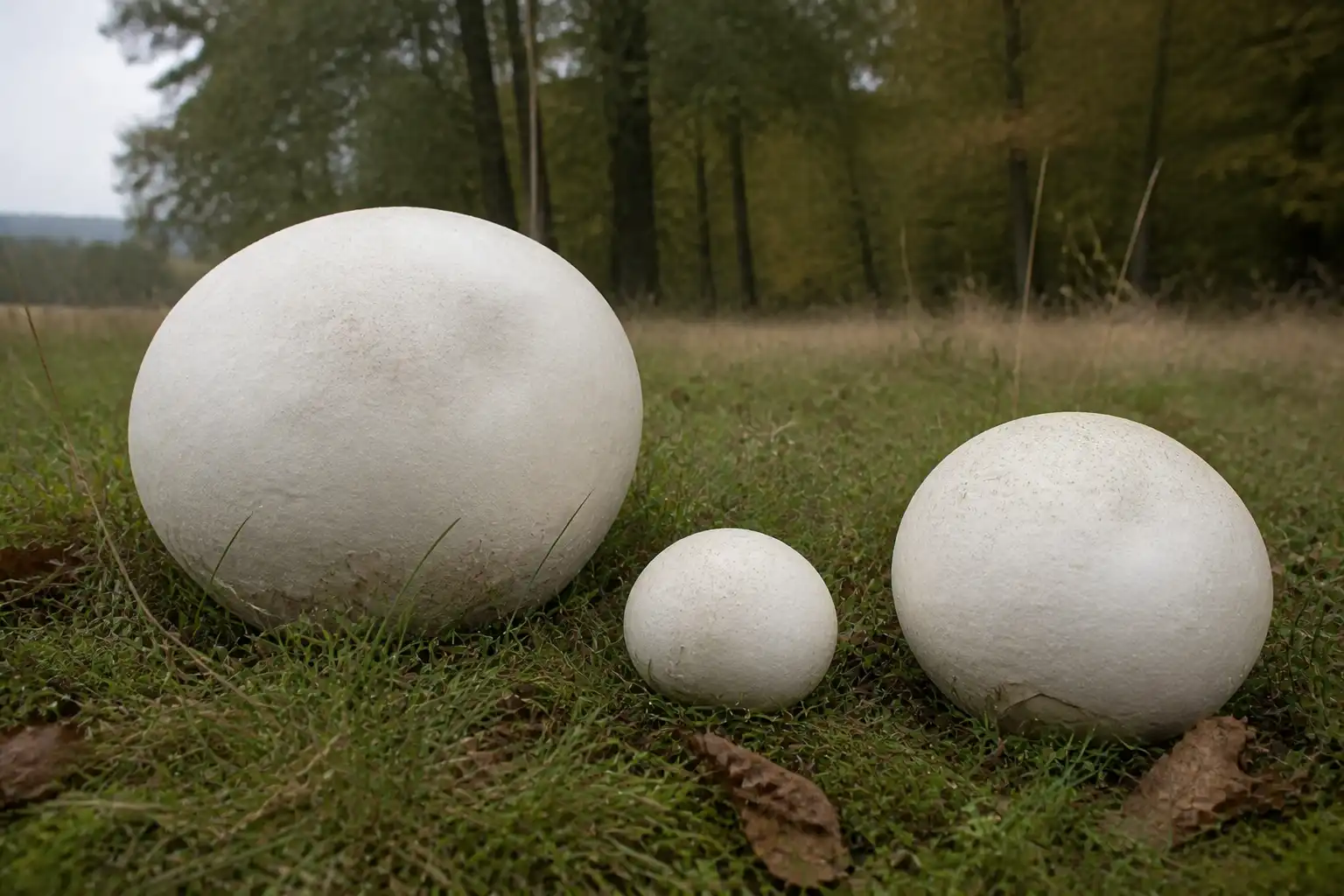
Giant Puffball (Calvatia gigantea): Identification and Safety
Learn giant puffball identification, white interior checks, dangerous lookalikes, habitat, maturity, and conservative food-safety limits.
identification
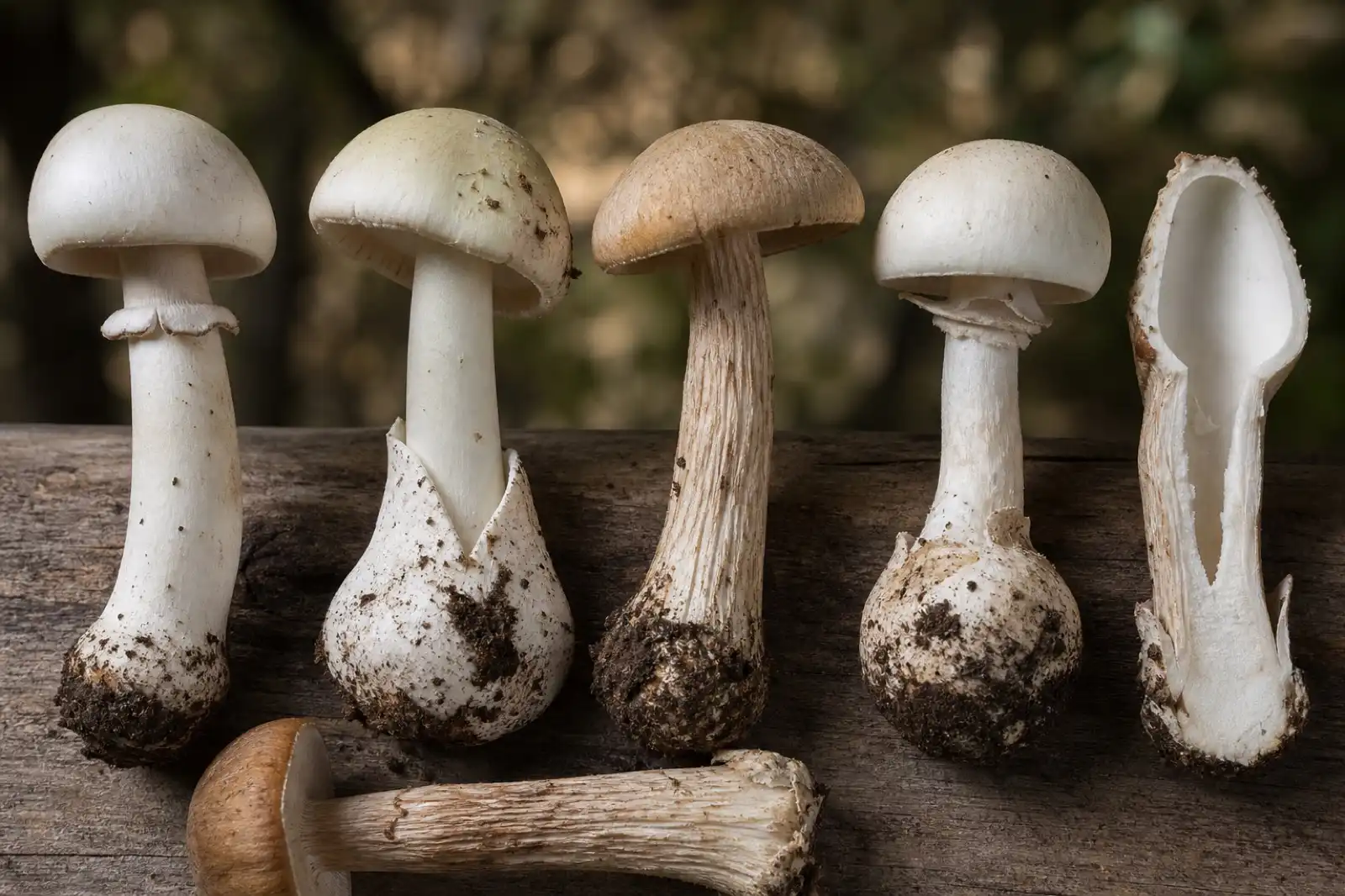
Mushroom Stem Features: Rings, Volvas, Texture, and Base
Document mushroom stem shape, attachment, rings, volvas, buried bases, internal structure, bruising, and texture without using one feature to decide edibility.
identification
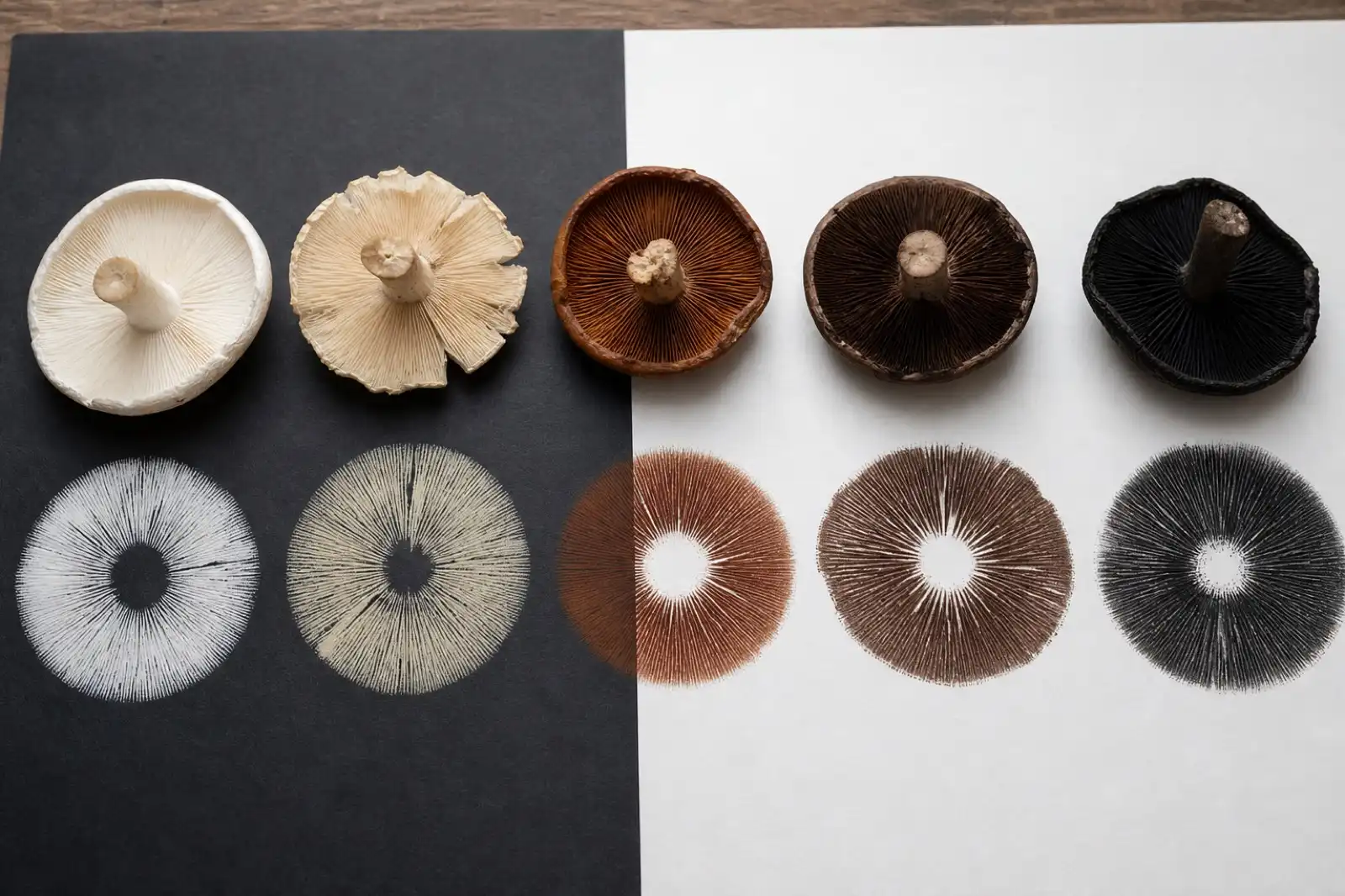
Mushroom Spore Print Colors and How to Record Them
Use a controlled spore deposit to distinguish broad color groups while recognizing that print color alone never identifies a species.
Continue exploring
Browse more practical guides in Mushroom Encyclopedia or visit the mushroom encyclopedia.