Mushroom Encyclopedia
Glistening Inkcap: Mica Granules, Wood, and Lookalikes
Document glistening inkcaps by mica-like cap granules, clustered hardwood growth, darkening gills, black spores, deliquescence, and close lookalikes.
By MushroomScope Editorial Team · · Updated
Species context
Treat profiles as reference material
Species profiles summarize documented traits, taxonomy, and lookalikes, but natural variation can be substantial.
Use the safety checklist →Decision limit
A profile cannot authenticate a specimen
Do not eat a wild mushroom from an online match, single feature, or generated image.
Read the safety disclaimer →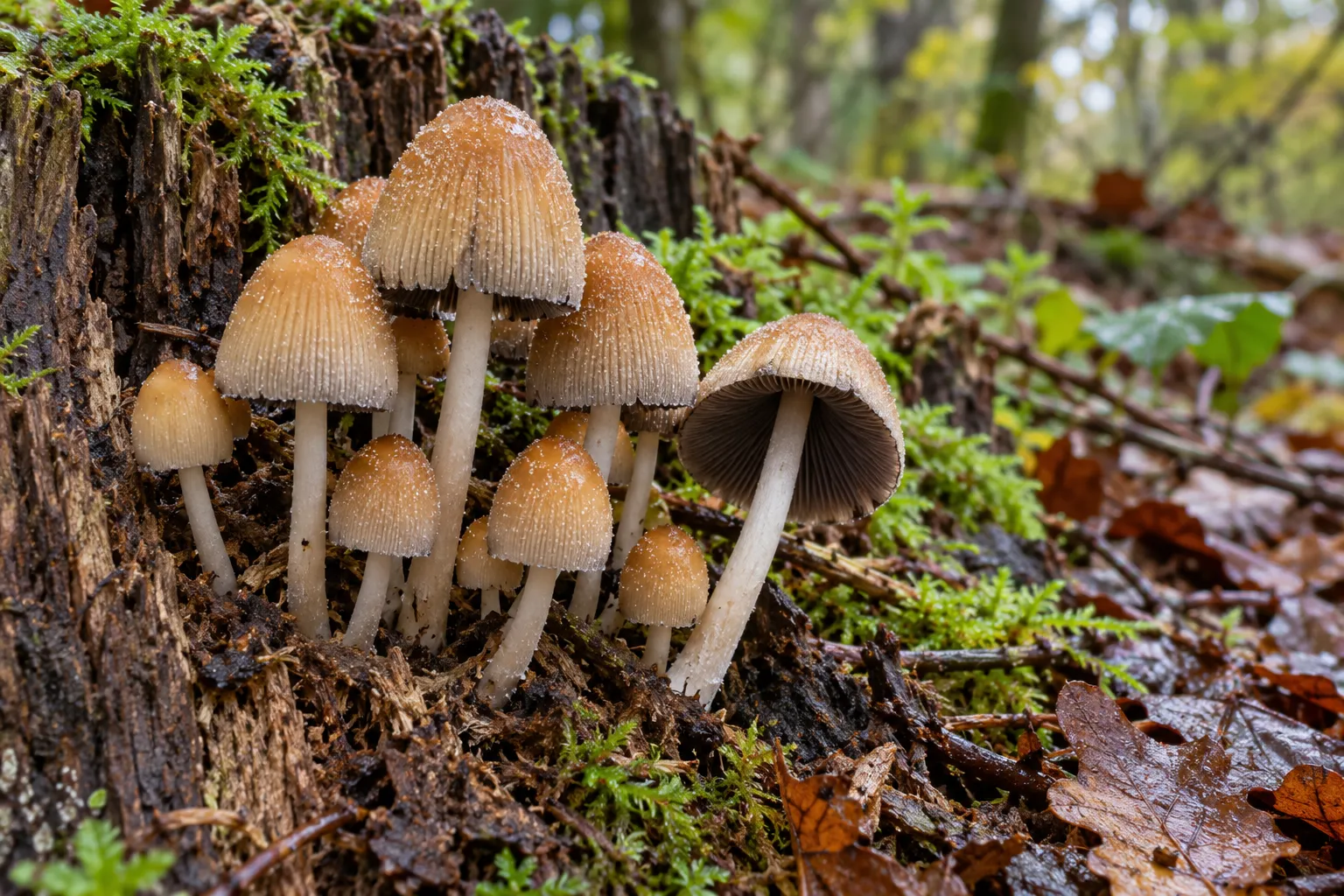
Quick facts
- Scientific name
- Coprinellus micaceus
- Common names
- Glistening inkcap, Mica cap, Shiny cap
- Taxonomy
- Coprinellus · Psathyrellaceae
- Edibility context
- Unknown: No food recommendation is made because group-level identification, substrate contamination, condition, and individual response remain unresolved.
- Spore print
- Dark brown-black to black.
- Toxicity context
- Unknown: Do not transfer alcohol warnings or edibility claims from other inkcaps; unknown exposures require local poison or medical guidance.
- Season
- April, May, June, July, August, September, October, November
- Growing difficulty
- Expert
- Regions
- Europe, North America, temperate Asia, other regions represented by verified vouchers
Safety limit: These labels summarize documented context; they never authenticate a wild specimen. Cooking does not make a poisonous species safe.
Glistening inkcap is easy to notice and surprisingly hard to close at species level. A fresh cluster can sparkle because tiny veil grains sit on honey-brown caps. A shower can wash those grains away, and a few hours of maturation can turn pale gills nearly black. The useful record is therefore not “small brown mushroom with glitter.” It is a linked series showing cap surface, gills, complete stems, wood attachment, spores, weather, and time.
The name Coprinellus micaceus is often applied broadly in field observations. Closely related taxa, especially C. truncorum, may not separate from photographs. This guide shows how to build an auditable micaceus-group record while keeping food decisions closed.
Photograph veil grains before weather removes them
Fresh young caps may carry pale, amber, or whitish granules that catch side light like mica. They are remnants of universal-veil tissue, not mineral crystals and not droplets. Photograph them dry, at low magnification, before touching the cap. Add a neutral scale and a frame that shows whether granules are evenly distributed or concentrated near the center.
Rain, dew, slugs, and fingers can remove the grains. Their absence on a mature or rain-washed cap is therefore weak negative evidence. Conversely, soil flecks, sawdust, frost, and reflective water beads can imitate the effect. A side-lit close-up should be paired with the broader developmental and substrate record.
Record cap diameter and shape for buttons, expanding bells, and older convex caps. The margin commonly shows fine radial grooves as the thin tissue becomes translucent over the gills. Note whether the center stays darker and whether the surface dries from the margin inward.
Link the cluster to hardwood or buried wood
Glistening inkcaps often form crowded groups around stumps, along dead roots, or from decomposing hardwood hidden beneath soil or turf. Photograph the cluster before separating stems. Then expose one attachment gently enough to determine whether it meets bark, wood fibers, a buried root, or only soil.
A lawn occurrence is not proof of a soil-feeding fungus. Old roots can extend meters from a removed tree, and construction fill may conceal boards or chips. Map the line or arc of clusters, note nearby stumps and broadleaf trees, and distinguish direct attachment from habitat background. The habitat identification guide gives a vocabulary for that separation.
Do not infer tree disease from fruit bodies beside a living trunk. The fungus can be using dead buried wood without causing the visible decline. Tree-risk conclusions need arboricultural assessment of roots, crown, wounds, and structural condition.
Follow gill color as a clock
Young gills are pale, then become gray-brown, dark brown, and finally black as spores mature. Photograph several intact caps from the same cluster and label their developmental stages. One underside frame should show attachment, spacing, edge condition, and color without crushing the fragile stem.
The gill-types guide helps describe the attachment, but that character alone does not identify an inkcap. Compare the same cap later if possible. Mottled maturation, insect damage, ordinary rot, and true deliquescence are different processes and should not share one label.
Distinguish deliquescence from simple collapse
Deliquescence is an organized self-digestion of mature gill and cap tissue that can release a dark liquid. In glistening inkcaps it may begin at the margin, yet dry weather can arrest the process and leave a curled or collapsed cap instead. A wet old specimen photographed once cannot demonstrate the sequence.
Mark one cluster and revisit it at fixed intervals. Record air temperature, rain, direct sun, cap-margin position, gill color, and whether black fluid appears. Do not manufacture the observation by soaking or crushing the cap. The time series is valuable even when no liquid forms because it documents the environmental boundary.
The separate common inky cap profile covers a larger gray species complex and its alcohol-interaction hazard. Never transfer that toxicology warning automatically to every fungus that darkens.
Make a black-spore record with one specimen code
Place a mature cap over pale and dark nonabsorbent surfaces, shield it from drafts, and retain its labeled stem and habitat photographs. A dark brown-black to black deposit fits the group. A white, pink, cinnamon, or rusty deposit redirects the identification.
Wet gill tissue can smear onto paper and mimic a dense print. Record whether the mark consists of loose powder with a radial pattern or liquefied tissue. The spore-print method is most useful when the print stays linked to a numbered specimen.
Spore color does not separate C. micaceus from its closest relatives. It supports the route to a specialist key and tells you when mature material is available for microscopy.
Measure microscopy instead of copying a range
Close separation within the micaceus group may depend on mature spore shape, dimensions, germ-pore form, cystidia, and veil elements. Mount material from the same numbered cap used for the field series. State the mounting medium, calibration method, magnification, number measured, and whether values exclude immature or visibly collapsed spores.
Coprinellus truncorum is commonly described as having differently shaped spores and a more central or rounded germ-pore configuration, but a copied distinction is not evidence from your collection. Apply a current regional key and retain a dried voucher. When characters overlap, report “Coprinellus micaceus group” rather than forcing a species name.
DNA data can clarify some vouchers, but a sequence needs clean material, an appropriate locus, quality control, and a curated comparison set. A nearest database hit does not repair mixed tissue or a mislabeled public sequence.
Separate mica cap from common inky cap
Common inky cap tends to be larger, smoother, and gray to gray-brown, often forming substantial clusters from buried wood. Glistening inkcap is typically smaller and warmer brown, with removable veil grains on young caps and conspicuous radial striation. Both can blacken, and weathered specimens can converge in appearance.
The safety consequence is important: Coprinopsis atramentaria has a well-established alcohol interaction, while lookalike names are often used loosely online. Do not diagnose the species or clear a meal from cap color. Preserve remaining uncooked material if an exposure occurs.
Separate fairy inkcaps by scale and colony form
Fairy inkcaps can cover a stump in hundreds of tiny, pale, evenly spaced caps. The colony can look like a miniature forest rather than a few dense bundles. Caps are usually smaller and the overall veil-granule pattern differs.
Count fruit bodies in a measured section, photograph individual caps beside a scale, and show their exact wood attachment. Colony size alone is not decisive, but it is more informative than a cropped portrait that hides the troop.
Other Coprinellus species may show orange-brown ozonium, different veil structures, or microscopic distinctions. Record any felt-like mat on the wood before moving the cluster.
Treat edibility reports as a separate question
Some regional field guides describe mica caps as edible when young, but that statement does not resolve the species group, contaminated urban substrate, rapid spoilage, or individual intolerance. MushroomScope makes no food recommendation. A specimen that has begun to blacken is also changing quickly and should not be treated as a stable ingredient.
Cooking cannot correct an incorrect name or remove every environmental contaminant. Never use an AI image, this page, or a single field character to authorize ingestion.
If symptoms follow a wild-mushroom exposure, contact local poison-control or emergency medical services. Preserve photographs, uncooked mushrooms, trimmings, meal remains, the amount eaten, preparation, alcohol timing, and symptom onset. Do not wait for an online identification when symptoms are severe.
Build a repeatable cluster record
- Photograph the complete colony and surrounding stump, roots, or disturbed ground.
- Capture young cap grains with diffuse side light before rain or handling.
- Measure several cap stages and retain complete ringless stems.
- Photograph gills from pale through black on linked specimens.
- Make a dark-spore record without confusing liquid tissue for powder.
- Revisit the cluster to document collapse or deliquescence.
- Voucher mature material and use microscopy when a species claim matters.
This sequence resists a common failure: combining a sparkling young cap, black gills from another cluster, and a downloaded spore range into a specimen that never existed.
Read distribution records cautiously
NCBI and biodiversity databases confirm that the name is widely used, but map points vary in documentation. Filter occurrence records by date, coordinate precision, identifier, image quality, and voucher status. Historical records under Coprinus micaceus may reflect an older broad concept.
Regional absence from a portal does not prove biological absence, and a dense cluster photographed in a new country does not by itself establish C. micaceus. Keep the observable record separate from the taxonomic conclusion.
Use the cover image only as editorial orientation
The cover is an original AI-generated editorial image. It was checked against existing natural-light field-guide covers for landscape composition, restrained color, sharp cap and gill texture, visible wood attachment, complete stems, and absence of text or watermark. It shows the intended micaceus-group concept, but the veil grains are illustrative and no anatomy in the image should be measured or used to clear a real specimen.
Frequently asked questions in context
Why did the glitter disappear overnight?
The granules are fragile veil remnants. Rain, condensation, insects, growth, and simple abrasion can remove them. Use young protected caps and other characters rather than treating disappearance as evidence of a different species.
Can the same buried root fruit repeatedly?
Yes. A decomposing woody network can support repeated clusters after suitable moisture and temperature. Map each flush to test that relationship; repeated location does not mean the individual mushrooms persist.
Is a black liquid enough to call it an inkcap?
No. Document organized deliquescence and the earlier cap, gill, veil, stem, substrate, and spore characters. Dark decay liquid from an unidentified mushroom is not a taxonomic test.
References
For a larger smooth-gray cluster whose gills pass from pale to black and whose cap margins liquefy, use the common inkcap field guide. Its alcohol-interaction boundary is a separate safety issue and must not be transferred from appearance alone.
- National Center for Biotechnology Information. Taxonomy Browser — Coprinellus micaceus. Current-name, synonym, and lineage checkpoint.
- Missouri Department of Conservation. Mica Cap. Regional morphology, season, habitat, and lookalike account.
- USDA Forest Service. Field Guide to Common Macrofungi in Eastern Forests. Professional field-guide context for coprinoid fungi and wood decay.
- North American Mycological Association. Mushroom Poisoning Syndromes. Conservative exposure-response context.
Editorial review: October 22, 2026. This page has editorial review only and no named mycologist, toxicologist, or clinician review. Taxonomy, regional occurrence, lookalikes, and poison contacts should be checked again at each substantive update.
Source quality notes
MushroomScope cites sources that match the page scope, such as taxonomic databases, extension guidance, food-safety agencies, food-composition databases, and peer-reviewed or institutional health references. Sources support context and uncertainty; they do not turn an online page into specimen identification, medical advice, or a tested recipe record.
Frequently asked questions
What makes a glistening inkcap look glittery?
Young caps can retain tiny reflective universal-veil granules. Rain, age, and handling remove them, so their absence on an older cap does not settle the identification.
Does glistening inkcap grow from soil?
It may appear terrestrial, but clusters commonly connect to a stump, dead hardwood roots, or buried woody debris. A careful attachment record is important.
Does Coprinellus micaceus always turn to ink?
Gills darken and cap margins may deliquesce, but weather or drying can interrupt the process. A timed series is more informative than one old specimen.
Can photographs separate it from Coprinellus truncorum?
Often not reliably. Closely related members of the micaceus group may require mature spores, cystidia, regional keys, and sometimes sequenced voucher material.
Is glistening inkcap edible?
This guide makes no food recommendation. A field image cannot resolve the species group, condition, contamination, or individual risk.
Related guides
mushrooms
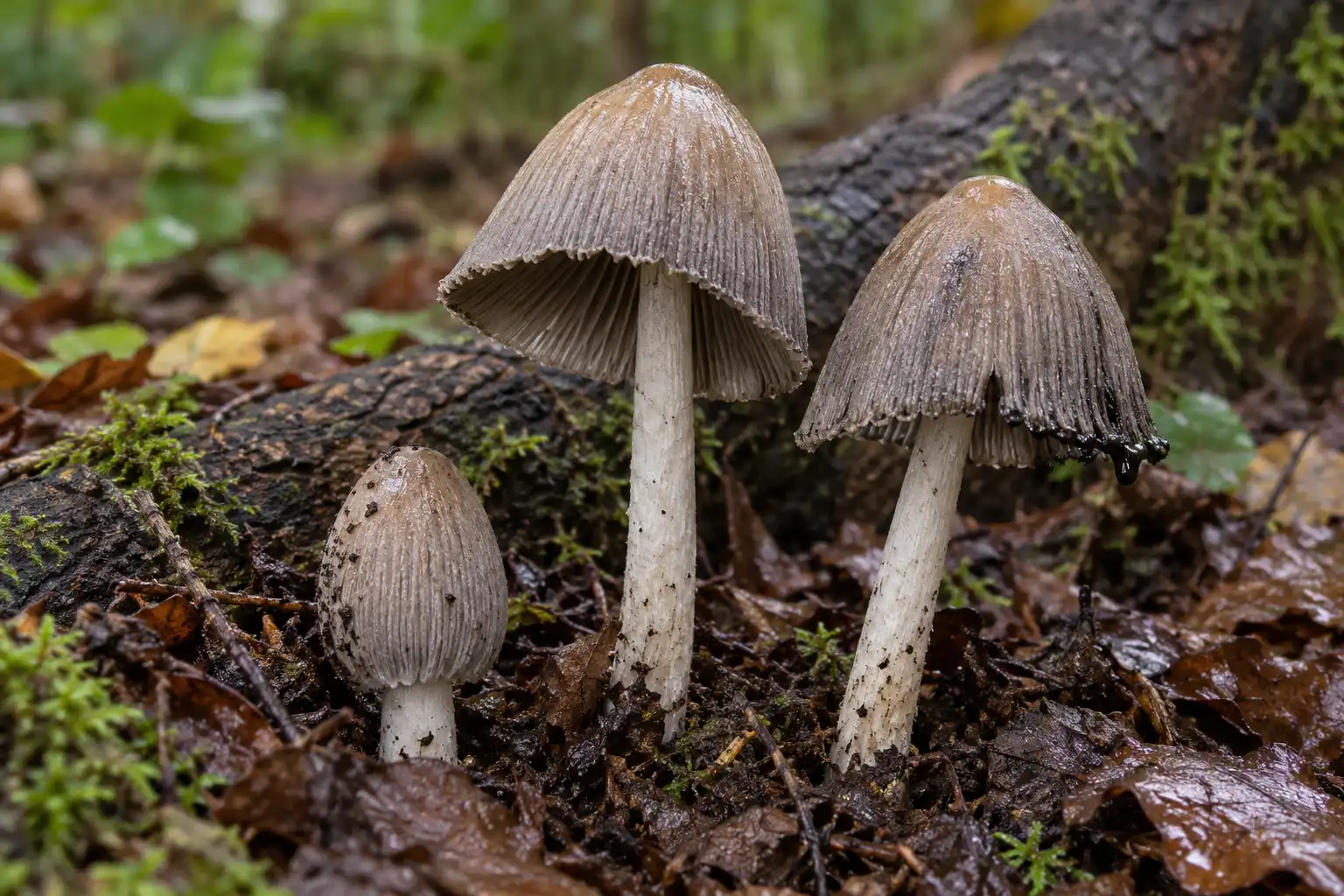
Common Inky Cap: Alcohol Interaction, Habitat, and Lookalikes
Identify common inky cap by smooth gray clustered caps, buried-wood ecology, black deliquescence, and its important delayed alcohol interaction.
identification
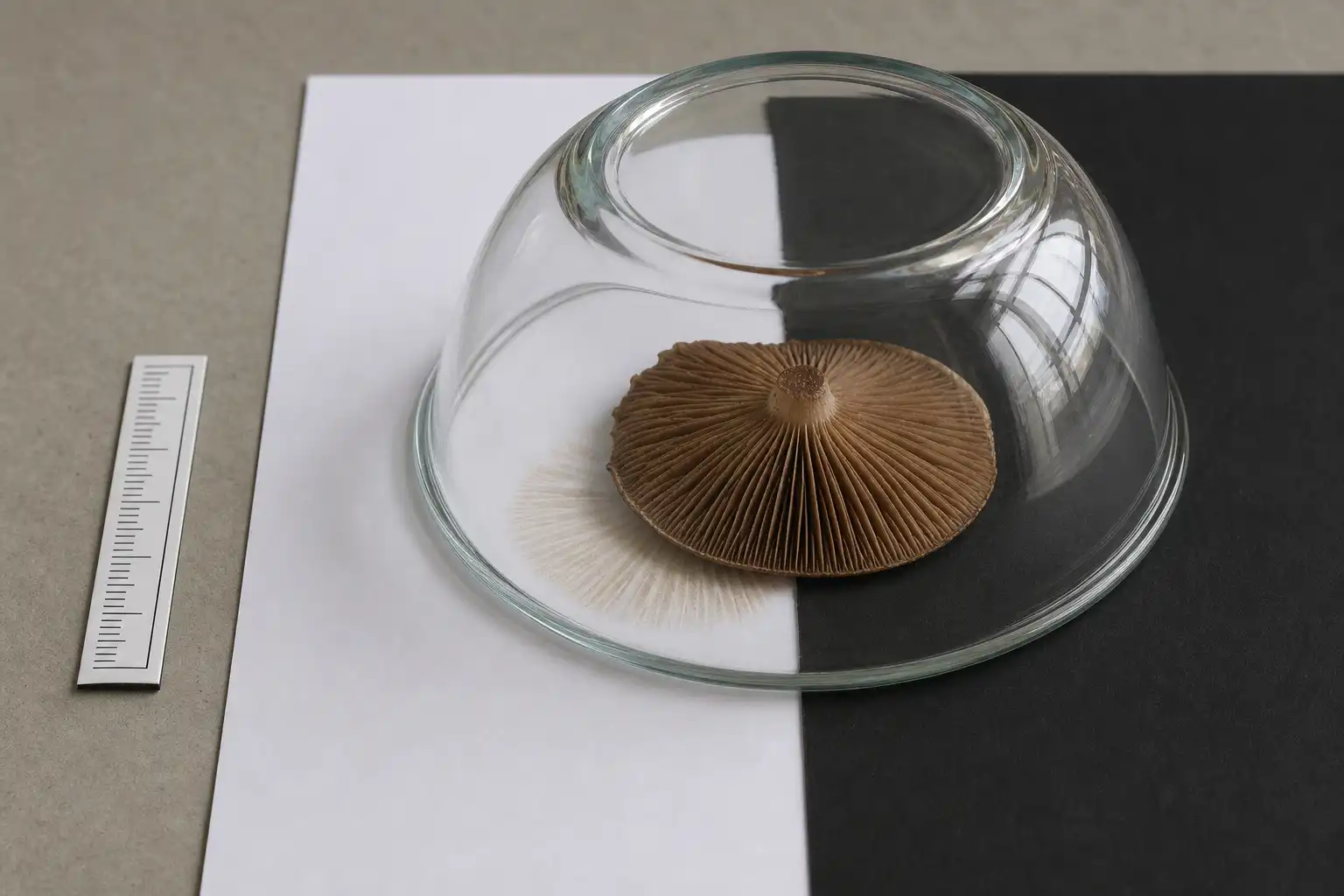
How to Make and Read a Mushroom Spore Print
Make a controlled mushroom spore print, record the result clearly, and understand why a print supports—but never proves—an identification.
identification
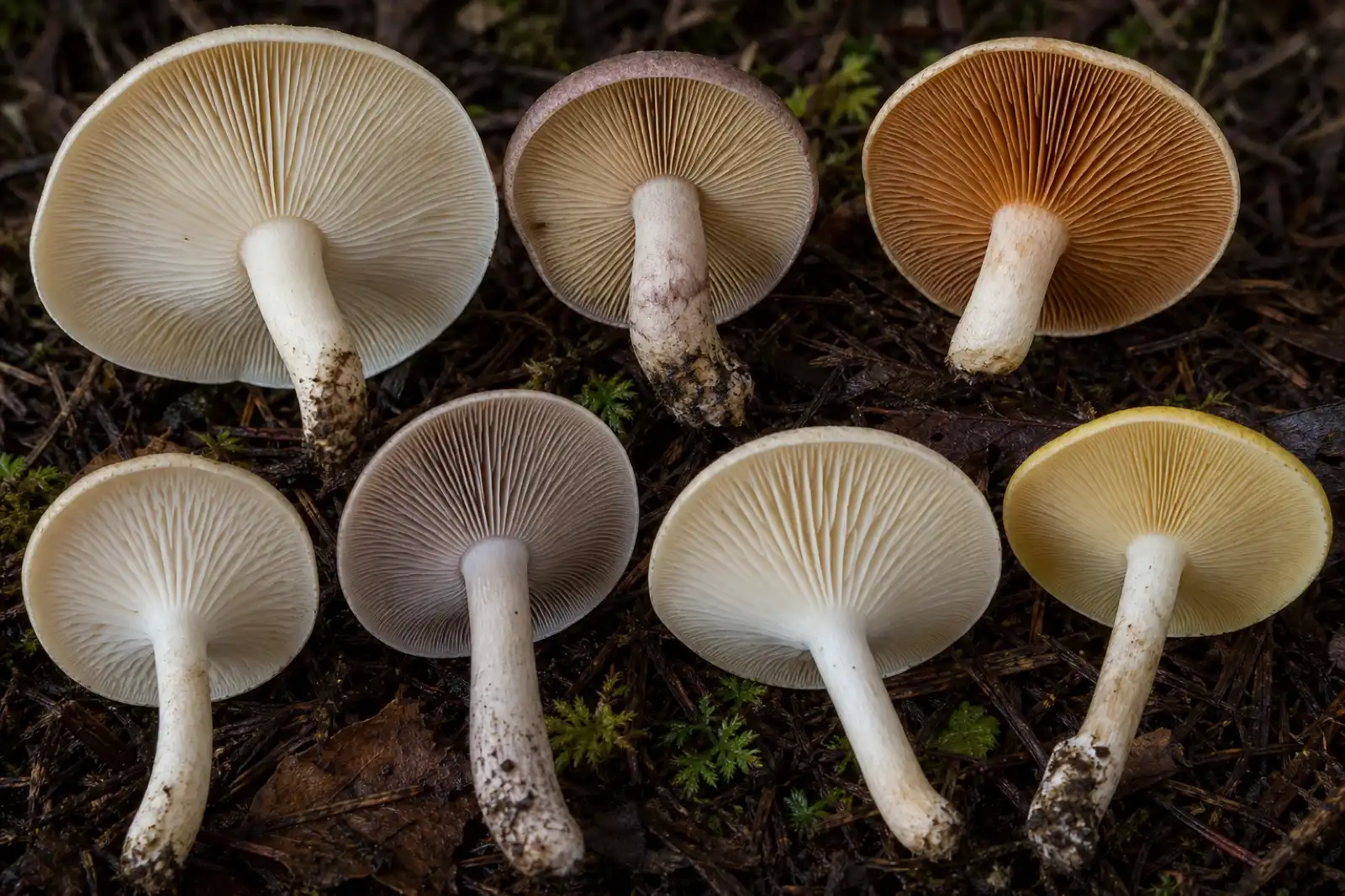
Mushroom Gill Types: Attachment, Spacing, and Color
Compare free, attached, notched, adnate, and decurrent mushroom gills while recording spacing, short gills, edge details, bruising, and color changes.
Continue exploring
Browse more practical guides in Mushroom Encyclopedia or visit the mushroom encyclopedia.