Mushroom Encyclopedia
Green-Cracked Brittlegill: Russula virescens Guide
Document Russula virescens through its green cracked cap, brittle white flesh, pale gills and spores, woodland ecology, lookalikes, and safety limits.
Species context
Treat profiles as reference material
Species profiles summarize documented traits, taxonomy, and lookalikes, but natural variation can be substantial.
Use the safety checklist →Decision limit
A profile cannot authenticate a specimen
Do not eat a wild mushroom from an online match, single feature, or generated image.
Read the safety disclaimer →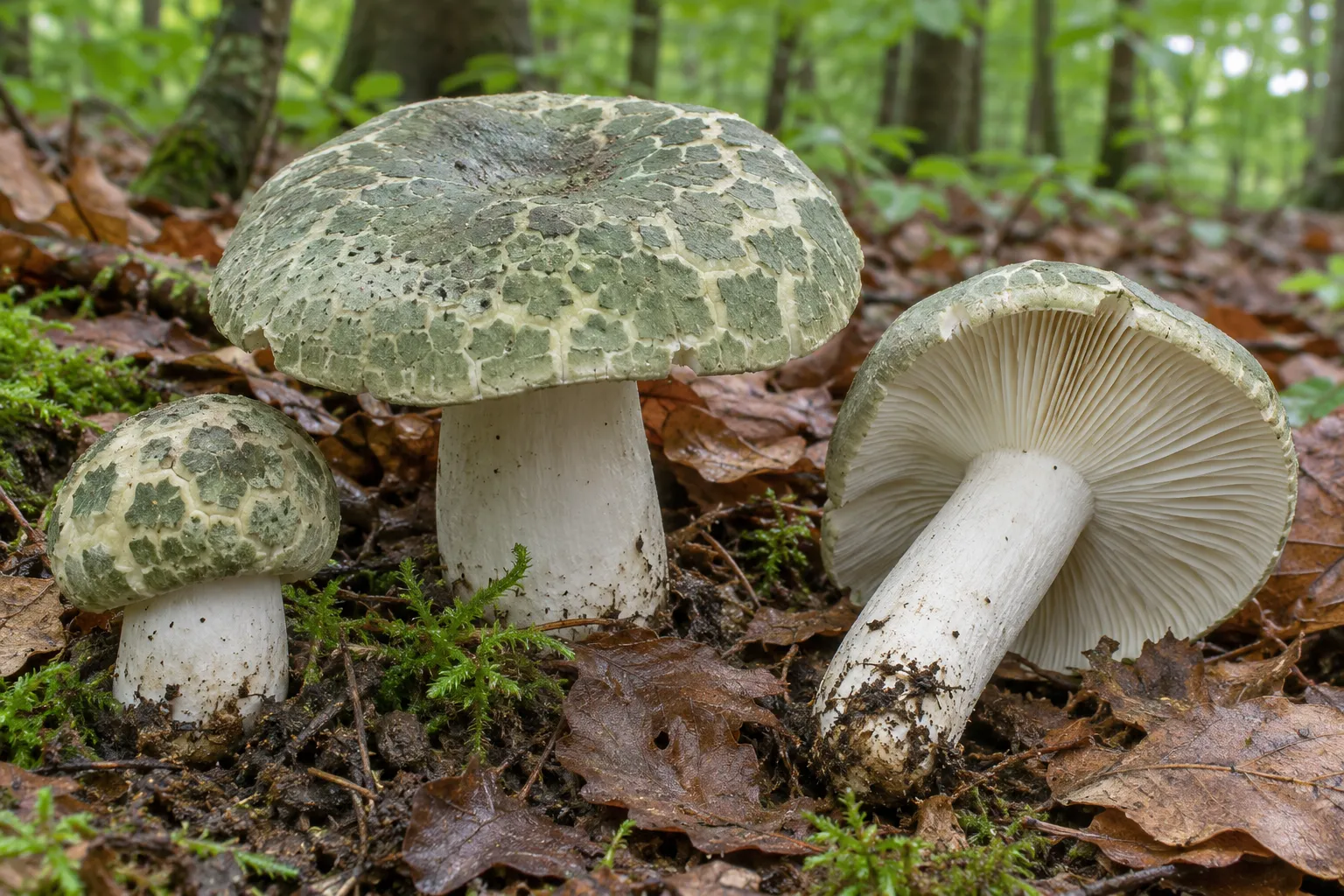
Quick facts
- Scientific name
- Russula virescens
- Common names
- Green-cracked brittlegill, Quilted green russula
- Taxonomy
- Russula · Russulaceae
- Edibility context
- Edible: Published food use does not clear a field collection; local identification, freshness, preparation, contamination, and individual response remain separate decisions.
- Spore print
- White to pale cream; microscopic ornamentation and a regional key support close comparisons.
- Toxicity context
- None Known: The principal risks are misidentification, mixed collections, spoilage, contamination, and personal gastrointestinal or allergic response.
- Season
- July, August, September, October
- Growing difficulty
- Expert
- Regions
- Europe, Asia, North American records requiring regional taxonomic review
Safety limit: These labels summarize documented context; they never authenticate a wild specimen. Cooking does not make a poisonous species safe.
The green-cracked brittlegill, Russula virescens, is named for a surface pattern rather than green color alone. Mature caps often break into irregular gray-green or olive patches separated by paler seams, producing a quilted or mosaic effect. Beneath that surface is the granular, brittle construction characteristic of Russula: a white ringless stem and crowded pale gills that can snap rather than bend.
Neither feature is sufficient alone. Young caps may not be cracked, weather can erase the pattern, and several green brittlegills overlap in woodland. A responsible record joins cap texture, complete base, gill behavior, spore deposit, microscopic characters, tree and soil context, geography, and a current key. Food use requires a separate local decision.
Recover the complete base before comparing colors
Photograph the undisturbed cap, underside, and stem in place, then loosen soil around one representative specimen. The complete base should show no cup-like volva, and the stem should have no ring. Record absence only after the relevant tissue is present; a stem snapped above soil proves nothing about its base.
This step matters because a green-capped Amanita follows a very different safety pathway. A ring or volva can be damaged or buried. If the base is missing, stop the food discussion and retain the record as incomplete.
Map the cap mosaic under neutral light
Place a gray card and ruler beside the cap. Photograph in open shade from above and at a low angle. Divide the cap into center, middle zone, and margin, then record patch color, patch width, seam width, surface moisture, central depression, and any peeling or abrasion.
A natural areolate surface consists of irregular islands rather than a uniform printed checkerboard. Note whether the green material is continuous in a young cap and breaks with expansion, or whether insects and drying have merely removed patches. Rain, glare, leaf stains, and phone white balance can all exaggerate green.
Confirm the brittle Russula construction
Use already damaged tissue or a small retained voucher. Fresh stem and cap flesh should fracture with a granular snap rather than separating into long fibers. This reflects the rounded cell clusters common in the family, but waterlogging, freezing, age, and larvae can soften the response.
Do not destroy multiple fruit bodies to demonstrate brittleness. Record the condition, location of the break, and result. The genus-level body plan supports a Russula path; it does not identify R. virescens.
Record gill attachment, spacing, and fracture
Take a low underside view before handling. Record whether gills reach the stem, fork, include short gills, bruise, or change from white to cream with maturity. Count gills across a defined cap arc rather than calling them simply crowded.
Apply only gentle lateral pressure to a fresh mature section. Green-cracked brittlegill gills are expected to behave as ordinary brittle Russula tissue, not show the notably waxy flexibility used for the charcoal burner. Any soaked or decomposing gill can smear, so condition must accompany the result. The gill-types guide provides a repeatable photography sequence.
Compare charcoal burner through mechanics
The charcoal burner, Russula cyanoxantha, may include green, gray, violet, and olive on one cap. Its stronger field clue is the unusual pliancy of mature gills, which can bend or smear under gentle pressure instead of shattering immediately. Its cap can be smooth or variably colored without the characteristic green areolate emphasis.
Use the charcoal burner guide to compare the same-age cap map, gill-pressure result, deposit color, stem response, trees, and microscopy. Do not decide from one green photograph.
Keep other green brittlegills in the table
Russula heterophylla can be green and may show conspicuous gill forking near the stem. Gray-green species complexes can reproduce parts of the palette, while weathered caps lose the very textures that field guides emphasize. Species concepts and names may differ between continents.
Build a table with cap patch geometry, cuticle behavior, margin, gill attachment and forking, fracture, spore-deposit shade, odor without tasting, stem changes, tree context, microscopic spores, chemical reactions required by the key, and region. A genus or group identification is better than forcing an incompatible species.
Obtain a massed spore deposit
Place a mature cap section across dark and light nonabsorbent surfaces, cover it against drafts, and label it to the specimen. Record duration and humidity. Judge the massed deposit under neutral light; isolated dust can look whiter than a thick layer.
White to pale cream is supportive but shared by many brittlegills. The spore-color guide explains why substrate, deposit thickness, and lighting need control. Microscopy may then compare spore size, shape, and amyloid ornamentation using the current regional key.
Connect woodland evidence without assigning a tree
The species is ectomycorrhizal and commonly reported in broadleaf or mixed woodland, including oak and beech contexts. Photograph canopy, bark, leaves, mast, soil surface, slope, drainage, and measured distances to plausible hosts. Roots overlap, and the nearest trunk is not necessarily the partner.
Write “fruiting on soil in mixed oak-beech woodland” unless root-tip or molecular evidence supports a specific association. This distinction protects the habitat record from becoming a biological claim that the observation did not test.
Separate distribution evidence from identity
GBIF can expose observations, vouchers, institutions, and taxonomic source links. NCBI provides taxonomic and sequence-linked context. Inspect record basis, identifier, date, media, and name history before using a map point. Neither database verifies the reader’s specimen.
Records outside a familiar range deserve a current local key and, where lawful, a dried voucher reviewed by a herbarium or experienced regional mycologist. Do not announce a range extension from a cap photograph.
Preserve a voucher that retains the key evidence
Assign one field number to site images, complete-base images, cap map, underside, section, deposit, microscopy, and dried material. Dry promptly with adequate airflow and keep each potentially different fruit body separate. A mixed Russula collection can otherwise inherit the best character from each specimen.
Cap colors often fade or brown in drying, so field photographs and notes are essential. If DNA sequencing is planned, follow the receiving laboratory’s tissue protocol and preserve chain of custody. A sequence from unlabelled mixed tissue cannot repair a weak field record.
Quantify mosaic development across cap expansion
Select three intact fruit bodies representing button, expanding, and mature stages within one labelled patch. Without assuming they are genetically identical, photograph each from the same height with a scale and gray card. Trace the visible green islands in a copy of the image, then record cap diameter, number of islands crossing a fixed 20 mm line, median island width, pale-seam width, and the proportion of the line occupied by exposed pale tissue.
Repeat after a dry interval if the mushrooms remain in place. The comparison can show whether apparent cracking increases as the cap expands or dries, but it does not make one texture threshold diagnostic. Abrasion, slug feeding, rain, and sun exposure must be scored separately. A young nearly continuous green cap and a mature quilted cap may belong to one developmental series; two adjacent caps with different gill deposits or microscopy may instead represent a mixed collection.
Keep the measurements linked to complete-base, underside, and spore records. The mosaic is most useful when it is one part of a specimen-level evidence chain, not when it becomes a decorative synonym for every green brittlegill.
Keep food and poisoning boundaries separate
The green-cracked brittlegill has an edible reputation in parts of its range. That describes correctly identified, suitable material; it does not approve a mushroom matched online. Close species, mixed baskets, deterioration, pollutants, pesticides, preparation, allergy, and individual gastrointestinal response remain relevant.
Do not taste unknown mushrooms as a beginner. Although taste characters appear in specialist Russula keys, they belong to controlled expert protocols after dangerous genera have been excluded and are unnecessary for this workflow.
If symptoms follow wild mushroom ingestion, contact emergency services or a poison center promptly. Preserve uncooked material, trimmings, photographs, location, meal details, and timing. Do not wait for a crowdsourced name.
Audit the editorial image
The 1536 × 1024 cover is an original AI-assisted editorial image. It was opened beside Purple Brittlegill and Scarlet Waxcap natural-light baselines and the Giant Club habitat reference. It passed checks for complete stems, visible pale gills, no ring or volva, irregular green areolate texture, restrained color, realistic leaf and moss materials, clear crop, and absence of text, watermark, logo, or collage seams.
The cap mosaic is deliberately prominent so the page’s subject is legible at responsive sizes. That editorial emphasis is not a promise that every specimen looks the same. The image cannot establish fracture behavior, spore color, microscopy, tree partner, or edibility.
Build a reviewable green-brittlegill record
- Photograph the complete base and exclude ring-and-volva anatomy.
- Map cap patches and pale seams by zone under neutral light.
- Record fresh-tissue fracture without overcollecting.
- Photograph gill attachment and test mature gill behavior gently.
- Obtain a controlled massed spore deposit.
- Document trees and soil without asserting an untested partner.
- Compare charcoal burner and other green Russula using one table.
- Use microscopy, a current regional key, and expert review when needed.
This evidence packet can support a defensible R. virescens hypothesis or show exactly why the collection remains unresolved. Both outcomes are safer and more useful than treating green cracks as a shortcut to food.
References
- GBIF species search: Russula virescens — taxonomic sources, occurrence records, and voucher leads.
- NCBI Taxonomy Browser: Russula virescens — nomenclatural and sequence-linked context.
- First Nature: Russula virescens — field morphology, habitat, season, and lookalike comparison.
- North American Mycological Association: mushroom poisoning syndromes — conservative response guidance after suspected ingestion.
Editorial status: reviewed by the MushroomScope editorial team on November 13, 2026; no named mycologist, toxicologist, clinician, or food-safety expert reviewed this page.
Source quality notes
MushroomScope cites sources that match the page scope, such as taxonomic databases, extension guidance, food-safety agencies, food-composition databases, and peer-reviewed or institutional health references. Sources support context and uncertainty; they do not turn an online page into specimen identification, medical advice, or a tested recipe record.
Frequently asked questions
Why is it called the green-cracked brittlegill?
The mature cap surface commonly breaks into irregular green patches separated by paler cracks, while the gills and granular flesh show the brittle Russula body plan.
Does every Russula virescens cap look cracked?
No. Young, shaded, wet, damaged, or faded caps may show less obvious mosaic texture, and several other green Russula species can overlap in color.
What trees are associated with Russula virescens?
It is ectomycorrhizal and is commonly reported in broadleaf and mixed woodland, including oak and beech contexts. The nearest tree is not automatically the root partner.
How does it differ from the charcoal burner?
Green-cracked brittlegill emphasizes an areolate green cap and normally brittle gills; charcoal burner is color-variable and notable for unusually pliant, waxy mature gills.
Can a photograph confirm that a green brittlegill is edible?
No. A photograph cannot resolve every Russula lookalike, specimen condition, contamination, preparation issue, or individual sensitivity. Local examination is required.
Related guides
mushrooms
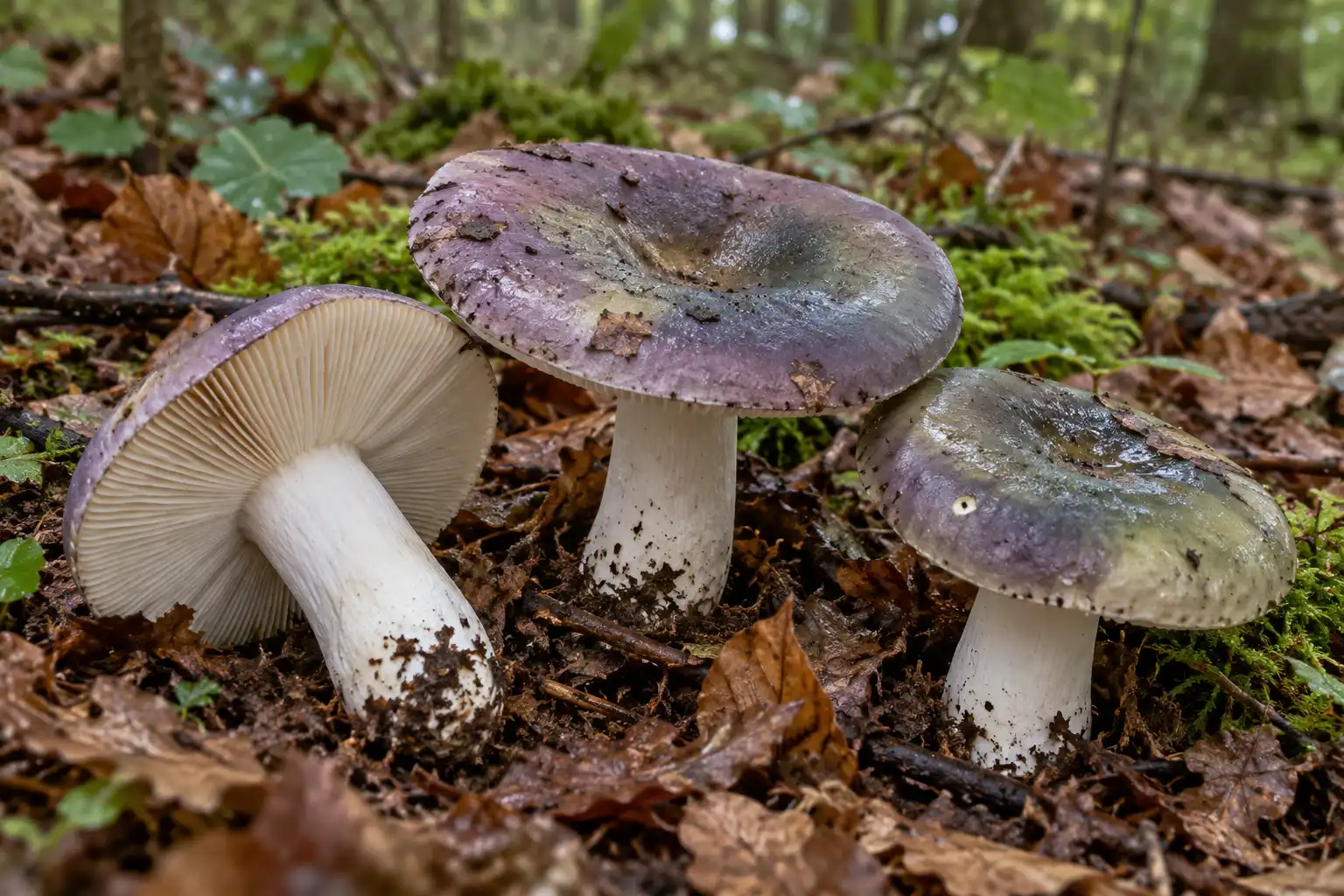
Charcoal Burner Mushroom: Flexible Gills and Color
Identify the charcoal burner mushroom by its variable cap, unusually flexible gills, white stem, woodland ecology, lookalikes, and safety limits.
mushrooms
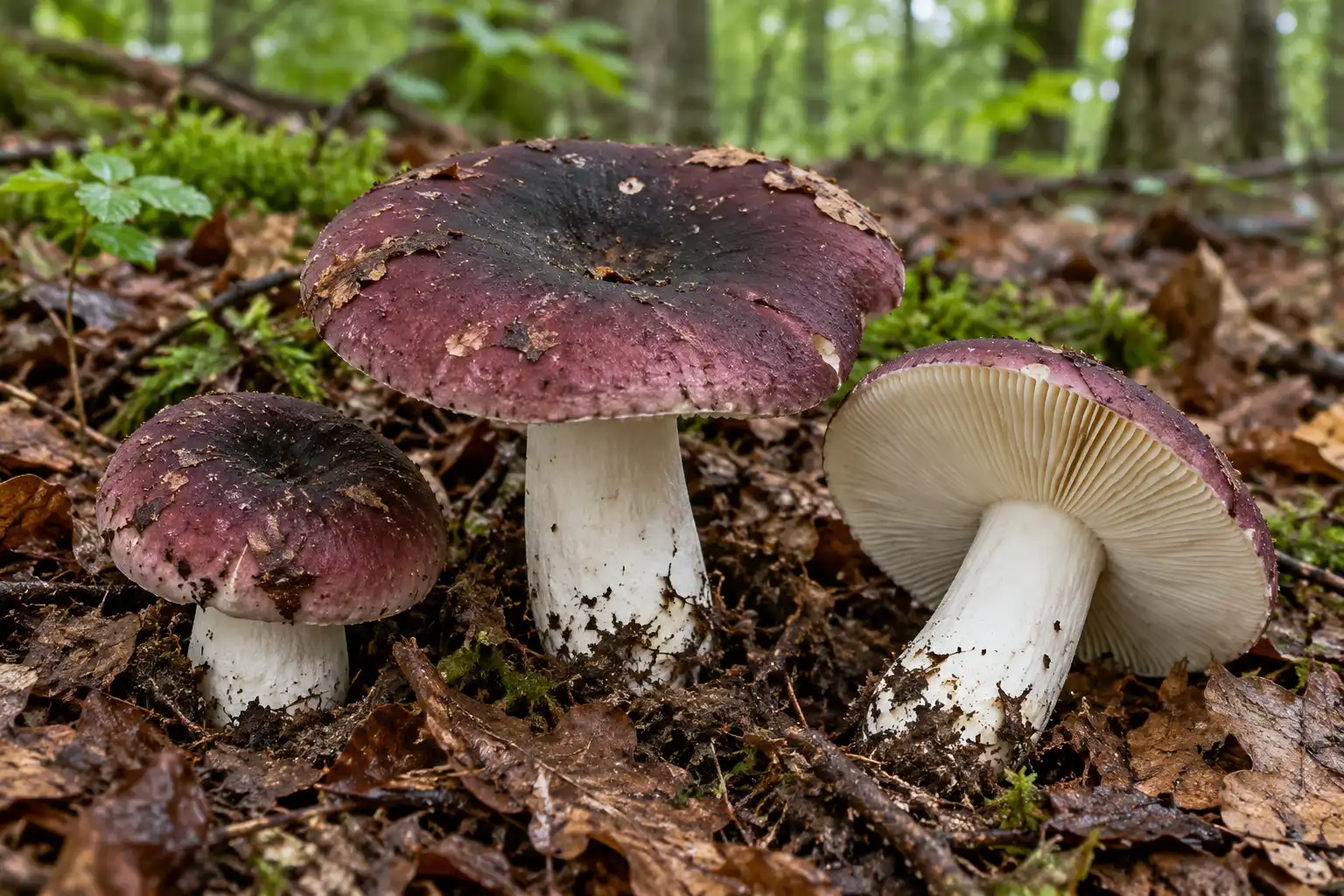
Purple Brittlegill: Color Variation, Hosts, and Identification
Study Purple brittlegill through cap color zones, brittle gills and stem, host evidence, spore characters, lookalikes, safety limits, and regional taxonomy.
identification
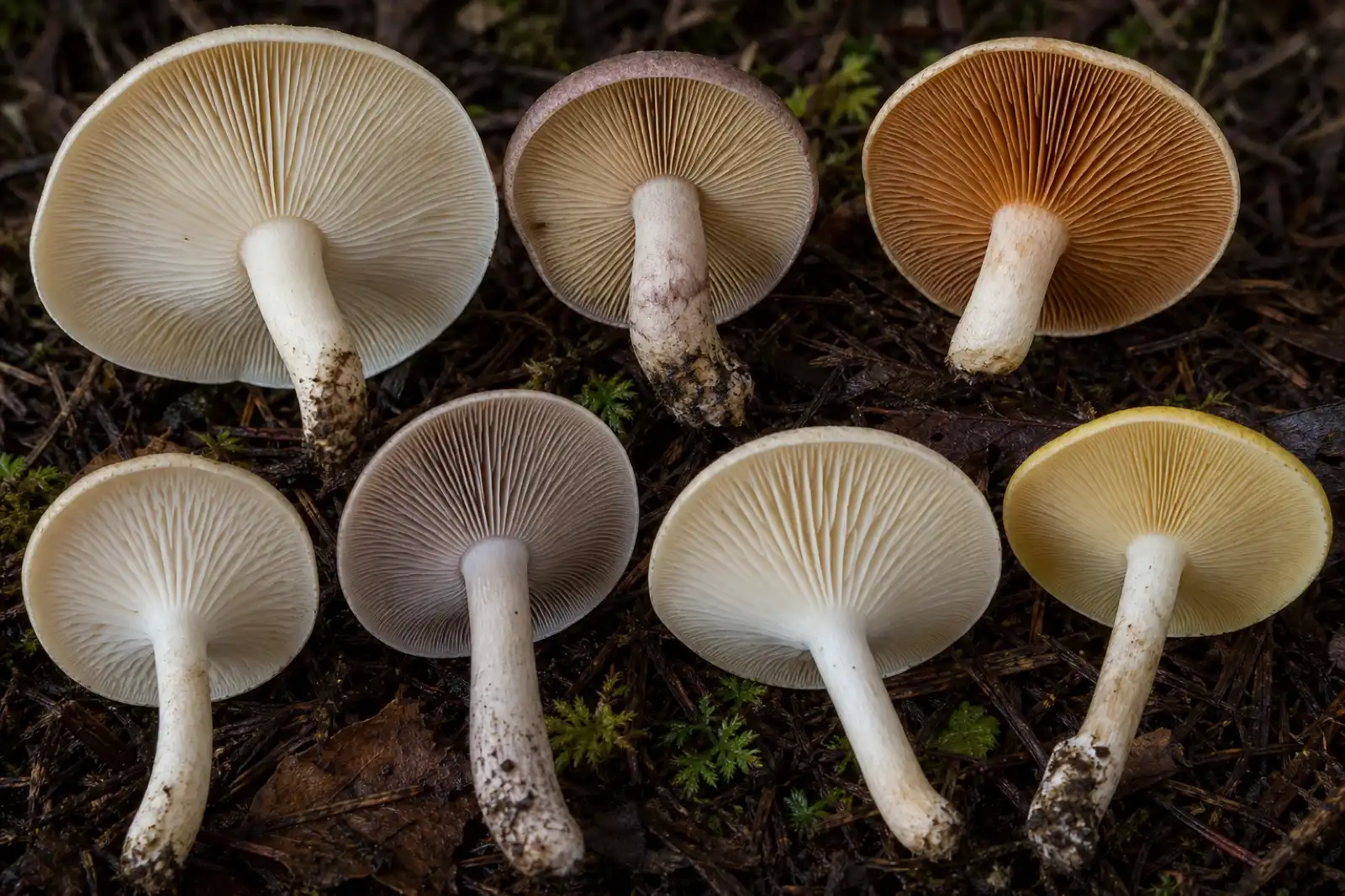
Mushroom Gill Types: Attachment, Spacing, and Color
Compare free, attached, notched, adnate, and decurrent mushroom gills while recording spacing, short gills, edge details, bruising, and color changes.
Continue exploring
Browse more practical guides in Mushroom Encyclopedia or visit the mushroom encyclopedia.