Mushroom Encyclopedia
Charcoal Burner Mushroom: Flexible Gills and Color
Identify the charcoal burner mushroom by its variable cap, unusually flexible gills, white stem, woodland ecology, lookalikes, and safety limits.
Species context
Treat profiles as reference material
Species profiles summarize documented traits, taxonomy, and lookalikes, but natural variation can be substantial.
Use the safety checklist →Decision limit
A profile cannot authenticate a specimen
Do not eat a wild mushroom from an online match, single feature, or generated image.
Read the safety disclaimer →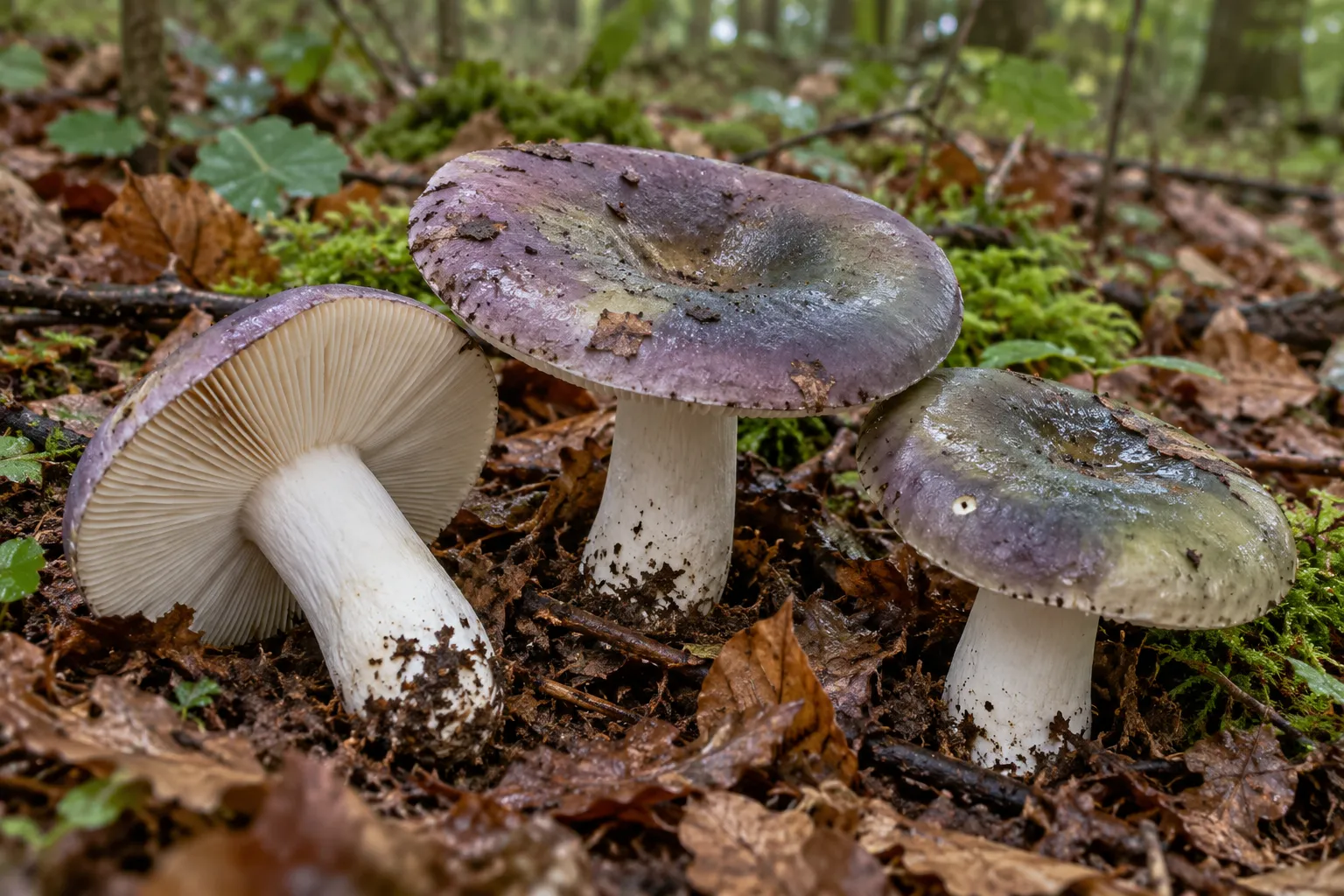
Quick facts
- Scientific name
- Russula cyanoxantha
- Common names
- charcoal burner, charcoal burner brittlegill
- Taxonomy
- Russula · Russulaceae
- Edibility context
- Edible: Published food use does not clear a wild collection; complete local identification, condition, preparation, and individual response still matter.
- Spore print
- White to very pale cream; microscopic ornamentation is needed for close comparisons.
- Toxicity context
- None Known: Misidentification with acrid, gastrointestinal, or poorly understood Russula species is the primary concern.
- Season
- July, August, September, October, November
- Growing difficulty
- Expert
- Regions
- Europe, Asia, North America records requiring regional interpretation
Safety limit: These labels summarize documented context; they never authenticate a wild specimen. Cooking does not make a poisonous species safe.
The charcoal burner, Russula cyanoxantha, is memorable because several muted colors may share one cap: violet at one edge, slate gray through the center, and olive or blue-green in irregular patches. That palette explains the common name, but it is not the most useful diagnostic character. The stronger field clue is mechanical. Mature gills are unusually pliant for a genus famous for brittle tissue, bending or smearing under gentle sideways pressure rather than snapping like dry chalk.
That distinction still does not identify a meal. Many Russula species overlap in color, stature, habitat, and spore-deposit shade. A responsible record combines intact anatomy, gill behavior, a mature spore deposit, tree and soil context, odor without tasting, microscopy where needed, geography, and a current regional key.
Establish the Russula body plan first
Photograph the undisturbed mushroom from cap to soil, then lift one specimen with the complete stem base. The stem should be central and lack both a ring and a cup-like volva. Break a small damaged portion away from the retained voucher: the flesh typically fractures with a granular, brittle texture because Russula tissue contains clusters of rounded cells rather than only long fibers.
This “brittlegill” fracture is a genus-level clue, not a species verdict. Old, soaked, frozen, or insect-tunneled mushrooms behave differently. Record condition and compare several parts. Never excavate an entire colony simply to demonstrate breakage.
Treat cap color as a mapped variable
Place a neutral gray card and ruler beside the cap and photograph in open shade. Record the colors by zone rather than choosing one label. A single cap can combine purple, lilac, charcoal, lead gray, bottle green, olive, cream, and brown. Rain can deepen the surface colors; sun and age can bleach them; leaf contact can leave sharply protected patches.
Measure cap width and depth of the central depression. Note whether the margin is smooth or faintly lined, whether the surface is dry or slightly greasy, and how far the cuticle peels toward the center. Do not force a specimen into R. cyanoxantha because a phone image looks purple-green. Pigment is supporting evidence only.
Test gill flexibility without crushing the specimen
Choose a mature, fresh gill section that has not been soaked by rain. With a clean finger or blunt tool, apply light lateral pressure across several gills. In a typical charcoal burner, the gills flex, smear, or feel waxy rather than fragmenting immediately. Compare that response with the brittle cap flesh and record the test on video or in close photographs.
Pressure must be gentle and documented. Any wet mushroom can become soft, and decomposing tissue can smear. Very young or dry material may not show the expected response. The test has value only when anatomy, condition, spore color, and other evidence agree. The gill-types guide shows how to photograph attachment and spacing before applying pressure.
Record gill attachment and maturation
Photograph a cap cut vertically through the stem. The crowded gills are white when young and may become pale cream as spores mature. Record whether they reach the stem, fork, form short gills, or show brown edges from damage. A low side view preserves spacing better than a flash-lit underside pointed directly at the lens.
Do not treat “white gills” as reassurance. White-gilled mushrooms occur across unrelated edible and poisonous groups. The absence of a ring or volva is meaningful only when the full base is actually present; a broken stem cannot prove absence.
Obtain and interpret the spore deposit
Use a mature cap section on both dark and light nonabsorbent surfaces, cover it against drafts, and label the specimen. Russula cyanoxantha is expected to make a white to very pale cream deposit. Photograph the massed deposit rather than isolated dust and compare it with a calibrated color reference under neutral light.
A pale print supports the identification but does not separate the many pale-spored brittlegills. Microscopic assessment can add spore dimensions and amyloid ornamentation, ideally measured from a labelled mature collection. The spore-color guide explains why deposit thickness and lighting matter.
Connect habitat evidence to trees cautiously
Charcoal burners are ectomycorrhizal. They are commonly reported in broadleaved and mixed woods, especially with beech and oak in European accounts. Photograph the canopy, nearby trunks, leaves, bark, soil surface, slope, and drainage. Measure distances to plausible host trees instead of writing “under oak” from memory.
Roots overlap underground, and the closest trunk is not automatically the fungal partner. A partner-specific claim needs root-tip or molecular evidence linked to the same site. For an ordinary field record, “mixed beech-oak woodland on well-drained soil” is accurate habitat context without overstating the association.
Separate lookalikes by evidence bundles
The gray, green, and violet brittlegills form a difficult field neighborhood. Russula heterophylla may be greener and can show frequent gill forking near the stem. Species in the R. grisea complex can reproduce much of the charcoal-burner palette. Other robust Russula species develop olive or purple caps with pale gills. Names and boundaries differ among regions and modern taxonomic treatments.
Build a comparison table for cap zones, gill flexibility, gill attachment and forking, spore-deposit shade, stem bruising, odor, habitat, associated trees, microscopic spore characters, and any chemical reactions required by the chosen key. A “charcoal burner group” or genus-level record is better than false precision.
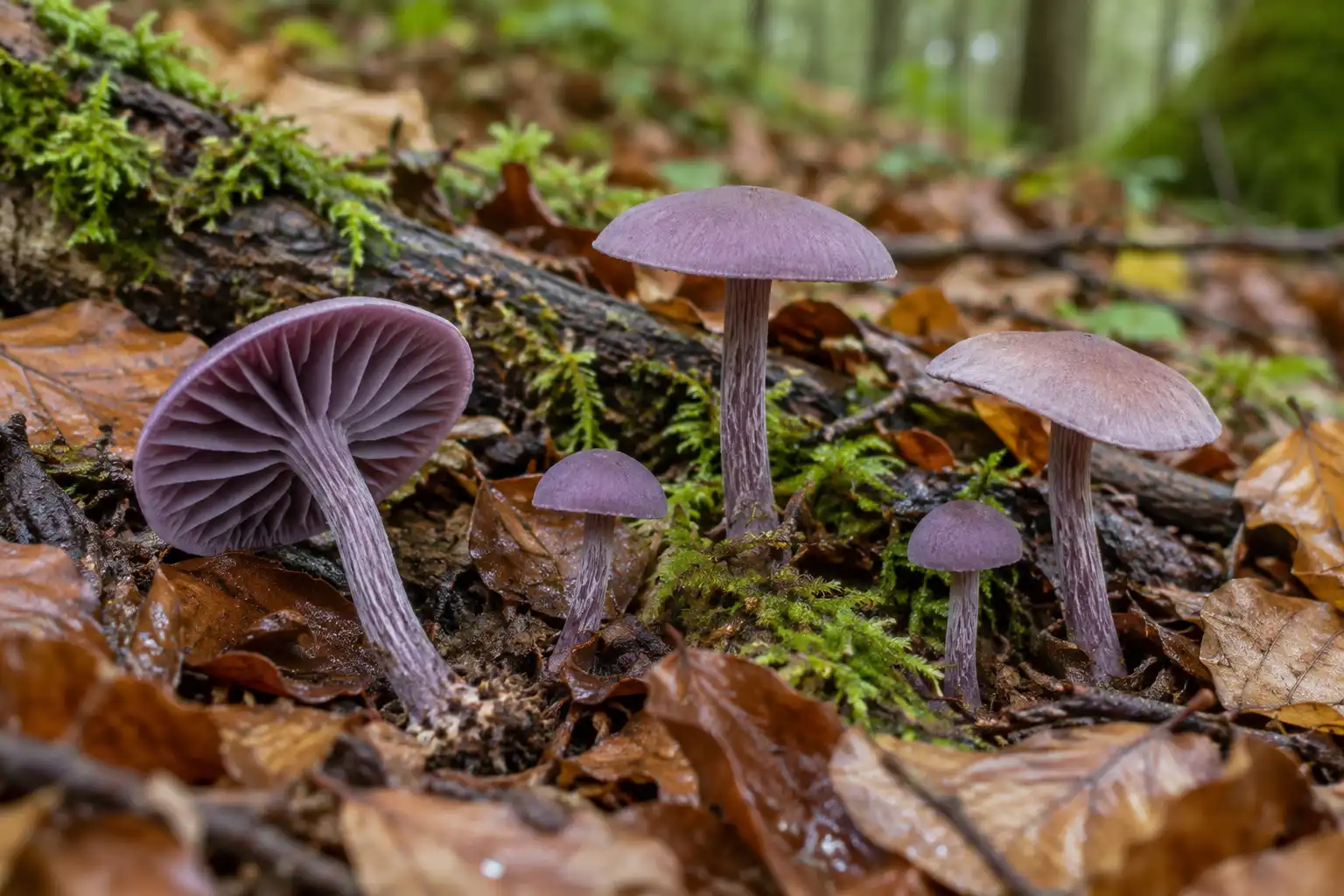
The amethyst deceiver can also look violet in woodland, but it is smaller and more fibrous, with thick widely spaced violet gills rather than crowded flexible white gills. See the amethyst deceiver guide for that contrasting body plan.
The green-cracked brittlegill guide follows a different green-cap pathway: an irregular areolate mosaic, normally brittle pale gills, complete ringless base, and controlled spore record. Compare mechanics and texture rather than assigning every green Russula to the charcoal burner.
Use taste characters only within expert protocols
Some keys divide brittlegills by mild or acrid taste, but tasting unknown mushrooms is inappropriate for beginners and unnecessary for a public web identification. Do not swallow any fragment. Regional experts who use a controlled taste-and-spit method do so only after excluding dangerous genera and assessing the specimen’s condition.
Odor can be recorded without close inhalation or prolonged handling. Describe it plainly and note whether the mushroom was fresh. Neither “mild” nor “pleasant” proves identity or food safety.
Measure variation across one collection
Select three to five fruit bodies of different apparent ages without overcollecting. Measure cap width, stem length and width, central depression, gill count across a defined arc, cuticle peel distance, and the result of the same gentle gill-pressure test. Photograph each specimen with a unique field number.
For a purple-capped Russula with a different gill response, compare the Purple brittlegill guide. It records a dark-centered cap series, brittle cream gills and oak-or-beech root context rather than transferring the charcoal burner’s flexible-gill character to every violet cap.
Variation within the group matters. If only one cap has flexible gills or a different deposit color, the collection may be mixed or damaged. Keep potentially different specimens separated from the moment of collection through microscopy and drying.
Preserve a useful voucher
Take site, cap, underside, full-base, section, spore-deposit, and tree-context photographs before drying. Keep a representative mature fruit body and a younger one if collection is permitted. Dry promptly with enough airflow to prevent cooking or mold, and retain the label with date, coordinates at an appropriate privacy level, habitat, measurements, and image identifiers.
Color often changes during drying, so field photographs are essential. A dried purple-brown cap without gill-behavior notes loses one of the most useful observations. If DNA work is planned, follow the receiving laboratory’s contamination and tissue-storage protocol rather than improvising.
Food and poisoning boundaries
The charcoal burner has a published edible reputation in parts of its range. That statement describes correctly identified, suitable material; it is not permission to eat a mushroom matched online. Species concepts, local lookalikes, environmental contamination, deterioration, preparation, allergy, and individual gastrointestinal response remain relevant.
Do not serve a wild collection to others on the strength of cap color or flexible gills. Obtain in-person confirmation from a qualified local identifier who can examine the complete material. Cook only an independently verified edible species according to reliable local guidance and try a modest portion when appropriate.
If symptoms follow a wild-mushroom exposure, contact local emergency or poison-control services promptly. Preserve uncooked material, trimmings, photographs, location, meal details, and timing. Do not wait for crowdsourced identification before seeking help.
Editorial and image limits
This page has editorial review only and no named mycologist, toxicologist, clinician, or food-safety expert reviewer. GBIF and NCBI support taxonomic and occurrence context; First Nature provides a field-description cross-check; NAMA supports conservative poisoning response. None can identify a reader’s specimen from this article.
The cover is an original AI editorial image, not a field photograph. It was accepted after comparison with natural-light Chanterelle and Scarlet Waxcap site baselines for restrained color, visible complete bases, plausible gill attachment, woodland texture, and absence of text, watermark, or obvious fused anatomy. It must not be used as identification evidence.
References
- Global Biodiversity Information Facility. Russula cyanoxantha search. Taxonomic and occurrence context.
- National Center for Biotechnology Information. Russula cyanoxantha taxonomy search. Independent nomenclatural checkpoint.
- First Nature. Russula cyanoxantha, Charcoal Burner. Macroscopic character and habitat cross-check.
- North American Mycological Association. Mushroom Poisoning Syndromes. Conservative poisoning-response context.
Editorial status: reviewed by the MushroomScope editorial team on October 28, 2026; no named mycologist, toxicologist, clinician, or food-safety expert reviewed this page.
Source quality notes
MushroomScope cites sources that match the page scope, such as taxonomic databases, extension guidance, food-safety agencies, food-composition databases, and peer-reviewed or institutional health references. Sources support context and uncertainty; they do not turn an online page into specimen identification, medical advice, or a tested recipe record.
Frequently asked questions
Why is Russula cyanoxantha called the charcoal burner?
Its cap often mixes smoky violet, gray, blue-green, and olive tones that resemble changing colors on charcoal, but color alone is highly variable.
What is unusual about charcoal burner gills?
Compared with many brittle Russula species, its mature gills are notably pliant and can bend or smear under gentle lateral pressure instead of shattering immediately.
Does the charcoal burner always have a purple cap?
No. Caps may be violet, gray, green, olive, brownish, or mixtures of those colors, and weather can fade or redistribute the pigments.
What trees are associated with Russula cyanoxantha?
It is ectomycorrhizal and is reported mainly in broadleaved and mixed woodland, commonly with beech and oak, but a nearby tree does not prove the root partner.
Can a photograph confirm that a charcoal burner is edible?
No. A web page or photograph cannot exclude other Russula species, contamination, deterioration, or individual intolerance. Local expert confirmation is needed for any food decision.
Related guides
identification
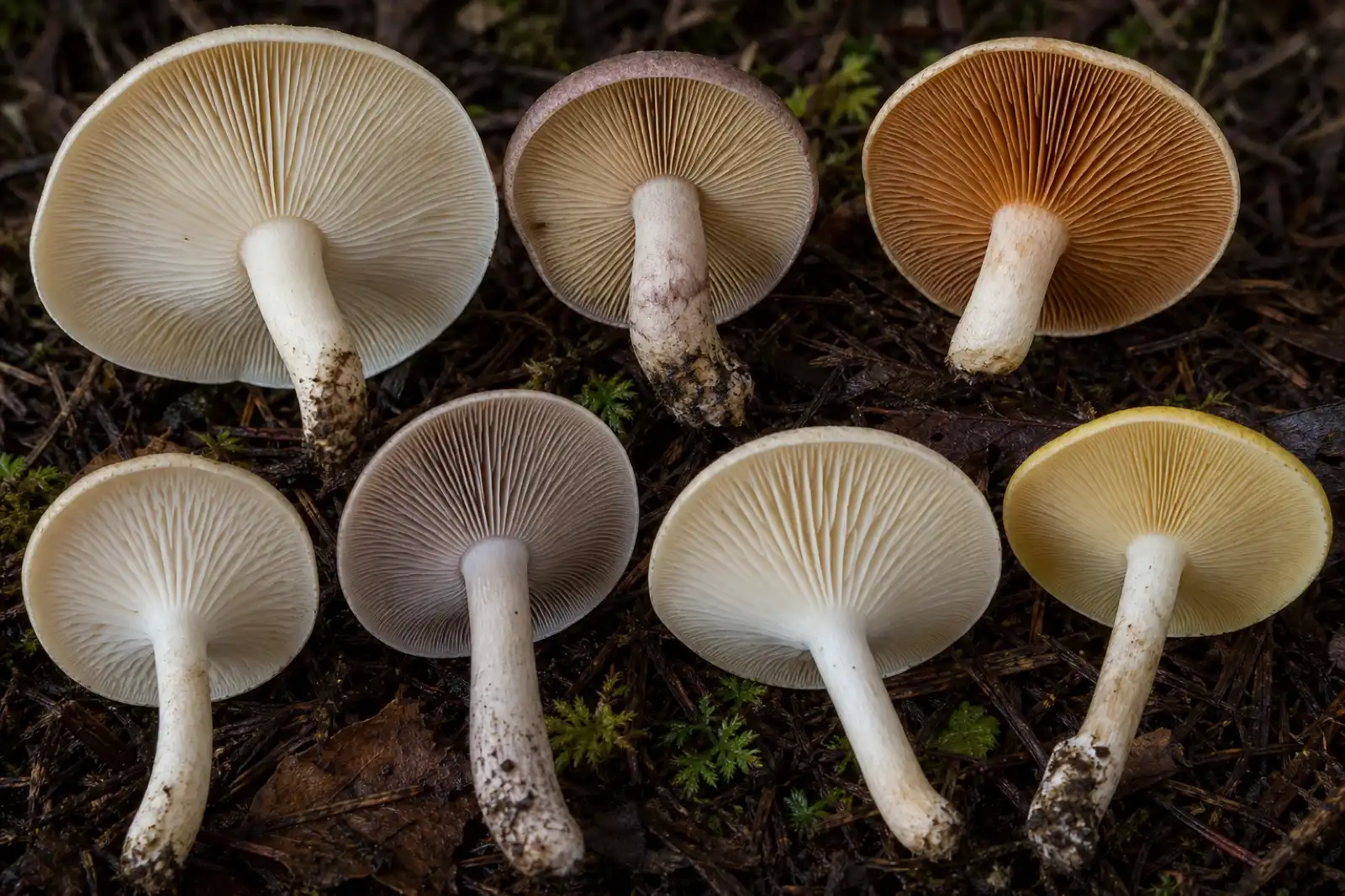
Mushroom Gill Types: Attachment, Spacing, and Color
Compare free, attached, notched, adnate, and decurrent mushroom gills while recording spacing, short gills, edge details, bruising, and color changes.
identification
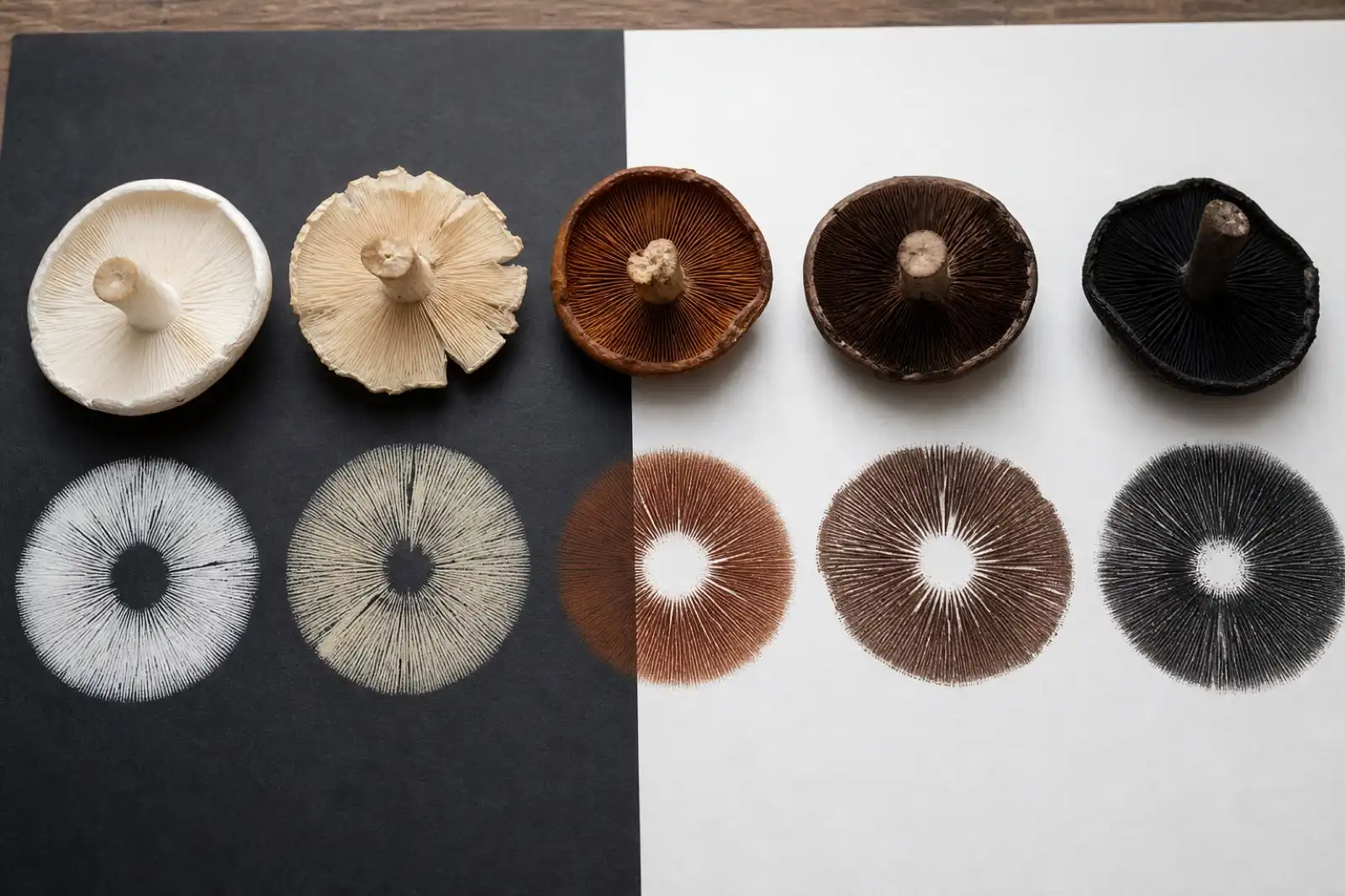
Mushroom Spore Print Colors and How to Record Them
Use a controlled spore deposit to distinguish broad color groups while recognizing that print color alone never identifies a species.
mushrooms
Amethyst Deceiver: Gills, Color Fading, and Habitat
Document Laccaria amethystina through widely spaced gills, fibrous violet stem, fading cap, beech-oak habitat, white spores, and regional lookalikes.
Continue exploring
Browse more practical guides in Mushroom Encyclopedia or visit the mushroom encyclopedia.