Mushroom Encyclopedia
Amethyst Deceiver: Gills, Color Fading, and Habitat
Document Laccaria amethystina through widely spaced gills, fibrous violet stem, fading cap, beech-oak habitat, white spores, and regional lookalikes.
Species context
Treat profiles as reference material
Species profiles summarize documented traits, taxonomy, and lookalikes, but natural variation can be substantial.
Use the safety checklist →Decision limit
A profile cannot authenticate a specimen
Do not eat a wild mushroom from an online match, single feature, or generated image.
Read the safety disclaimer →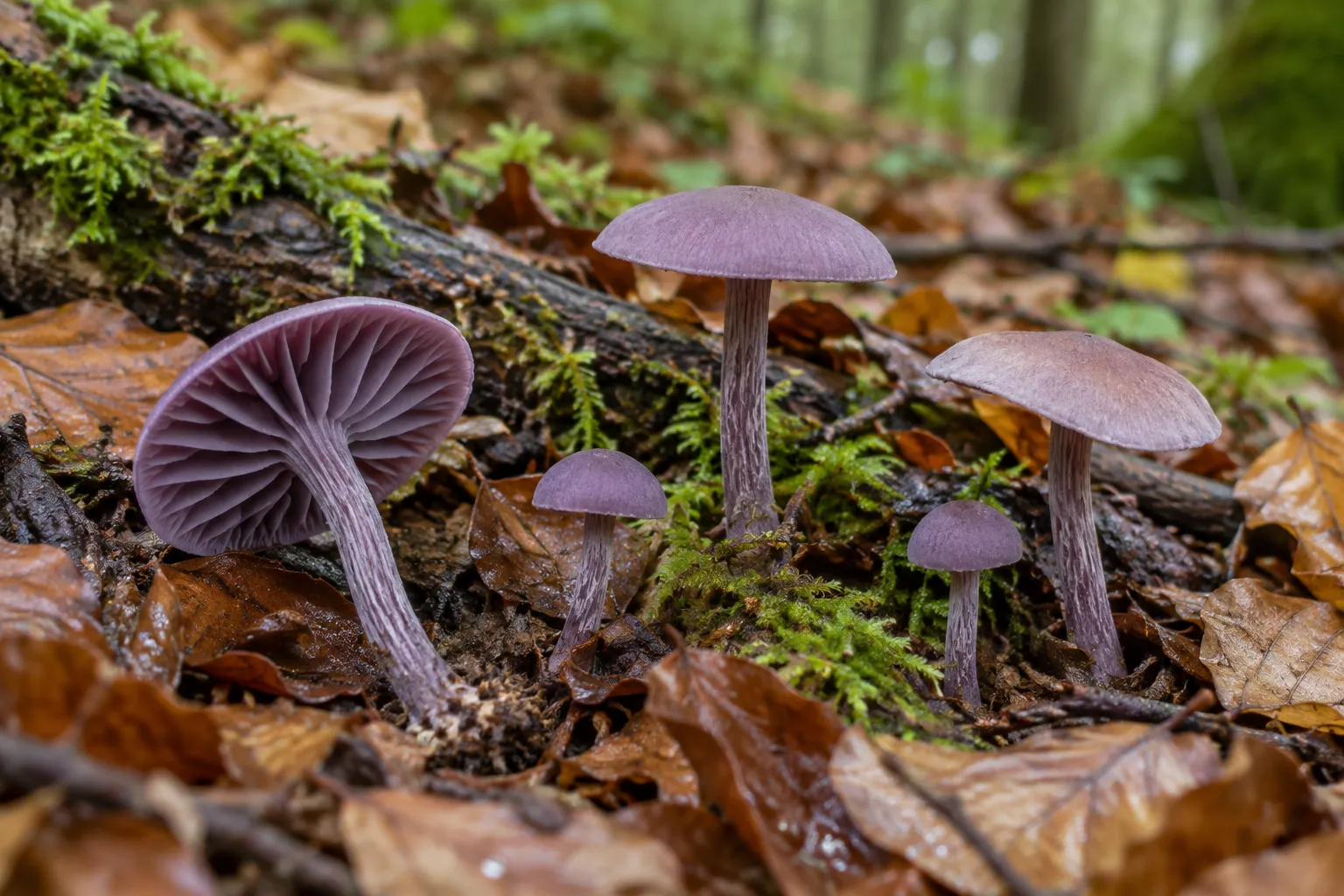
Quick facts
- Scientific name
- Laccaria amethystina
- Common names
- Amethyst deceiver, Amethyst laccaria
- Taxonomy
- Laccaria · Hydnangiaceae
- Edibility context
- Edible: Food-use reports do not provide remote clearance; correct identification, site contamination, condition, and individual response matter.
- Spore print
- White.
- Toxicity context
- Low: The principal risks are misidentification, contaminated sites, spoilage, and individual reaction.
- Season
- July, August, September, October, November
- Growing difficulty
- Not Cultivated
- Regions
- Europe, Asia, North America
Safety limit: These labels summarize documented context; they never authenticate a wild specimen. Cooking does not make a poisonous species safe.
The amethyst deceiver, Laccaria amethystina, is a small woodland mushroom whose color can be brilliant violet after rain and surprisingly dull after a dry day. That change explains the “deceiver” name and also explains why color-first identification fails. A defensible record combines thick, widely spaced gills, a slender fibrous stem without ring or volva, a white spore deposit, woodland host context, and a linked series showing how cap color changes with moisture and age.
This guide focuses on observable transitions rather than a perfect purple portrait. It separates cap fading from taxonomic difference, shows how the gill architecture contrasts with purple Cortinarius, and explains why host, region, microscopy, and site contamination stay relevant even when the field pattern looks familiar.
Safety boundary: Purple color does not establish identity or edibility. A web page cannot examine a complete collection or exclude hazardous regional lookalikes. Seek qualified local, in-person confirmation before any food decision. If symptoms follow wild-mushroom ingestion, contact local emergency services or a poison center and keep uncooked material.
Photograph color before the cap dries
Begin with the fruit body in place under diffuse natural light. Fresh hydrated caps may be deep amethyst, violet, or purple-lilac. As they lose water, they can fade from the center or across the entire surface toward pale lilac, gray, or buff. Automatic phone processing often increases magenta and makes the mushroom appear more saturated than it was.
Place a neutral gray reference beside, not on, the specimen and record whether it recently rained. Photograph again after a measured interval if collection is legal. Describe the direction of change—center first, margin first, or uniform—rather than assigning one permanent color. A dried buff cap linked to an earlier violet image is more informative than two unlinked specimens presented as identical.
Read the gills as architecture
Turn one cap only enough to show the underside without tearing it from the stem. The gills are relatively thick and widely spaced, often with shorter gills between full-length ones. Their attachment can be broadly adnate or slightly decurrent. They may retain violet longer than the upper cap, especially in sheltered fresh specimens.
Record spacing near both margin and stem, the number and arrangement of short gills, branching, edge color, and any cross-veins. The gill-types guide supplies attachment vocabulary, but the specimen may not match a single diagram cleanly. Thick distant gills are a useful Laccaria pattern; they are not a species verdict by themselves.
Examine the fibrous stem from apex to base
The stem is slender, often slightly twisted, and visibly longitudinally fibrous. Violet tones may be strongest when young and moist, then fade or become brownish with handling. Record whether the base has pale or lilac mycelium and whether litter adheres to it. Photograph the entire base before cleaning.
There should be no persistent ring and no volva. An unexpected web-like veil, ring zone, bulb, or basal cup redirects the comparison. Fibers must also be distinguished from a cobwebby cortina: stem tissue has aligned longitudinal texture, while veil remnants bridge cap and stem or leave deposited spores on a band.
Use a developmental series to explain deception
Assign field numbers to at least three fruit bodies if a lawful collection is abundant: a young convex cap, a freshly expanded specimen, and an older flat or depressed cap. For each, record diameter, gill color, stem color, moisture, and nearby tree context. Do not line up mushrooms from different woodland sites and treat them as one series.
With age, the cap can flatten, become centrally depressed, develop a wavy margin, and lose much of its purple color. The gills may remain more colorful, while the stem becomes tougher and browner. This within-collection sequence is the best demonstration of why a fixed color swatch is inadequate.
Obtain a clean white spore deposit
Use a mature cap on a divided black-and-white nonabsorbent surface and cover it against drafts. A white deposit can be hard to see on paper, so side lighting and the dark half are important. Record duration and do not call a few pale fragments a print. The spore-color guide describes controls for moisture and tissue debris.
White spores help separate an amethyst deceiver candidate from purple Cortinarius, which mature toward rusty or cinnamon-brown deposits. Print color does not distinguish every pale-spored purple mushroom. Preserve the deposit and a dried voucher if a species-level record matters.
For the larger, crowded-gilled litter decomposer in the same color range, compare the blewit identification guide. Its stout fibrous build and pale pinkish-buff deposit answer a different identification question from this small, widely gilled, white-spored Laccaria profile.
Map the host neighborhood
Laccaria amethystina is ectomycorrhizal. It is often recorded in broadleaf or mixed woodland, including stands with beech and oak, but roots cross paths underground and several hosts may surround one fruit body. Photograph canopy, bark, leaves, seedlings, litter, and the wider stand. State “mixed beech and oak woodland” when that is the evidence; do not assign the nearest trunk as a confirmed partner.
The habitat identification guide explains the difference between substrate and ecological partner. A mushroom emerging through a fallen leaf still grows from soil and mycorrhizal roots, not from that leaf. Repeated fruiting near the same host strengthens a field association, while root-tip or molecular work is needed for direct confirmation.
Compare the Laccaria laccata complex
The deceiver group is variable by design: orange-brown, pinkish, lilac, or faded caps can converge in dry weather, and thick distant gills recur across species. Laccaria laccata in the broad historical sense represents a complex of similar taxa rather than a universal fallback name. Regional keys may use spore shape and ornament, cap-surface anatomy, color distribution, and host.
Do not force a faded L. amethystina into a brown species or force every lilac gill into L. amethystina. Record the color series, mature spores, habitat, and geographic treatment. A precise genus-level record with documented unknowns is more useful than a species label derived from one fresh cap.
Exclude purple Cortinarius by veil and spores
Many web searches for “purple mushroom” mix unrelated genera. Cortinarius species may have violet caps, gills, and stems when young. Look for a cobwebby cortina between cap margin and stem, rusty spores caught on veil fibers, a bulbous base, more crowded gills, and a mature rusty-brown deposit. Weather can remove the veil, so absence on one old specimen is weak evidence.
Some Cortinarius are dangerously toxic, and common-name resemblance carries no safety value. Photograph a young specimen before the veil disappears, retain the entire base, and print mature spores. If the deposit is rusty rather than white, stop using an amethyst deceiver hypothesis.
Treat Mycena and other small purple mushrooms separately
Small Mycena can be lilac or violet, but they commonly have thinner, more crowded gills and delicate, sometimes translucent-striate caps and stems. Inocybe, Entoloma, waxcaps, and other groups can contribute purple or lilac species depending on region. Compare attachment, spacing, flesh texture, veil structures, spore color, odor, habitat, and microscopy rather than searching for the closest image.
The complete photo checklist prevents a colorful cap from becoming the only evidence. Take habitat, cap, side, underside, stem base, section, scale, and spore-deposit views under consistent labels.
Use microscopy for regional species questions
Mature spores of Laccaria are ornamented, and their dimensions and shape can help separate species concepts. A useful record states mounting medium, calibration, number of mature spores measured, range, and whether ornament was included in measurement. One photogenic spore is not a population sample.
Cap-surface structure and basidia can also matter. DNA sequence matches need an interpretable locus, quality control, a voucher, and well-curated references; the nearest database name does not automatically resolve a regional complex. Preserve dried material and field metadata so another worker can revisit the record after taxonomic changes.
Record soil and contamination context
Ectomycorrhizal fungi exchange nutrients with trees and can accumulate elements from soil. Published measurements from one site cannot be transferred to every woodland. Mine spoil, roadsides, treated parks, firing ranges, industrial land, and contaminated fill deserve explicit site records. “Edible species” does not mean “safe specimen from any soil.”
For citizen-science observations, record land-use history without making an unsupported chemical claim. For any contemplated food use, local contamination advice and a qualified identifier are separate requirements. Washing removes surface debris; it does not erase accumulated contaminants or a mistaken identity.
Keep food history separate from identification
Amethyst deceivers are reported as edible in some field traditions, but they are small, variable mushrooms with multiple purple lookalikes. A food-use label describes a correctly identified, fresh specimen from an appropriate site. It is not permission based on color, an app result, or this page.
If locally confirmed material is used, avoid old, waterlogged, insect-damaged, roadside, or chemically treated collections. Cook thoroughly and keep the first portion small because individual allergy and gastrointestinal reactions remain possible. If illness occurs, preserve raw and cooked material, meal timing, photographs, and the site record for medical and identification support.
Why cultivation is not a beginner substrate project
Because L. amethystina forms ectomycorrhizae with living plants, a jar of grain or a bag of sterilized sawdust does not reproduce its woodland relationship. Establishing a verified host association requires authenticated culture, compatible seedlings, controlled soil conditions, contamination management, and long observation. A fruit body near a planted tree is not proof that an inoculation worked.
Beginner food cultivation is better directed toward authenticated saprotrophic species with validated supplier instructions. This field page should not be converted into a grow recipe by copying generic humidity and temperature numbers.
Evidence boundaries and editorial method
GBIF and NCBI support current name and lineage context; occurrence records vary in voucher quality and geographic interpretation. First Nature provides a European field description of cap change, gills, stem, spores, habitat, and season. NAMA supplies conservative poisoning-response guidance rather than a food endorsement.
This page has editorial review status and no named mycologist or clinician reviewer. Its method favors repeatable observation, a complete specimen, regional comparison, and explicit uncertainty. Corrections should identify the claim, source, and date rather than silently replacing one photograph-driven assertion with another.
Field summary
Document the amethyst deceiver as a changing woodland organism: fresh cap color, timed drying, thick distant gills, fibrous ringless stem, intact base, white spore deposit, host neighborhood, and a linked series of ages. Then compare pale-spored Laccaria and rusty-spored veiled purple mushrooms using regional literature and microscopy. The sequence explains both the useful pattern and the reason the common name warns against overconfidence.
For the brown, strongly hygrophanous side of this genus, use the common deceiver field guide. It separates moisture-driven cap change from species-level evidence and keeps thick gills, fibrous stem, white spores, host context, and microscopy in one record.
References
- Global Biodiversity Information Facility. Laccaria amethystina species record. Taxonomic backbone and occurrence context.
- National Center for Biotechnology Information. NCBI Taxonomy Browser — Laccaria amethystina. Independent nomenclature checkpoint.
- North American Mycological Association. Mushroom Poisoning Syndromes. Poison-response context.
- First Nature. Laccaria amethystina, Amethyst Deceiver. Regional morphology, habitat, season, and spore description. For a larger woodland comparison with mixed violet, gray, and green cap tones, use the charcoal burner guide: its crowded pale, unusually pliant gills and brittle Russula flesh contrast with the amethyst deceiver’s spaced violet gills and fibrous stature.
Source quality notes
MushroomScope cites sources that match the page scope, such as taxonomic databases, extension guidance, food-safety agencies, food-composition databases, and peer-reviewed or institutional health references. Sources support context and uncertainty; they do not turn an online page into specimen identification, medical advice, or a tested recipe record.
Frequently asked questions
Why is it called the amethyst deceiver?
Its violet color can fade markedly as the cap dries or ages, so old fruit bodies may look buff or gray-lilac and unlike fresh purple examples.
What are the most useful amethyst deceiver field characters?
Record the thick widely spaced gills, fibrous violet stem, small cap that fades on drying, white spore deposit, woodland host context, and a series of ages.
Does purple color identify Laccaria amethystina?
No. Purple occurs in multiple unrelated mushrooms, and Laccaria color changes with moisture and age; morphology, ecology, spores, microscopy, and region must agree.
What trees are associated with amethyst deceivers?
They form ectomycorrhizal partnerships in broadleaf and mixed woods, often reported with beech and oak, but the nearest trunk alone does not prove the host.
Can an online photo confirm an amethyst deceiver is edible?
No. Remote images cannot exclude regional lookalikes, contamination, maturity, or individual reaction; obtain qualified local in-person confirmation before any food decision.
Related guides
identification
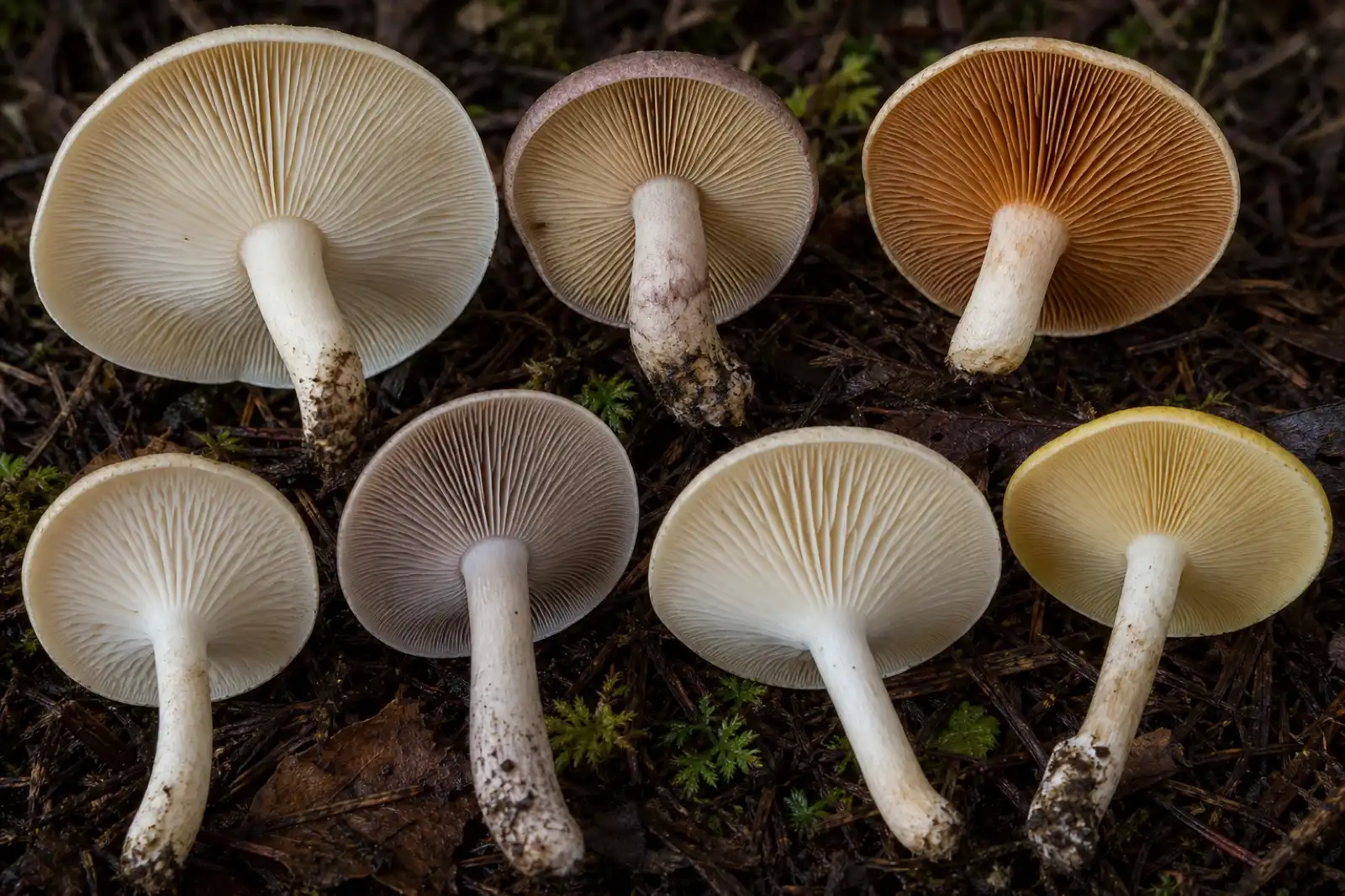
Mushroom Gill Types: Attachment, Spacing, and Color
Compare free, attached, notched, adnate, and decurrent mushroom gills while recording spacing, short gills, edge details, bruising, and color changes.
identification
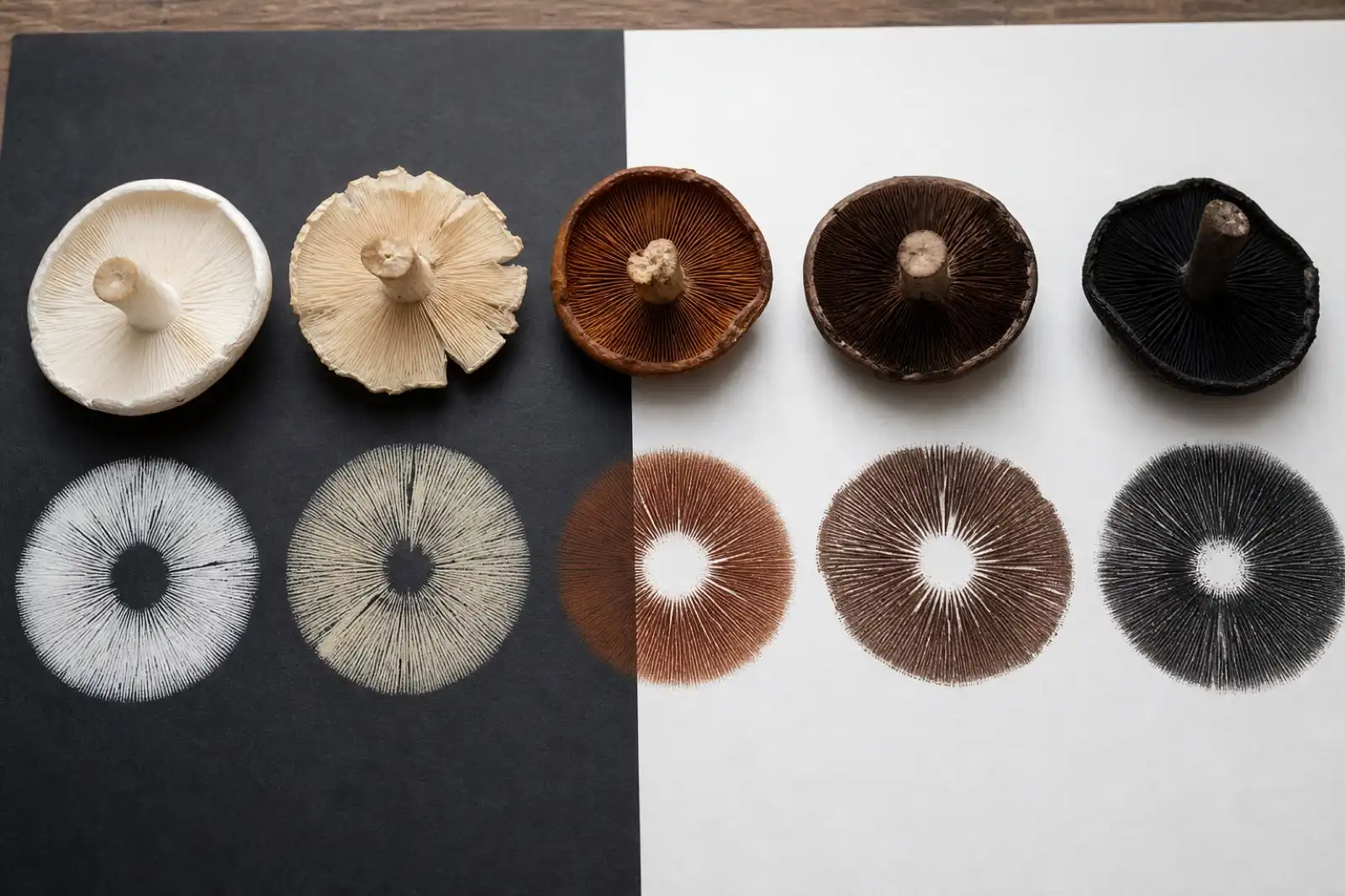
Mushroom Spore Print Colors and How to Record Them
Use a controlled spore deposit to distinguish broad color groups while recognizing that print color alone never identifies a species.
identification
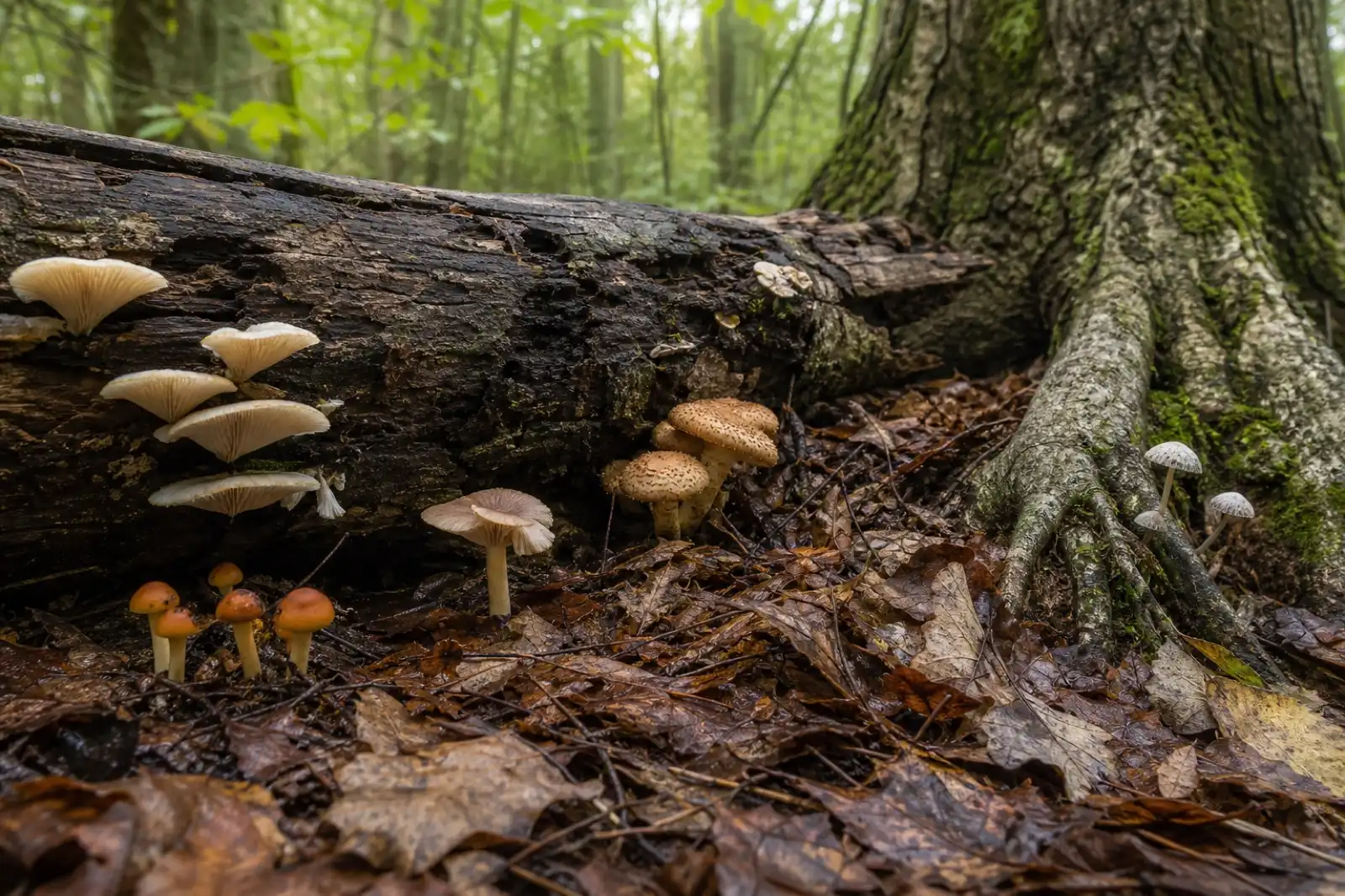
Using Habitat to Identify Mushrooms
Record substrate, associated plants, soil, wood type, moisture, elevation, and fruiting pattern as identification evidence.
Continue exploring
Browse more practical guides in Mushroom Encyclopedia or visit the mushroom encyclopedia.