Mushroom Encyclopedia
Jelly Ear Fungus: Wood, Texture, Lookalikes, and Safety
Document jelly ear fungus by elastic brown lobes, elder wood, wet-dry change, attachment, regional names, lookalikes, food boundaries, and specimen records.
By MushroomScope Editorial Team · · Updated
Species context
Treat profiles as reference material
Species profiles summarize documented traits, taxonomy, and lookalikes, but natural variation can be substantial.
Use the safety checklist →Decision limit
A profile cannot authenticate a specimen
Do not eat a wild mushroom from an online match, single feature, or generated image.
Read the safety disclaimer →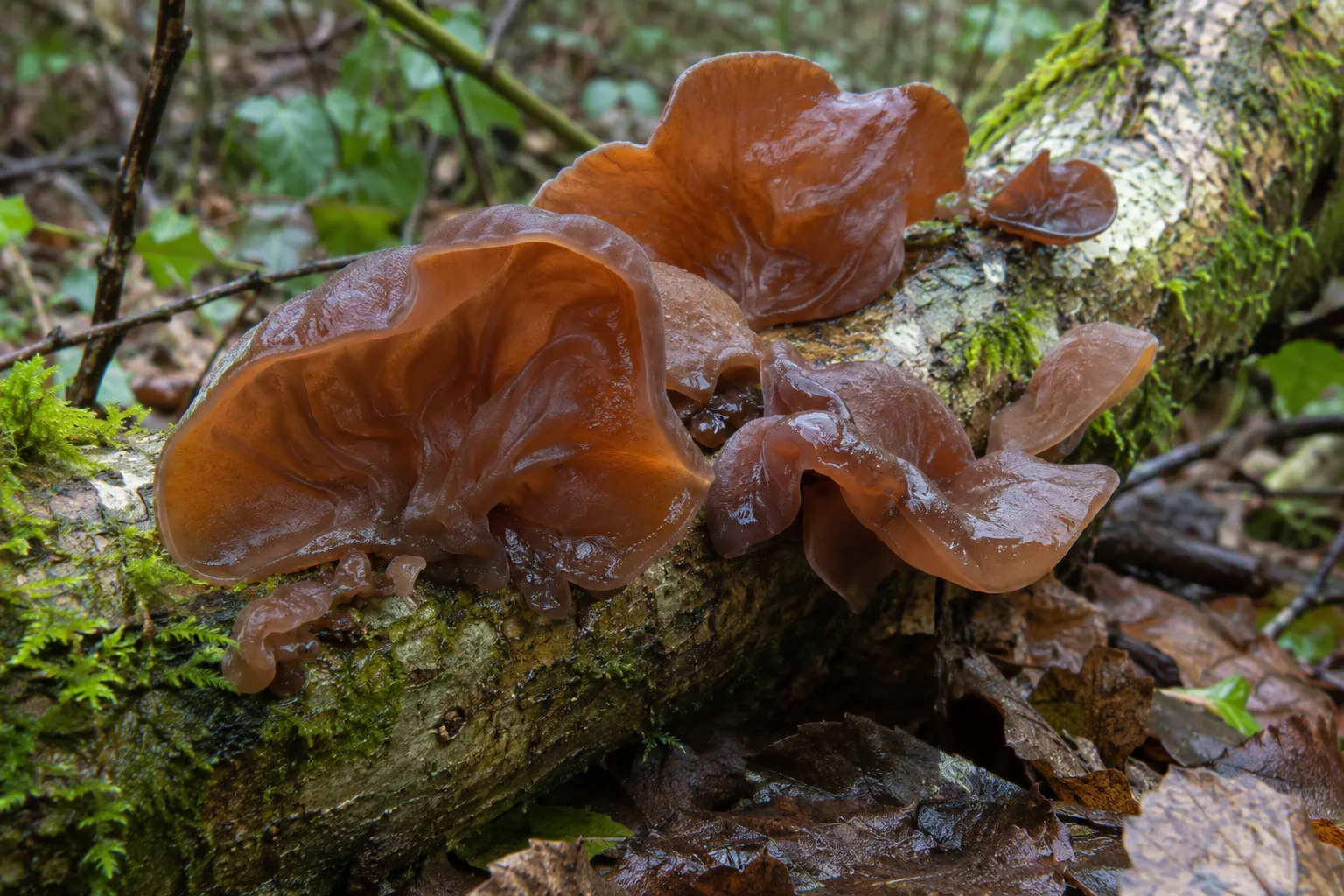
Quick facts
- Scientific name
- Auricularia auricula-judae
- Common names
- jelly ear, wood ear, elder ear
- Taxonomy
- Auricularia · Auriculariaceae
- Edibility context
- Conditional: Auricularia has culinary use, but species identity, product provenance, pollution, spoilage, preparation, and individual reactions remain separate safety questions.
- Spore print
- White, although a print alone does not separate related Auricularia species.
- Toxicity context
- Low: No classic severe toxin syndrome is asserted for authenticated material; wild misidentification and contaminated or spoiled collections remain material risks.
- Season
- January, March, October, December
- Growing difficulty
- Moderate
- Regions
- Europe, temperate western Asia, introduced or historical records requiring current taxonomic review
Safety limit: These labels summarize documented context; they never authenticate a wild specimen. Cooking does not make a poisonous species safe.
Jelly ear is a shape-changing wood fungus, not a fixed brown icon. A rain-soaked fruit body can be broad, translucent, elastic, and strongly ear-like; the same lobe after several dry days may become dark, thin, curled, and almost horny. A useful field record follows that change and anchors it to a host, region, and exact point of attachment.
The name also needs care. Auricularia auricula-judae is strongly associated with elder in European literature, while “wood ear” can refer to several related species in field guides, food markets, and cultivation. This page owns the field-documentation intent for the elder-associated species concept. The separate wood ear guide explains the broader culinary and cultivation label.
Begin with the whole branch and host
Photograph the branch before moving a fruit body. Include bark, buds or leaves when present, branch diameter, whether the wood is fallen or still attached, and the condition of the surrounding shrub. Elder is a high-value clue in much of Europe, but it is not a password that turns every brown jelly into this species.
Host claims should be graded. A branch connected to a recognizable plant offers stronger evidence than loose bark on the ground. If the wood cannot be named confidently, record it as unknown hardwood and preserve photographs. The habitat guide shows how to separate substrate observation from an unsupported host conclusion.
Record lobe architecture across a cluster
Measure several lobes rather than selecting the most ear-like specimen. Young growth may begin as small buttons or shallow folds. Mature lobes often develop an uneven cup or ear form, with a wavy margin and a smooth-to-wrinkled inner face. Adjacent lobes can merge visually, so trace each attachment to the wood.
Add a millimeter scale without pressing the tissue flat. Record maximum width, thickness at the margin and base, and whether the fruit bodies arise singly, in rows, or as overlapping groups. Shape varies with available bark surface and hydration; a single dramatic profile is not the population.
Compare the two surfaces
The inner fertile surface tends to look smoother, while the outward face may be finely textured. Macro side light can reveal those differences without the glare produced by a direct flash. Photograph both faces and the margin in the same hydration state.
There are no true gills, teeth, or pores. Grooves made by folding should not be described as gills. If the underside is never shown, the record cannot exclude many cup-shaped or gelatinous fungi whose upper view is similar.
Treat texture as a measured character
“Rubbery” can mean different things to different observers. With clean gloves or a tool, note whether a small lawful voucher bends without cracking, stretches, tears, rebounds, or collapses under its own weight. Do not taste it. Old material may become soft from decay rather than properly gelatinous from hydration.
Cut one voucher through the attachment. Record thickness, internal color, layering, insects, odor at normal working distance, and any watery exudate. A clean cross-section helps separate a naturally thin lobe from a partly decomposed mass.
Follow one fruit body through wet and dry conditions
Use bark cracks as fixed landmarks and photograph the same numbered lobe before rain, after rain, and during drying. Measure width and margin angle at consistent camera distance. The aim is not to prove a theatrical “revival,” but to document reversible expansion in the same tissue.
Do not substitute a neighboring fruit body at the second time point. New lobes and rehydrated old lobes answer different questions. Note temperature, rainfall source, and elapsed time without presenting one observation as a universal response curve.
Separate jelly ear from culinary trade names
Commercial wood ear may be sold dried, sliced, or under regional common names. Processing removes host and attachment evidence, while rehydration changes dimensions. A packet therefore needs label, producer, lot, origin, scientific name if supplied, and preparation instructions—not a comparison with a woodland photograph.
The cloud ear guide covers another cultivated-name context. Do not silently transfer nutrient values, clinical findings, or preparation advice between products identified only by an English common name.
Compare black and brown jelly fungi structurally
Species of Exidia may form dark buttons, cushions, spreading patches, or convoluted masses on wood. Some become ear-like at a glance, especially when partly dry. Compare attachment width, lobe thickness, surface ornament, host, spore form, and whether separate fruit bodies merge into a continuous mass.
Color is weak by itself. Wet tissue can look amber in transmitted light and nearly black against bark; camera exposure can exaggerate both. Preserve raw images or neutral edits so the record does not manufacture a taxonomic difference.
Exclude cup fungi and leathery brackets
Brown cup fungi may offer a smooth interior and wavy rim but often have a different, more brittle flesh and an attachment arising from soil, litter, burned ground, or wood. Thin leathery brackets remain firm rather than swelling into elastic jelly. A cross-section and hydration record outperform a top-view resemblance.
For tiny pink-violet gelatinous cushions and irregular cups directly on hardwood, use the purple jellydisc guide. Its scale and microscopy pathway should not be merged with the larger ear-shaped Auricularia record.
When the candidate remains ambiguous, use a regional key and microscopy. Spore dimensions, basidial structure, hairs, tissue organization, and modern sequence evidence may be necessary among related Auricularia names.
Interpret distribution records cautiously
GBIF is useful for mapping occurrence records, not for declaring that every record represents a current accepted concept. Older names, broad historical identifications, cultivated occurrences, georeferencing errors, and taxonomic revisions can enlarge an apparent range.
Record the source and date for the name you use. Outside the best-documented European elder-associated context, consider whether a regional Auricularia treatment recognizes a different species. “Worldwide” should trigger more checking, not less.
Keep food use separate from field identification
Authenticated wood-ear mushrooms have established culinary uses, but that does not validate a wild collection. Pollution beside roads, treated timber, animal waste, decomposition, mixed species, and individual allergy or intolerance are separate from the species question.
This page cannot confirm edibility from an image. A first-time wild food decision belongs with a knowledgeable local expert who can examine complete material. When using a commercial product, follow its storage and cooking directions and discard packages with spoilage, damage, or recall concerns.
Avoid unsupported medicinal conclusions
Laboratory studies of polysaccharides or extracts do not show that a home-prepared fruit body treats disease. Species, strain, extraction, dose, comparator, outcome, and human evidence all matter. A result from one authenticated preparation cannot be transferred to an unidentified woodland lobe or supplement label.
No named clinician, dietitian, or mycologist reviewed this article. Its review status is editorial. The source list supports taxonomy, field characters, and conservative poisoning response; it is not evidence of personal medical benefit.
Build a reproducible field record
- Photograph the complete colony and host before disturbance.
- Add a scale to several lobes and their attachments.
- Capture inner and outer surfaces with side light.
- Record weather and hydration state.
- Photograph a clean cross-section of a minimal lawful voucher.
- Note region, date, host confidence, and wood condition.
- Preserve microscopy or sequence data under the same collection number.
The general identification workflow helps keep observations, comparisons, and conclusions in separate fields.
Respond conservatively to illness
If illness follows consumption of a wild fungus, contact local emergency or poison-control services promptly. Retain photographs, leftovers, packaging, cooking details, amounts, and timing. Do not wait for an online name or induce vomiting unless a medical professional directs it.
NAMA’s syndrome material supports communication and urgency, not diagnosis from this page. Any persistent or severe symptoms need qualified medical assessment.
Image and evidence limits
The cover is an original 1536×1024 RGB AI editorial image. It was checked against two site reference covers for natural light, woodland material, restrained color, depth of field, clear attachment, complete lobes, sharpness, and absence of text, logos, watermarks, stretching, and obvious malformed anatomy. It depicts plausible habitat context, not a collected voucher.
GBIF and NCBI support name and lineage checkpoints. First Nature supplies a regional field account, and NAMA supports conservative poisoning communication. None can turn the illustration or a reader’s photograph into a verified identification.
References
Separate observation confidence from name confidence
A field notebook benefits from two confidence fields. Observation confidence asks whether the photograph and notes clearly show brown gelatinous lobes, direct wood attachment, hydration state, and a defensible host. Name confidence asks whether those characters, region, microscopy, and current literature justify A. auricula-judae rather than another Auricularia. A strong observation can support a cautious genus-level record even when a species name remains unresolved.
Revisit the record after a regional specialist or collection database supplies better evidence. Keep the original wording and add a dated determination note instead of rewriting history. That audit trail makes a corrected record more valuable than an early confident guess, especially where common names and older species concepts overlap.
Audit mixed colonies before collecting
A wet elder branch may carry several gelatinous fungi, crusts, molds, algae, and decomposing lobes at once. Number each visually separate patch before removing anything. Compare color, thickness, attachment width, outer texture, and drying response between patches rather than pooling them into one bag. If two forms remain different after hydration is standardized, preserve them as separate vouchers and determinations.
Mixed material is especially important for food safety and sequence work. A clean sequence from one fragment cannot authenticate every lobe in a basket, and a familiar ear shape does not make neighboring jelly tissue equivalent. Photograph the exact sampled point, sterilize tools between vouchers, and keep labels physically separate through drying and microscopy. This chain of evidence supports later correction without suggesting that a website can authorize consumption.
See the linked GBIF, NCBI, First Nature, and NAMA sources listed above.
Source quality notes
MushroomScope cites sources that match the page scope, such as taxonomic databases, extension guidance, food-safety agencies, food-composition databases, and peer-reviewed or institutional health references. Sources support context and uncertainty; they do not turn an online page into specimen identification, medical advice, or a tested recipe record.
Frequently asked questions
Why does jelly ear change shape after rain?
Its gelatinous tissue absorbs water and expands into flexible lobes; drying makes the same fruit body thinner, darker, firmer, and more curled.
Does jelly ear grow only on elder?
Elder is an important host in its best-known European concept, but records occur on other wood. Host, region, attachment, and microscopic evidence must be considered together.
Is jelly ear the same as culinary wood ear?
The names overlap in trade and conversation, but several Auricularia species enter food markets. Preserve the scientific name and product provenance instead of treating every brown ear as one species.
Can a photograph confirm jelly ear fungus?
No. A photograph can document shape and substrate, but a defensible identification also needs region, host, attachment, texture, development, and sometimes microscopic or sequence evidence.
Can wild jelly ear be eaten?
This page does not verify a wild collection for food. Use traceable commercial products, or obtain local expert confirmation and assess contamination, condition, and individual tolerance.
Related guides
mushrooms
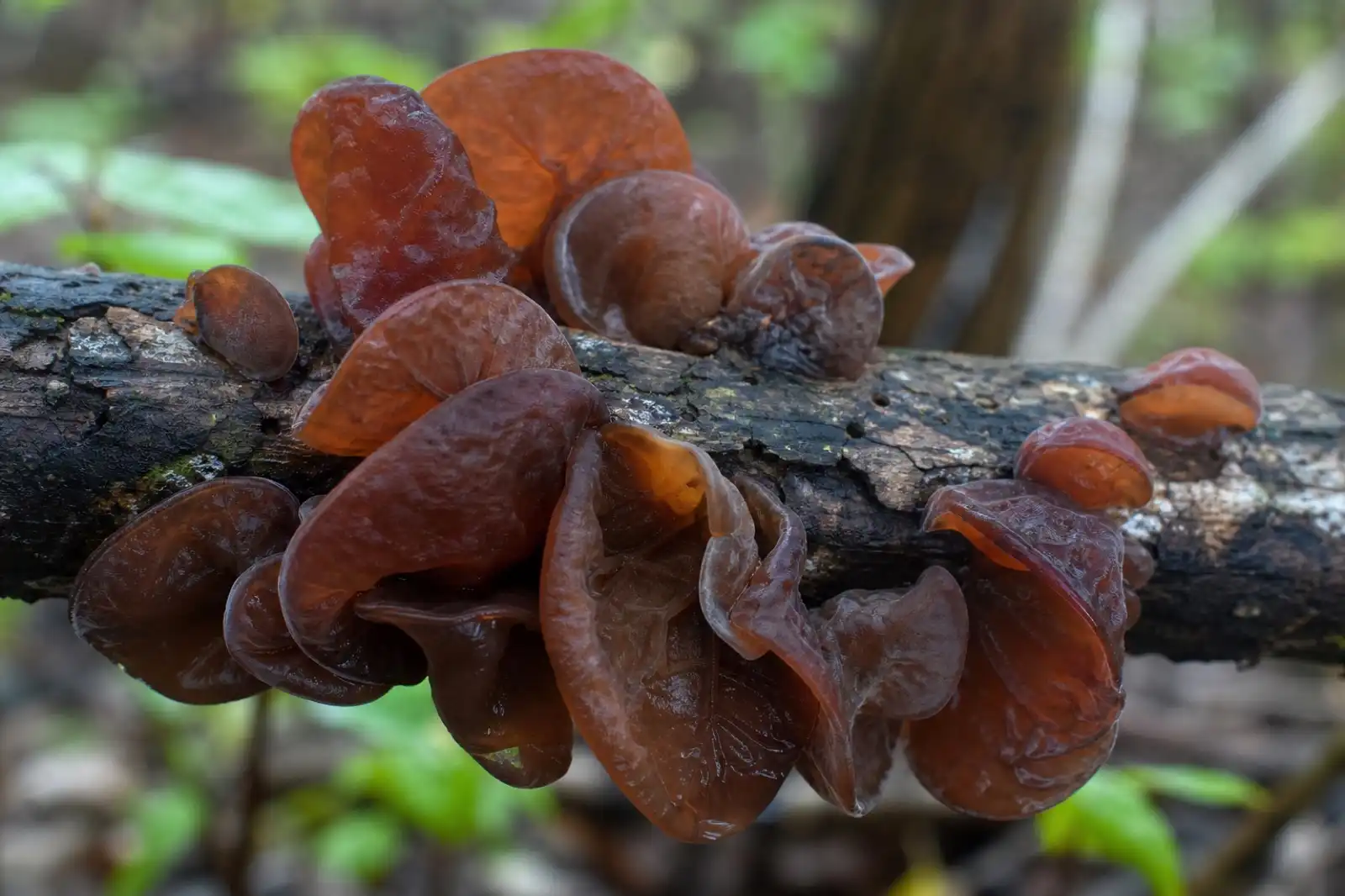
Auricularia heimuer: Wood Ear Mushroom Species Guide
A practical guide to Auricularia heimuer identification, wood-decay ecology, log and bag cultivation, nutrition, rehydration safety, and FAQs.
mushrooms
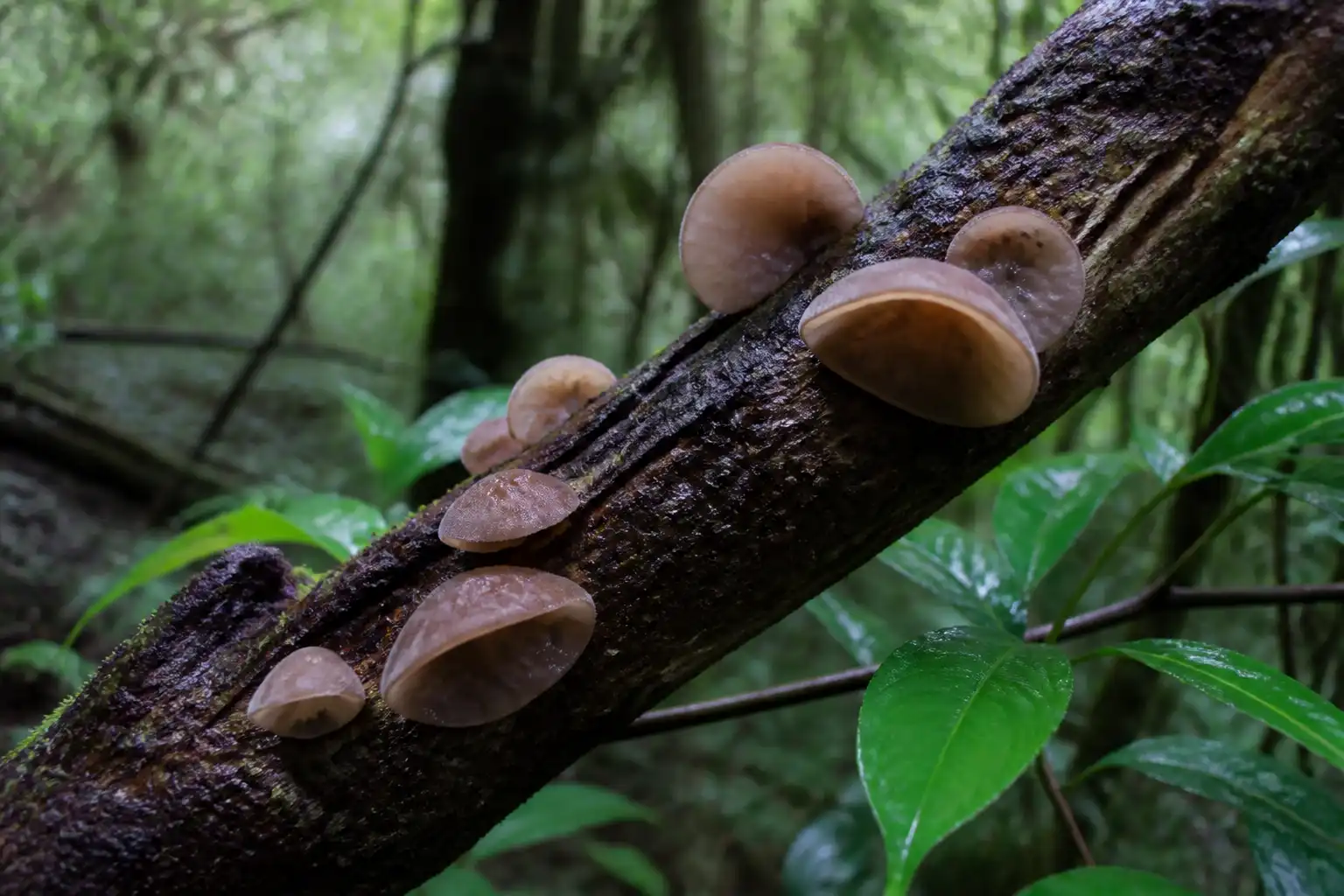
Cloud Ear Fungus: Auricularia cornea, Market Names, and Uses
Understand cloud ear through Auricularia cornea taxonomy, pale hairy fruit bodies, tropical hardwood ecology, market-name limits, cultivation, and cooking.
identification
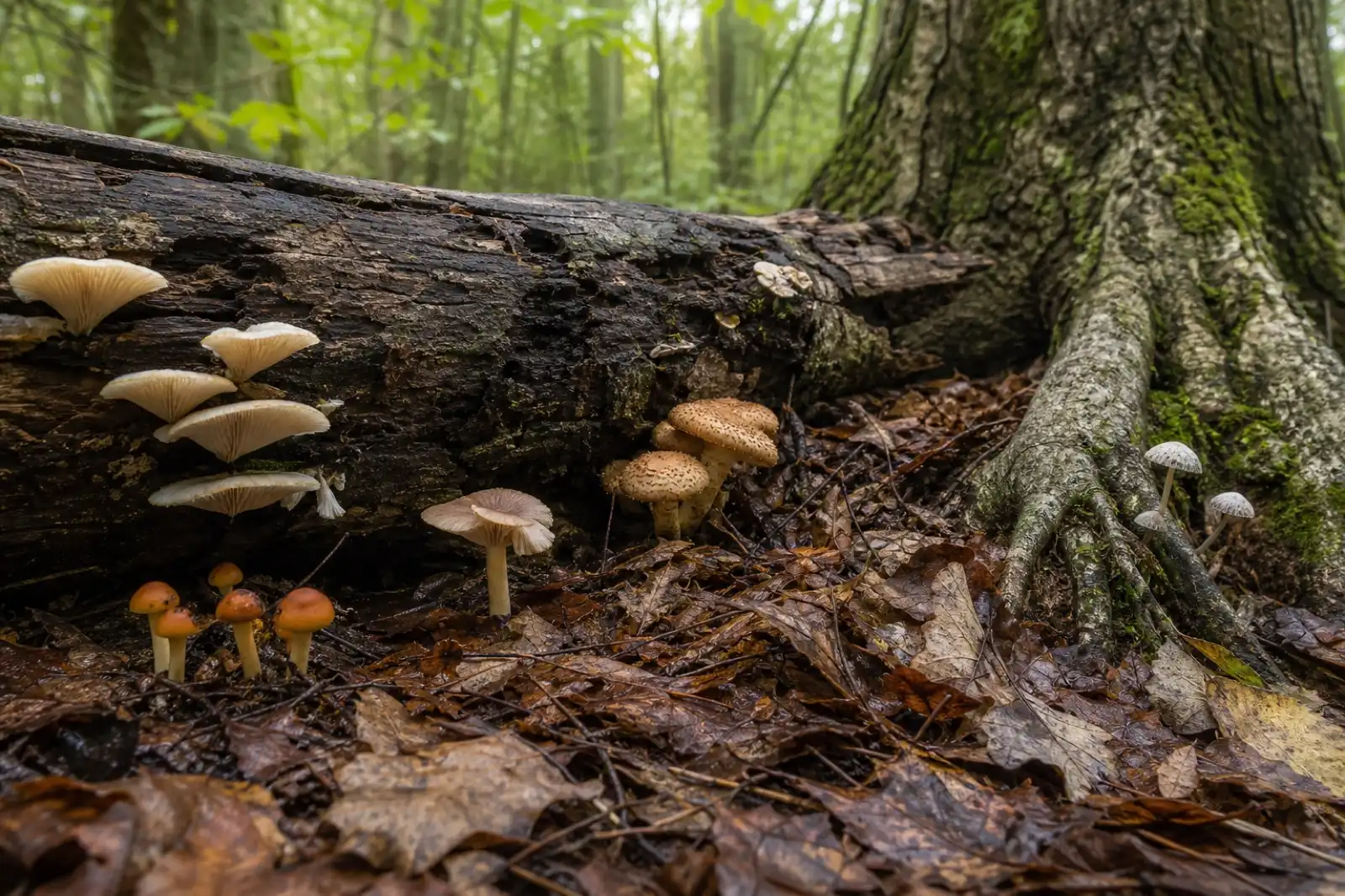
Using Habitat to Identify Mushrooms
Record substrate, associated plants, soil, wood type, moisture, elevation, and fruiting pattern as identification evidence.
Continue exploring
Browse more practical guides in Mushroom Encyclopedia or visit the mushroom encyclopedia.