Mushroom Encyclopedia
Larch Bolete: Suillus grevillei Field Guide
Document larch bolete through its sticky golden cap, yellow pores, ring zone, larch-root ecology, lookalikes, regional limits, and safe field records.
By MushroomScope Editorial Team · · Updated
Species context
Treat profiles as reference material
Species profiles summarize documented traits, taxonomy, and lookalikes, but natural variation can be substantial.
Use the safety checklist →Decision limit
A profile cannot authenticate a specimen
Do not eat a wild mushroom from an online match, single feature, or generated image.
Read the safety disclaimer →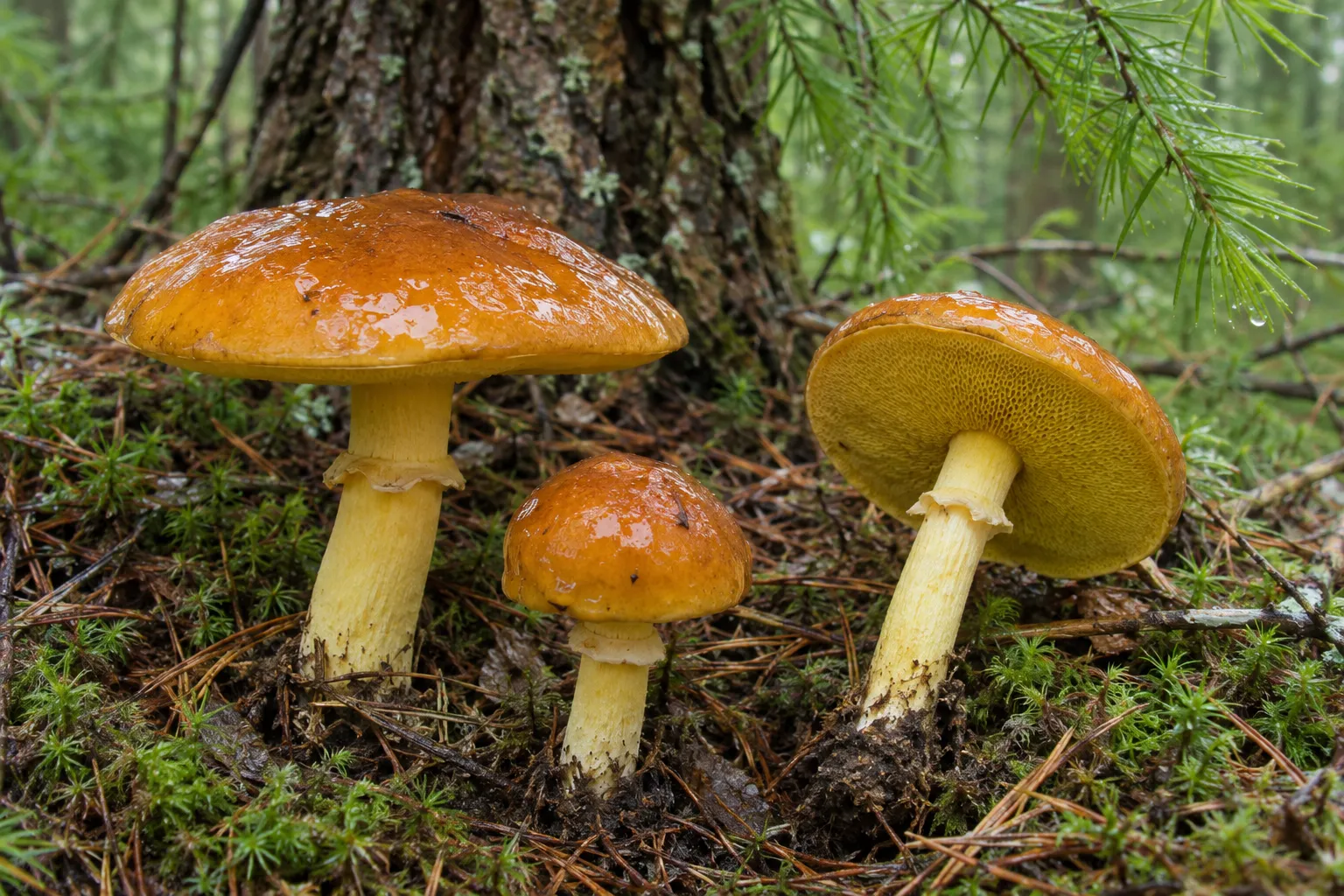
Quick facts
- Scientific name
- Suillus grevillei
- Common names
- Larch bolete, Greville's bolete
- Taxonomy
- Suillus · Suillaceae
- Edibility context
- Conditional: It has a regional culinary history, but this page does not approve any wild collection; identity, local rules, contamination, freshness, and individual sensitivity remain separate questions.
- Spore print
- Olive brown to cinnamon-olive.
- Toxicity context
- Low: Mistaken identity, gastrointestinal sensitivity, inadequate cooking, spoilage, and mixed collections remain material risks.
- Season
- June, July, August, September, October, November
- Growing difficulty
- Expert
- Regions
- Europe, temperate regions with native or planted Larix, parts of Asia represented by verified records
Safety limit: These labels summarize documented context; they never authenticate a wild specimen. Cooking does not make a poisonous species safe.
Larch bolete is best understood as a host-linked field hypothesis, not as a yellow mushroom found near a conifer. Suillus grevillei combines a wet-looking golden cap, yellow pores, a fragile partial veil, a yellowish stem with fine glandular dots, and a mycorrhizal relationship with Larix. Weather can erase the veil, darken the cap, or soften the pores, so a defensible record follows development and documents the trees as carefully as the fruit bodies.
This guide owns the species-level intent for S. grevillei. For the broader underside workflow, begin with the bolete identification guide. A photograph, including the editorial cover, cannot establish edibility or replace a regional key and complete specimen.
Confirm tubes and pores before reading color
Turn a mature cap far enough to see the underside. A larch bolete has vertical tubes ending in pores, not blade-like gills. Young pores are bright yellow and relatively small; with expansion they become more angular, wider, and duller. Photograph them untouched, then after one measured press, because handling marks can otherwise be mistaken for a natural pattern.
Describe the response by tissue and time. Record the pore color immediately, at thirty seconds, and at five minutes. Then section a second specimen through cap and stem and repeat the timing for flesh and tube layer. A vague note such as “bruised brown” loses the location and speed needed for comparison.
Follow the cap from yellow button to orange-brown adult
Young caps are convex and can be bright lemon-yellow or golden. Mature caps often deepen through orange-yellow to orange-brown. The skin is viscid in wet weather and may hold needles, soil, or grass. Surface water alone is not the same as an intrinsically gelatinous cap skin, so compare a rain-wet specimen with one that has drained under shelter for several minutes.
Measure the same cap during expansion if a monitored patch permits it. Note diameter, margin curvature, color under neutral light, and whether the skin peels. Do not increase saturation to match memory. A neutral gray reference and an unedited file make later review more useful than an attractive but processed photograph.
Cap color is supporting evidence, not a password. Yellow Suillus overlap, old fruit bodies darken, and a shaded cap may look olive. The host, pore layer, veil sequence, stem surface, spores, and regional species set must carry the record together.
Reconstruct the partial veil and ring zone
In a young fruit body, a pale to yellowish partial veil can cover the pores from cap margin to stem. As the cap expands, the veil tears and may leave material on the margin and a delicate ring or annular zone on the stem. Rain, slugs, handling, and age can remove most of it.
Photograph unopened buttons from the side without tearing them. On opened specimens, record whether the ring is membranous, collapsed, sticky, or reduced to a colored zone. Compare several stages in one colony. A single mature, ringless individual does not demonstrate that the species lacks a veil; conversely, the presence of any ring does not establish S. grevillei.
Use the ring sequence to separate developmental loss from a genuinely ringless taxon. Link every photo to a specimen number so the button, open cap, pore close-up, and section do not accidentally describe different mushrooms as one idealized individual.
Inspect glandular dots and the complete stem
The stem is commonly yellowish and may carry small glandular dots, especially toward the upper portion. These dots are produced by secretions and can become more noticeable with age. Soil splash, insect marks, and camera sharpening can imitate them, so inspect the clean surface under magnification rather than inferring dots from a distant frame.
Excavate one lawful representative with the base intact. Larch bolete has no volva. Record stem length and width at top, middle, and base; photograph each side; and note changes above and below the ring zone. A cut base discards evidence and prevents checking whether two close fruit bodies are truly separate.
Prove larch presence without guessing the host tree
The ecological anchor is Larix, but “under a conifer” is not specific enough. Larches bear needles in soft clusters on short shoots and are deciduous; pines, spruces, firs, and cedars differ in needle attachment and cone characters. Photograph twigs, bark, the full tree, and the fruiting position. If the tree identification is uncertain, record that uncertainty.
Roots cross paths, especially in parks and mixed plantations. Map every plausible tree within the patch, its distance and direction, and whether buried wood or moved soil is present. The nearest trunk may not own the roots beneath the mushroom. Repeat fruiting around a confirmed larch over several seasons is stronger host evidence than one cap beside one trunk.
The habitat identification guide separates observed substrate from inferred biological partner. Write “fruiting from moss over soil, 2.4 m east of a verified European larch” rather than “growing on larch.” The fungus is associated with living roots; the fruit body is not normally decomposing the visible trunk.
Treat the grevillei complex as a regional question
Recent phylogenetic work shows that names around the Suillus grevillei complex require geographic care. Darker reddish-brown collections, particularly in eastern Eurasia and North America, may involve S. clintonianus or another interpretation rather than a broad color variant automatically folded into European S. grevillei.
Preserve locality, host identity, cap color before handling, veil material, spore deposit, microscopy, and a dried voucher when lawful. If a record lies outside the well-supported range or carries atypical colors, stop at Suillus or the complex until an appropriate regional authority resolves it. A global occurrence map is a research lead, not proof that every plotted name uses the same modern concept.
Separate larch bolete from three practical lookalikes
The slippery jack guide covers Suillus luteus, another ringed, viscid bolete. Its cap is generally darker brown and it is associated with pines. When caps fade or become rain-soaked, verify the tree, veil, pore color, stem glandular pattern, and local key rather than relying on brown versus yellow.
Suillus viscidus also belongs with larch and therefore defeats a host-only identification. It tends toward gray, gray-brown, or olive-brown caps and has its own veil and pore development. Record a series rather than selecting the brightest individual from a mixed patch.
The S. grevillei–S. clintonianus boundary is not a simple field-color binary. Dark red-brown caps can be informative, but modern studies also compare microscopy and multiple genetic regions. Where the distinction matters, retain evidence appropriate to that question instead of forcing a photograph into a familiar name.
Make a spore record that stays tied to the specimen
Choose a mature but not collapsing cap. Place it over light and dark nonabsorbent surfaces, cover against drafts, and label the setup with the specimen code. The expected deposit is olive-brown to cinnamon-olive. A failed print is not a white print, and color seen through wet paper is not a reliable deposit.
Microscopy can document spore size and shape, but report the mounting medium, calibration, number measured, and range rather than copying one value from a guide. Retain a portion of the deposit with the dried material. Measurements from a second collection should not be silently attached to the first.
Build a repeatable larch-root-zone survey
Mark a modest plot around one verified larch without damaging roots. On each visit, record rainfall, minimum temperature, soil-surface condition, fruit-body count, developmental stages, and distances from the trunk. Photograph from fixed positions. This can reveal whether caps recur along one root corridor or after a particular weather sequence.
Separate detection from absence. No visible mushrooms on a dry visit does not mean the underground mycelium is absent. Likewise, many caps in one wet week do not establish a permanent abundance trend. A multi-year series with unchanged search effort is more useful than opportunistic totals.
Where collecting is restricted, measurements and photographs may be the appropriate endpoint. Follow landowner rules and local conservation guidance. Do not strip a small colony to create a complete age series; one representative specimen plus in-place documentation can answer most routine questions.
Keep food history behind a firm safety boundary
Larch bolete is reported as edible in parts of its range, often with the slimy cap skin removed and the mushroom cooked. That history does not clear a modern collection. Species identity, regional lookalikes, spoilage, roadside or treated-soil contamination, allergies, and gastrointestinal sensitivity are separate decisions.
Online image agreement is not qualified local confirmation. If verified mushrooms are used as food, keep the first portion small, cook thoroughly, and never serve an uncertain or mixed collection. If illness follows mushroom consumption, contact local poison or emergency services promptly and preserve uncooked material, trimmings, photographs, locality, and meal timing.
Frequently asked questions in context
Why is the cover image not identification evidence?
It is an original AI editorial image designed to illustrate a recordable character set. It has no voucher, collection site, microscope slide, sequence, or independently verified host. Use it to plan photographs, not to match a meal.
Can larch bolete grow on a stump?
Fruit bodies normally emerge from soil in a living larch root zone. A cap beside a stump may arise from soil or roots beneath debris; document the attachment before claiming a wood substrate.
Can it be grown on a sawdust block?
Not by the ordinary method used for saprotrophic oyster mushrooms. Its mycorrhizal partnership with living larch roots makes a simple indoor block recipe biologically mismatched.
References
- Global Biodiversity Information Facility. Suillus grevillei taxon record. Nomenclature, classification, and occurrence context.
- Wu et al. A subgeneric revision of Suillus. Morphological and multigene context for the genus and larch-associated collections.
- Zhang et al. Cryptic diversity within the Suillus grevillei complex. Geographic and evidence limits around S. grevillei and S. clintonianus.
- North American Mycological Association. Mushroom Poisoning Syndromes. Conservative poisoning-response context.
Editorial review: November 25, 2026. This article has editorial review only and no named mycologist or clinician review. Taxonomy, regional range, host evidence, and poison-response contacts should be rechecked at every substantive update.
Source quality notes
MushroomScope cites sources that match the page scope, such as taxonomic databases, extension guidance, food-safety agencies, food-composition databases, and peer-reviewed or institutional health references. Sources support context and uncertainty; they do not turn an online page into specimen identification, medical advice, or a tested recipe record.
Frequently asked questions
What features support a larch bolete record?
Use the sticky yellow-to-orange cap, yellow pores, partial-veil remnants or ring zone, pale yellow stem, soil-fruiting habit, and a documented larch root zone together. No one feature proves the species.
Must larch bolete grow beside a larch tree?
The species is mycorrhizal with larches, but the nearest trunk is not automatically the partner. Map all plausible trees and roots, and verify that the tree is Larix rather than another conifer.
How does larch bolete differ from slippery jack?
Slippery jack usually has a darker brown cap and is commonly associated with pine, while larch bolete is typically golden-yellow to orange and linked with larch. Veil, pore, stem, host, and regional characters all need comparison.
Does a sticky yellow cap prove Suillus grevillei?
No. Several Suillus species can be yellow and viscid. The pore surface, veil development, stem markings, host, geography, and mature stages must agree.
Can this guide confirm that a larch bolete is edible?
No. A webpage or image cannot authenticate a wild specimen, exclude lookalikes, assess spoilage, or predict an individual reaction. Seek qualified local confirmation for any food decision.
Related guides
identification
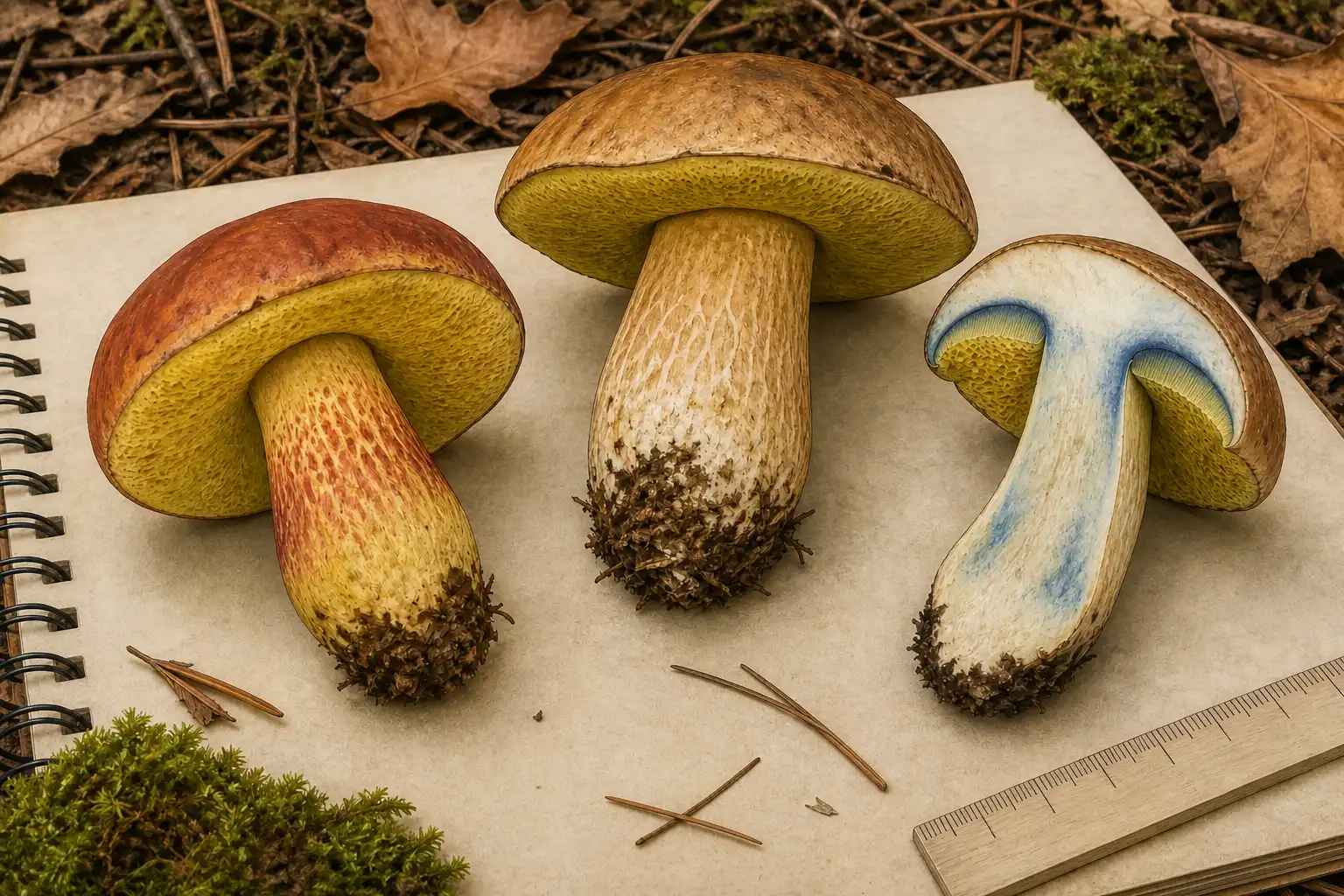
Bolete Identification: Pores, Staining, and Lookalikes
Learn how to document a bolete's pores, flesh staining, stem, habitat, and lookalikes without treating any one feature as an edibility test.
mushrooms
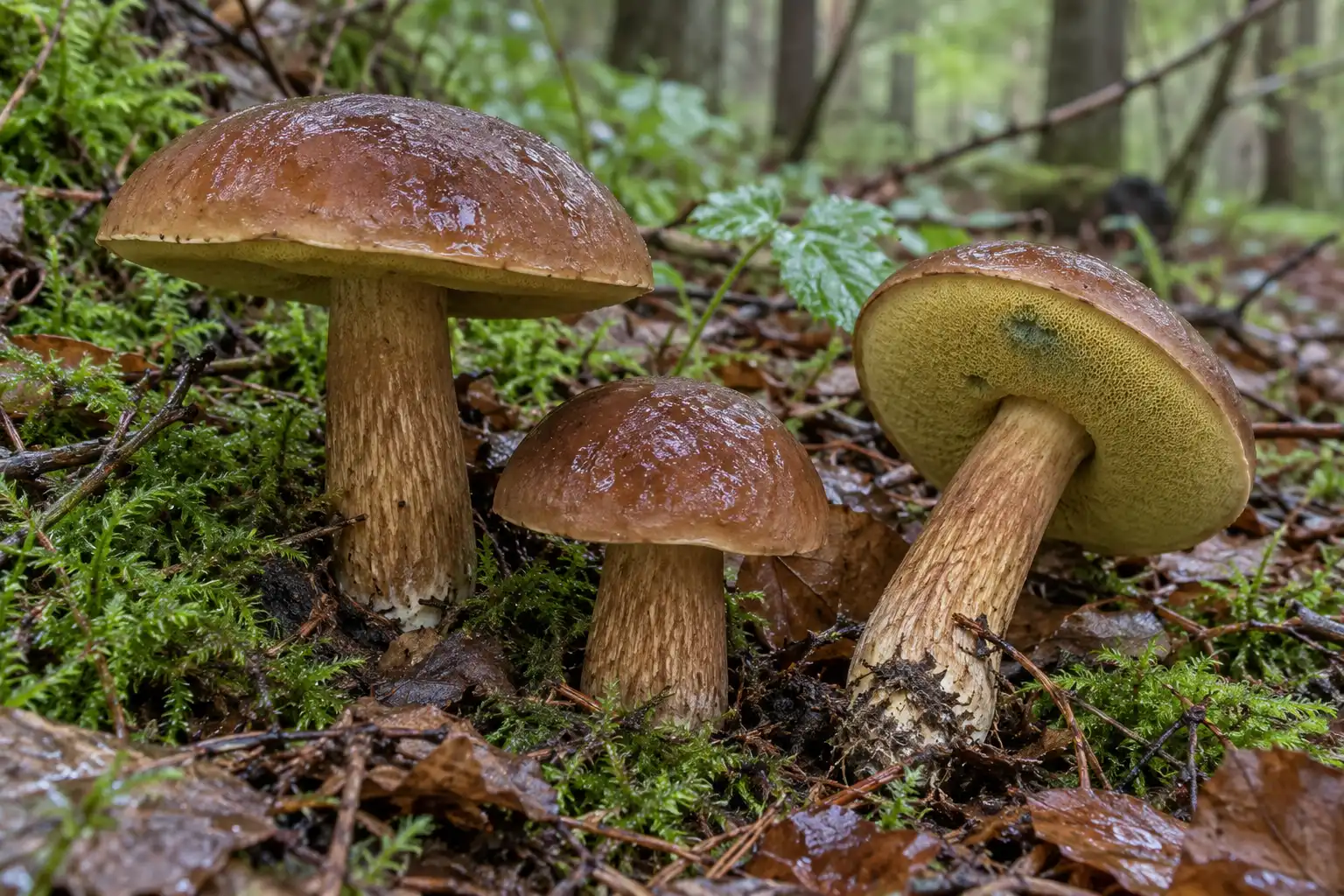
Bay Bolete: Imleria badia Identification and Ecology Guide
Document bay boletes through chestnut caps, yellow pores, measured blue bruising, stem texture, woodland hosts, lookalikes, and food-safety limits.
mushrooms
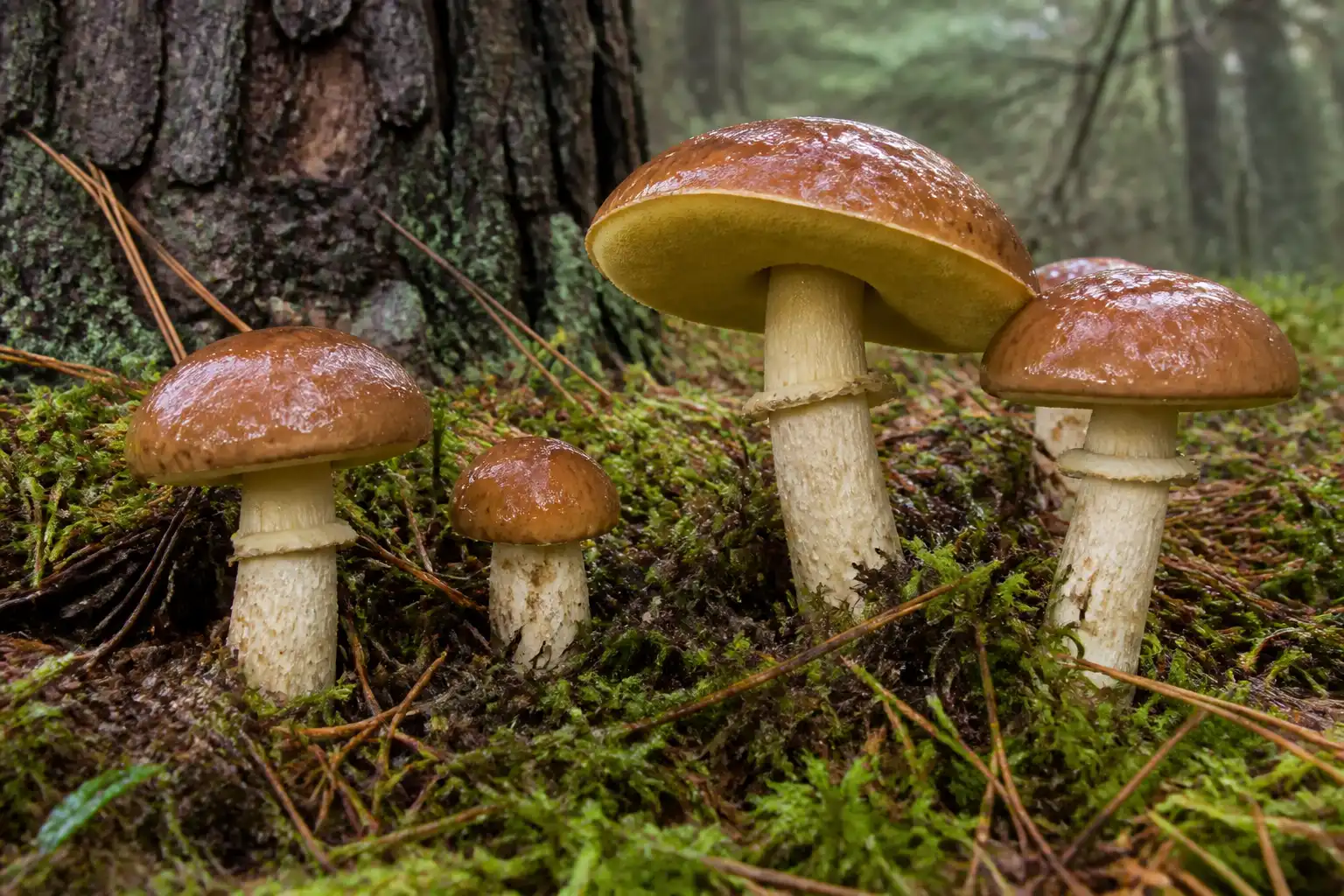
Slippery Jack: Viscid Cap, Pine Partnership, and Safety
Recognize slippery jack by its viscid brown cap, yellow pores and ring, while documenting pine ecology, lookalikes, handling limits, and food safety.
Continue exploring
Browse more practical guides in Mushroom Encyclopedia or visit the mushroom encyclopedia.