Mushroom Encyclopedia
Bay Bolete: Imleria badia Identification and Ecology Guide
Document bay boletes through chestnut caps, yellow pores, measured blue bruising, stem texture, woodland hosts, lookalikes, and food-safety limits.
By MushroomScope Editorial Team · · Updated
Species context
Treat profiles as reference material
Species profiles summarize documented traits, taxonomy, and lookalikes, but natural variation can be substantial.
Use the safety checklist →Decision limit
A profile cannot authenticate a specimen
Do not eat a wild mushroom from an online match, single feature, or generated image.
Read the safety disclaimer →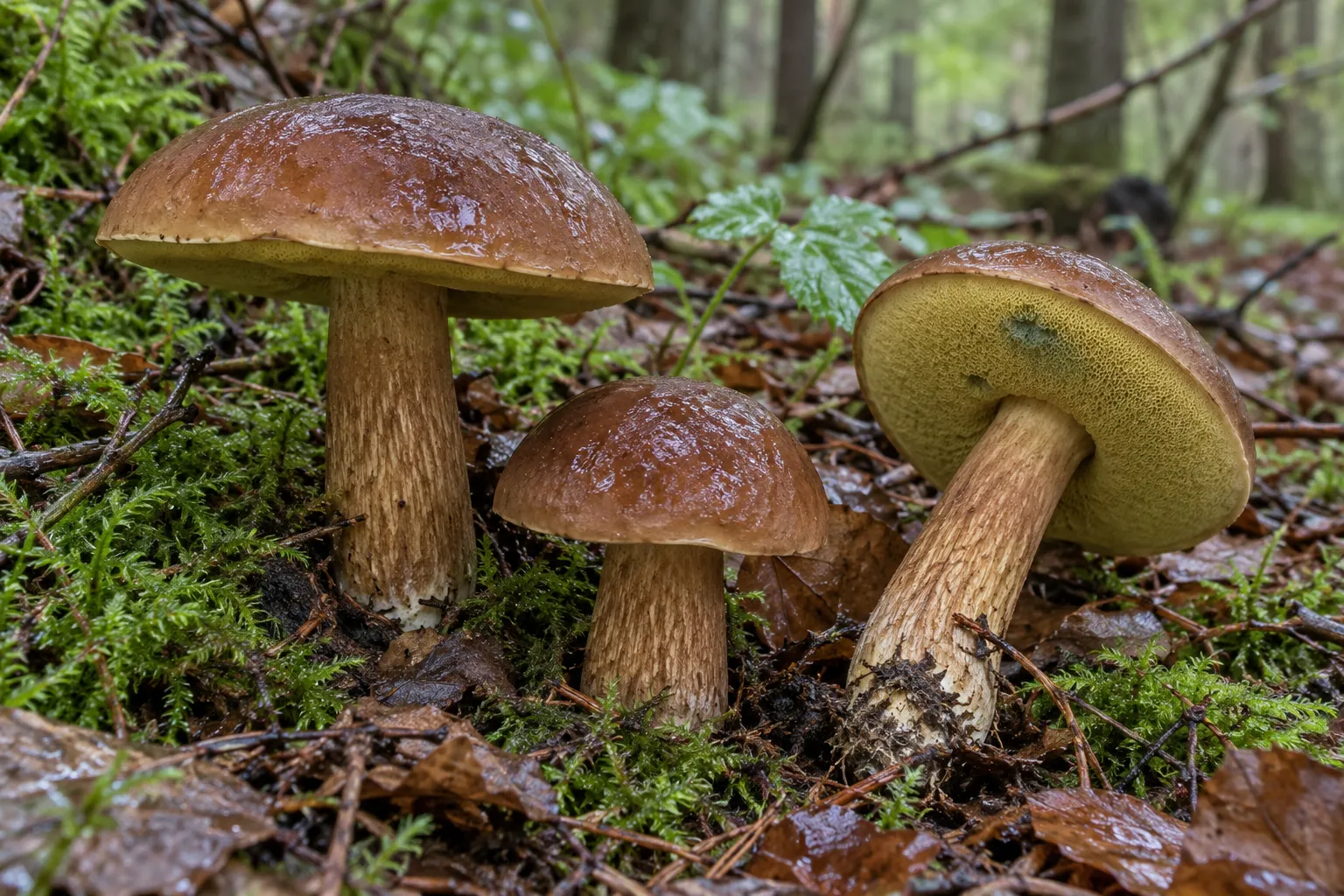
Quick facts
- Scientific name
- Imleria badia
- Common names
- Bay bolete, Bay-brown bolete
- Taxonomy
- Imleria · Boletaceae
- Edibility context
- Conditional: Has a regional culinary history after expert identification and thorough cooking; this page does not clear any wild specimen for consumption.
- Spore print
- Olive brown.
- Toxicity context
- Low: Identification error, spoilage, contamination, individual reactions, and unsuitable regional lookalikes remain material risks.
- Season
- July, August, September, October, November
- Growing difficulty
- Expert
- Regions
- Europe, temperate Asia, other regions represented by verified records
Safety limit: These labels summarize documented context; they never authenticate a wild specimen. Cooking does not make a poisonous species safe.
Bay bolete is a useful lesson in why a familiar brown cap and blue bruise cannot carry an identification. Imleria badia combines a chestnut-bay cap, yellow-to-olive pores, a brownish fibrous stem, olive-brown spores, woodland soil ecology, and bruising that varies with age and moisture. Each character is informative; none is exclusive.
This guide treats the name as a documented hypothesis rather than a meal recommendation. Start with the bolete identification workflow, preserve the complete base, and compare the collection with a current regional key. An editorial image can show what to photograph, but it is not a field voucher and cannot resolve local species boundaries.
Confirm a pore layer before using bolete comparisons
Turn a mature cap far enough to view the underside. Bay boletes have a removable layer of vertical tubes whose openings appear as many small pores. They do not have blade-like gills. Young pores are yellow; mature pores become duller olive-yellow. The tubes may be depressed around the stem, but attachment varies with expansion.
Photograph the pore surface in neutral light before touching it. Then press one defined spot and record the first change at 30 seconds, two minutes, and ten minutes. A blue-green mark may develop, but weak or absent change does not automatically contradict the species. Dryness, age, temperature, pressure, and tissue condition affect the response.
Read the chestnut cap as texture, not just color
The cap commonly ranges from warm chestnut to dark bay brown. It can look polished or slightly tacky after rain and drier or finely velvety later. Color shifts with wetness, age, camera processing, and reflected green woodland light. Record the fresh surface, whether debris adheres, and whether the skin peels or cracks rather than writing only “brown.”
Young caps are convex and expand toward broadly convex or nearly flat. Measure width and margin shape across several stages. A cap that has split during drought does not acquire the normal cracked pattern of another genus, and rain-darkened material should not be compared with a dry studio color chart.
Inspect the stem for fibers, netting, scabers, and a ring
The stem is usually tan to brown with longitudinal fibers or streaks. It lacks a ring and volva. It also generally lacks the prominent pale reticulation expected on the upper stem of many porcini, and it does not carry the dark raised scabers typical of Leccinum. Those negative observations are useful only when the surface is clean and in focus.
Excavate rather than cutting the base. Photograph all sides with scale because soil can conceal color zones, insect tunnels, or attached mycelium. Do not infer that a cleanly cut market specimen and an intact woodland collection provide equivalent evidence.
Time bruising instead of treating blue as a verdict
Blue staining in boletes results from chemical oxidation after cells are damaged, but many lineages can produce a blue response. Record the tissue tested—pores, tube layer, cap flesh, stem surface, or stem flesh—and keep the pressure and timing consistent. “It blues” discards most of the useful information.
Make a longitudinal section through cap and stem, photograph immediately, and repeat at fixed intervals. Bay bolete flesh may remain pale or show a modest change, while the pore surface can react more clearly. A violent, instant blue reaction throughout yellow flesh points toward a different comparison problem, not toward greater confidence.
Chemical reactions are supporting characters. They do not prove edibility and should never be interpreted as a toxin test. Avoid casual taste tests; bitterness, mild flavor, or lack of flavor cannot rule out a dangerous identification error.
Use an olive-brown spore deposit as supporting evidence
Place a mature cap over contrasting nonabsorbent surfaces and protect it from drafts. A useful deposit should be olive brown. Pale tubes do not imply pale spores, and a failed print supplies no positive result. Dry, immature, waterlogged, or insect-damaged caps may not release enough spores.
Record deposit color in daylight and retain a small sample with the collection code. Microscopy can add spore measurements and tissue characters, but measurements need calibrated equipment, the number measured, mounting medium, and length-by-width values. An isolated number copied from a guide is not an observation from the specimen.
Map woodland and potential hosts without inventing certainty
Imleria badia is mycorrhizal: its underground fungus exchanges resources with living plant roots. Fruit bodies therefore emerge from soil, moss, needle litter, or leaf litter rather than functioning as ordinary wood-decay brackets. Conifers are frequent associates, while broadleaf associations are also reported.
The nearest trunk is not necessarily the partner. Photograph the surrounding stand, list plausible tree species within the root zone, and note whether buried wood is present. Repeat visits can show whether fruiting tracks the same patch, host canopy, rainfall event, or disturbance edge. The habitat identification guide explains how to separate substrate observation from host inference.
Database points need the same caution. An occurrence can be old, broadly georeferenced, misidentified, or published under a former name. Read the underlying record before using a map pin to claim a country, elevation, or host association.
Phenology is another useful constraint. Record the first and last fruiting dates at a marked patch, recent rainfall, minimum temperatures, canopy condition, and whether the same host zone fruits again. One unusually early cap does not redefine a regional season, while a sequence of voucher-backed observations can reveal a local weather response. Keep absence data modest: failing to see mushrooms during one visit is not proof that the underground fungus or host association is absent.
Where collection pressure is a concern, measurements and photographs may supply enough evidence for a preliminary record without removing the entire flush. Follow landowner rules and local conservation guidance, retain only the minimum lawful material needed for confirmation, and avoid publishing precise coordinates for a vulnerable population.
Keep the current name linked to older literature
Bay bolete has appeared in older sources as Boletus badius and Xerocomus badius. Current databases commonly use Imleria badia. Preserve the name used by each source and collection rather than silently rewriting historical records. A name change can reflect a new genus placement without implying that old photographs or descriptions became useless.
For a defensible record, write the accepted name, original label, identifier, date, locality precision, and evidence type. When regional literature recognizes a species complex or a similar local taxon, stop at the most supportable level instead of expanding a European name worldwide.
Separate bay bolete from porcini and cracked-cap boletes
Porcini in the Boletus edulis complex are commonly more robust, may have a club-shaped stem with conspicuous pale netting, and generally lack blue-staining flesh. Bay bolete often has a slimmer brownish stem without that strong net. These are comparison tendencies, not a two-item field test; mature pores, weather, and regional species complicate both groups.
Many Xerocomellus and related boletes can bruise blue. Their caps may crack to expose red or pale tissue, stems may show red zones, and sectioned flesh may develop patterned color changes. Photograph fissures before deciding whether they are intrinsic or simply drought damage.
Bitter bolete can mimic a brown, pale-pored bolete when young. Its pores mature pinkish and a coarse dark net can mark the stem. Do not use a nibble as the deciding test. The porcini guide provides a separate robust-stem comparison, while this page keeps the bay-bolete hypothesis tied to its complete character set.
Build a collection record that survives review
- Photograph the undisturbed group, ground surface, and surrounding trees.
- Excavate one permitted specimen with the complete stem base.
- Record cap width, stem dimensions, surface moisture, and developmental stage.
- Photograph pores before and after a timed pressure test.
- Section one specimen and record tissue changes at fixed intervals.
- Make a mature spore deposit and link it to the same specimen code.
- Compare with a current regional key and, where needed, microscopy or DNA.
Keep each observation attached to one fruit body. Combining the cap of one mushroom, bruise of another, and stem of a third creates an imaginary specimen. A useful series shows how characters vary while locality and substrate remain constant.
Keep culinary history behind an identification boundary
Bay bolete has a culinary history in parts of Europe, but a common name cannot clear a collection. Identity, local lookalikes, freshness, pollution, legal access, individual allergy, and cooking are separate decisions. Older fruit bodies can be waterlogged, insect-damaged, or microbially spoiled even when the name is correct.
Only commercially sourced or independently confirmed material belongs in a food workflow. Refrigerate promptly, discard spoiled specimens, and cook thoroughly. Do not serve a first wild collection to other people or use online agreement as expert confirmation. If illness follows mushroom consumption, contact local emergency or poison services promptly and retain uncooked material, trimmings, photographs, and meal timing.
Frequently asked questions in context
Why is the cap sometimes very shiny?
Rain can make the smooth cap tacky and reflective. That texture supports the record but is not diagnostic because many boletes darken or shine when wet.
Should every blue-staining bolete be avoided?
Blue staining is an identification character, not a direct edibility or toxicity meter. It can occur in edible, inedible, and toxic boletes, so the complete regional identification still governs safety.
Can bay boletes be cultivated on sawdust blocks?
They are mycorrhizal rather than ordinary saprotrophic crop mushrooms. Their living-root relationship makes a household sawdust-block recipe inappropriate; a fruiting claim needs host-linked, authenticated evidence.
For a high-consequence red-pored comparison, use the Scarletina bolete guide to examine discrete red stem dots, untouched pore color, and a timed blue-oxidation sequence. Those characters differ from the bay bolete’s yellowish pores and less ornamented stem.
For a host-specific yellow comparison, the larch bolete guide documents a golden viscid cap, partial-veil sequence, and verified Larix root zone rather than extending bay-bolete characters to every yellow-pored woodland species.
References
- Global Biodiversity Information Facility. Imleria badia species record. Taxonomic backbone and occurrence context.
- National Center for Biotechnology Information. NCBI Taxonomy Browser — Imleria badia. Independent lineage and nomenclature checkpoint.
- North American Mycological Association. Mushroom Poisoning Syndromes. Conservative poisoning-response context.
- U.S. Food and Drug Administration. Selecting and Serving Produce Safely. General handling guidance for verified food products.
Editorial review: October 20, 2026. This article has editorial review only and no named mycologist or clinician review. Taxonomy, range, regional lookalikes, and poison-response contacts should be rechecked at every substantive update.
Source quality notes
MushroomScope cites sources that match the page scope, such as taxonomic databases, extension guidance, food-safety agencies, food-composition databases, and peer-reviewed or institutional health references. Sources support context and uncertainty; they do not turn an online page into specimen identification, medical advice, or a tested recipe record.
Frequently asked questions
What field characters support a bay bolete identification?
A chestnut to bay-brown cap, yellow to olive pores that may bruise blue, a brownish fibrous stem without a ring, and soil-fruiting woodland ecology form a useful character set. No single character proves the species.
Does blue bruising prove a mushroom is a bay bolete?
No. Many unrelated boletes change blue, while a bay bolete may bruise slowly or weakly. Record the exact tissue, color, and elapsed time, then compare the complete morphology and regional species set.
Is the bay bolete the same as porcini?
No. Bay bolete is Imleria badia. Porcini usually refers to members of the Boletus edulis complex, which have different stem ornamentation, pore development, and taxonomic boundaries.
Can a photographed bay bolete be approved for eating?
No. A photograph cannot establish identity, freshness, contamination, or individual suitability. Wild-food decisions require the complete specimen and qualified local confirmation.
Where does Imleria badia grow?
It fruits from soil in temperate woodland, often with conifers and sometimes broadleaf trees. Host, region, weather, and the current local species concept should be recorded rather than inferred from one nearby tree.
Related guides
identification
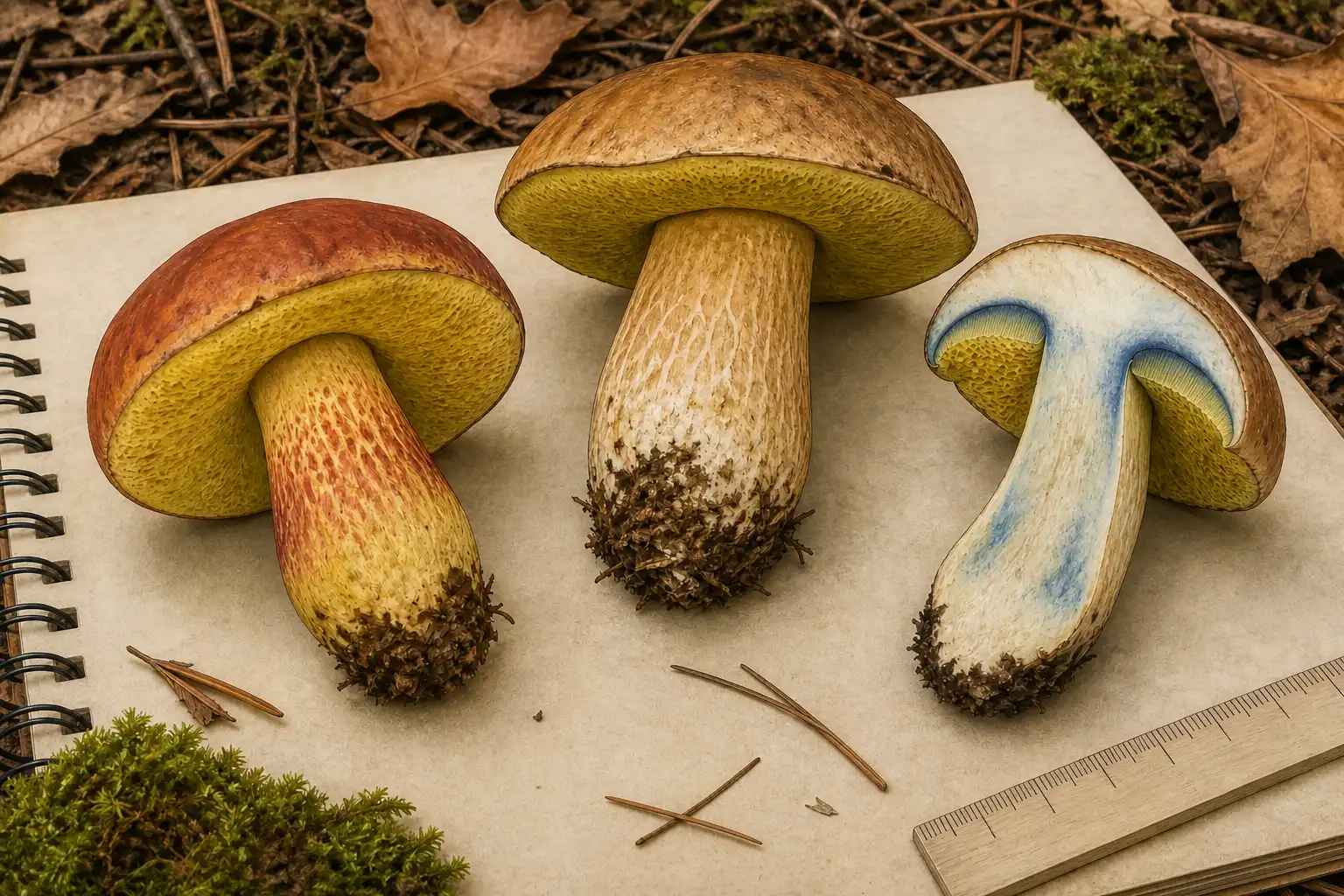
Bolete Identification: Pores, Staining, and Lookalikes
Learn how to document a bolete's pores, flesh staining, stem, habitat, and lookalikes without treating any one feature as an edibility test.
mushrooms
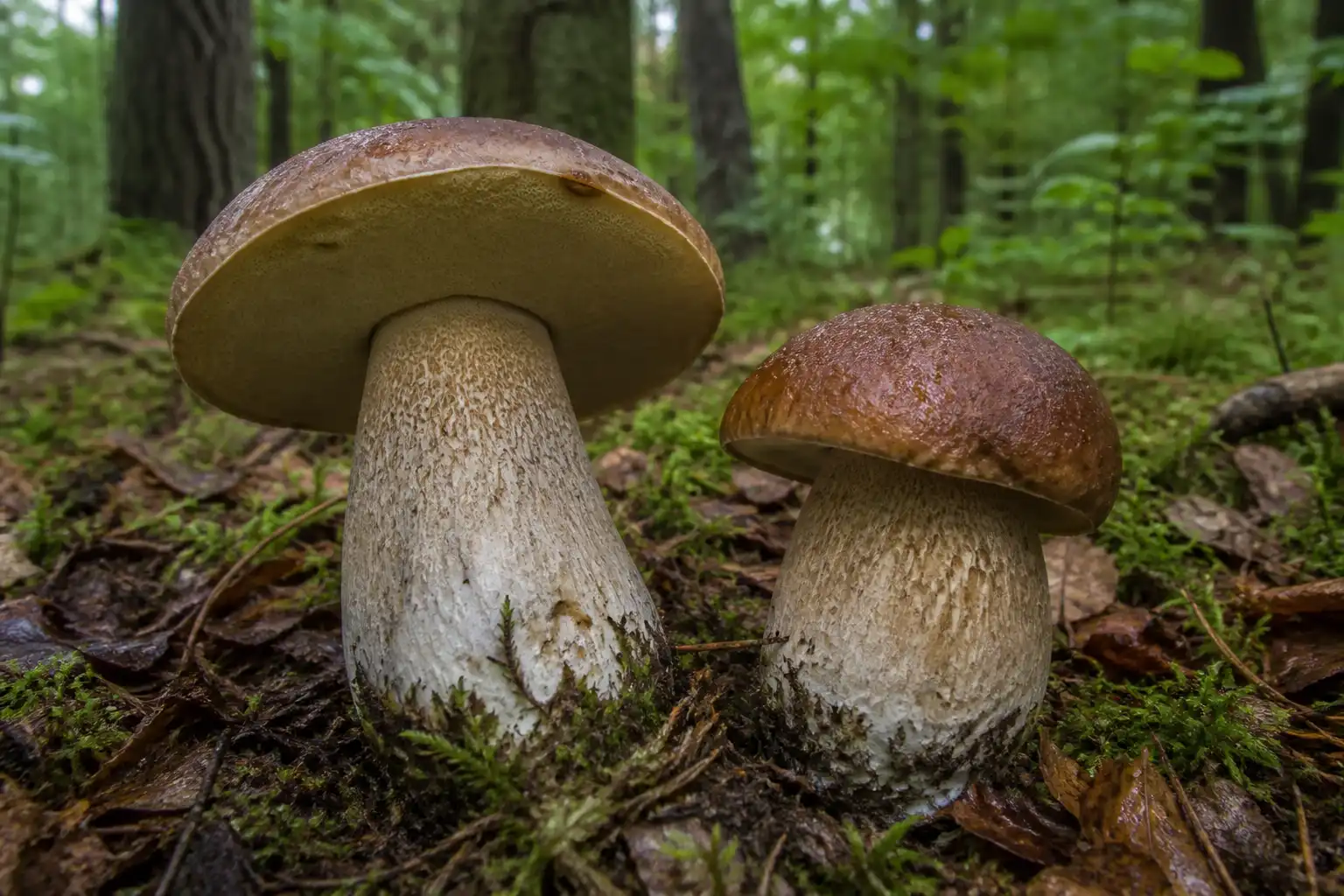
Porcini Mushrooms: Bolete Features, Tree Partners, and Safety
Understand porcini through Boletus edulis pores, reticulate stems, tree partnerships, regional species limits, lookalikes, cooking, and safety.
mushrooms
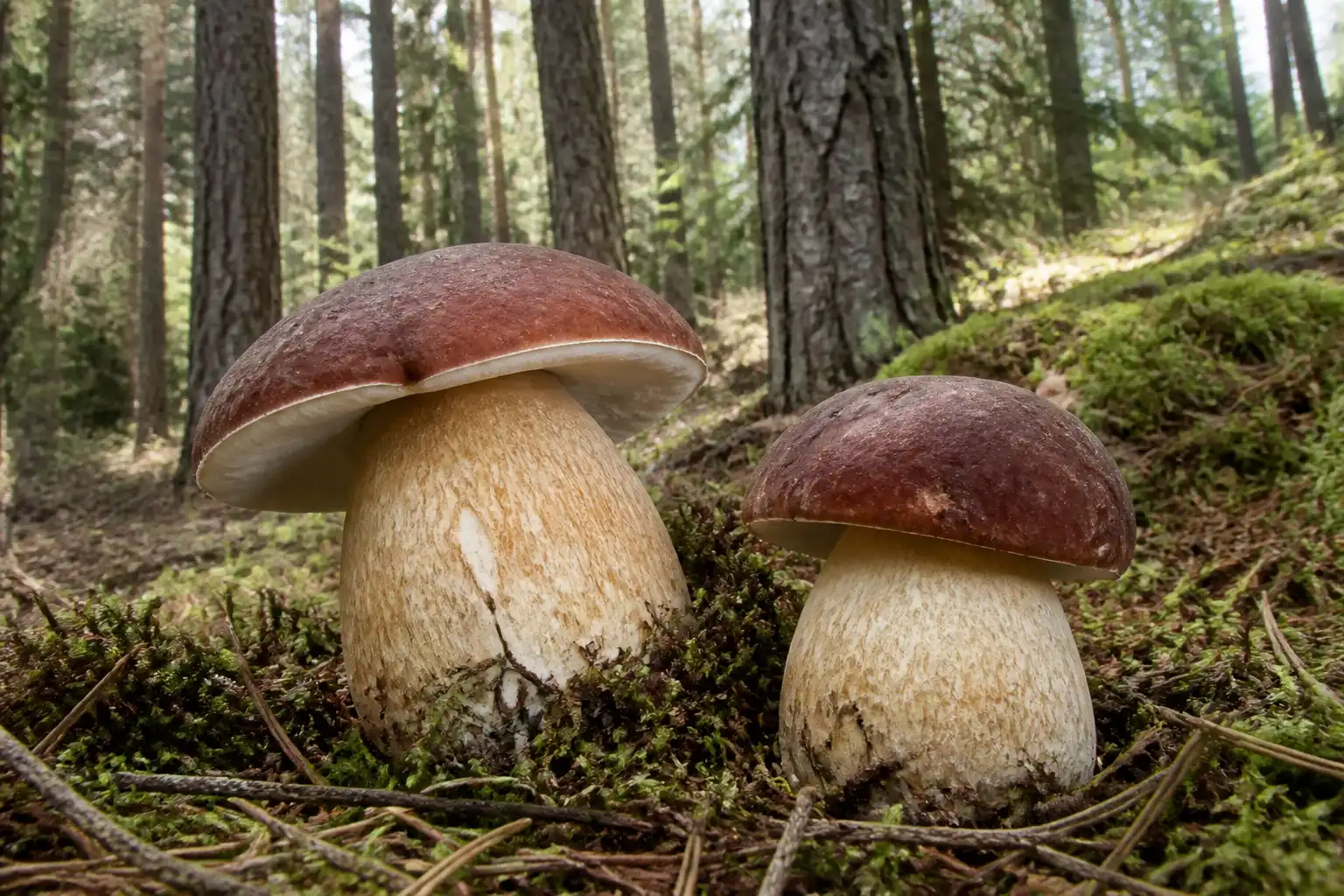
Pine Bolete: Red-Brown Cap, Pine Ecology, and Lookalikes
Document pine bolete caps, pores, stem reticulation, pine-associated ecology, regional lookalikes, food-safety limits, and why cultivation is difficult.
Continue exploring
Browse more practical guides in Mushroom Encyclopedia or visit the mushroom encyclopedia.