Mushroom Encyclopedia
Pine Bolete: Red-Brown Cap, Pine Ecology, and Lookalikes
Document pine bolete caps, pores, stem reticulation, pine-associated ecology, regional lookalikes, food-safety limits, and why cultivation is difficult.
Species context
Treat profiles as reference material
Species profiles summarize documented traits, taxonomy, and lookalikes, but natural variation can be substantial.
Use the safety checklist →Decision limit
A profile cannot authenticate a specimen
Do not eat a wild mushroom from an online match, single feature, or generated image.
Read the safety disclaimer →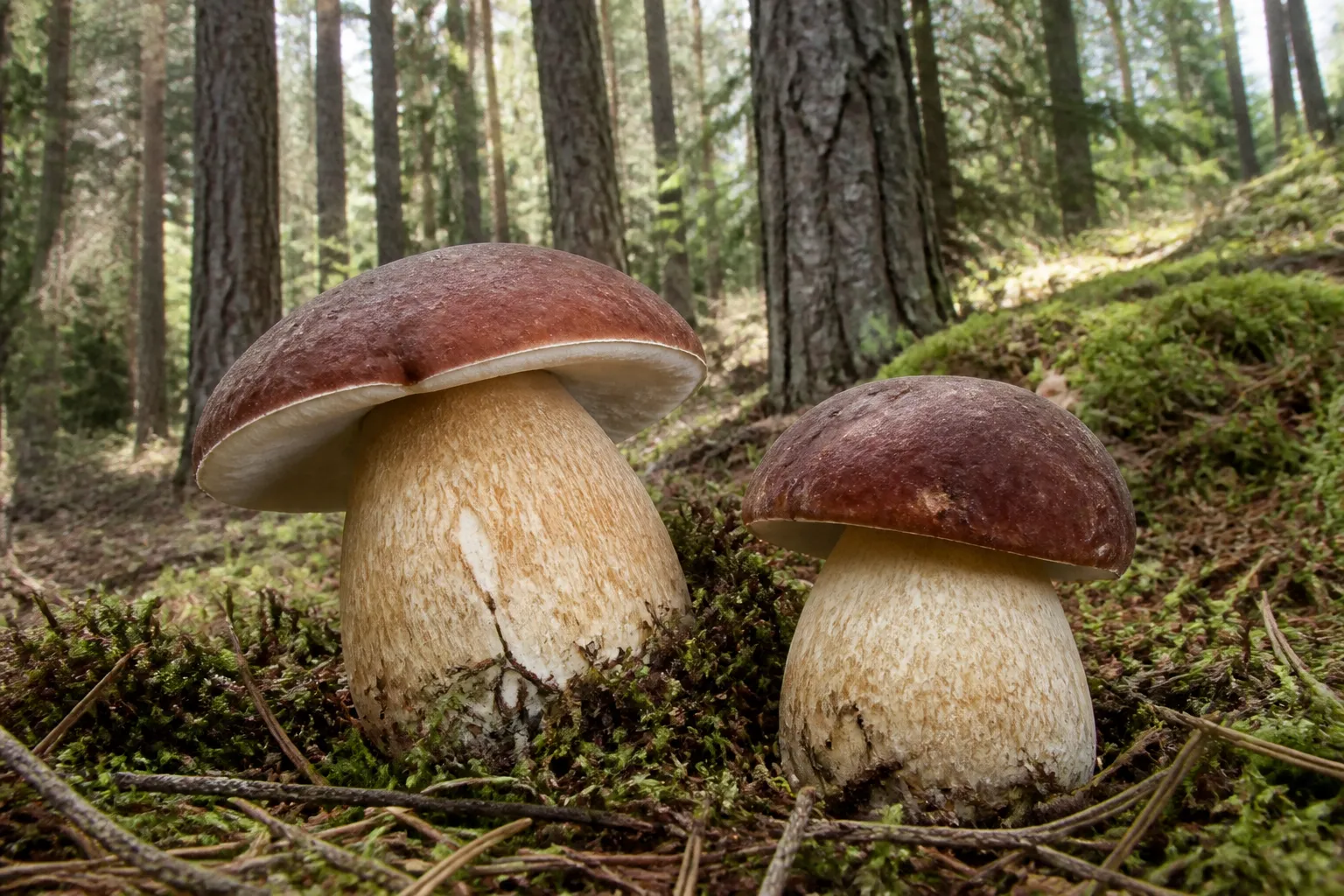
Quick facts
- Scientific name
- Boletus pinophilus
- Common names
- Pine bolete
- Taxonomy
- Boletus · Boletaceae
- Edibility context
- Edible: This database label is context, not remote clearance of a wild specimen; identity, preparation, spoilage, contamination, and individual reaction matter.
- Spore print
- Olive brown.
- Toxicity context
- None Known: Risk includes misidentification and individual reaction. Consult current local toxicology guidance before any food decision.
- Season
- June, July, August, September, October
- Growing difficulty
- Not Cultivated
- Regions
- Europe, Asia
Safety limit: These labels summarize documented context; they never authenticate a wild specimen. Cooking does not make a poisonous species safe.
Identification overview
A typical pine bolete record combines a robust reddish- to chestnut-brown cap, a fine pore surface that changes from whitish to yellow-olive, and a thick pale stem carrying raised netlike reticulation. Cut flesh is usually white and lacks the dramatic rapid blue reaction seen in some other boletes, but absence of blue is not a safety test. Photograph several ages, the complete stem base, pore surface and a timed cut reaction. An olive-brown spore deposit only supports the wider bolete assessment.
Habitat and season
This is an ectomycorrhizal mushroom linked mainly with pines and other conifers in its established Eurasian range. The fruit body rises from soil, but the feeding relationship is with living roots rather than leaf litter. Record which tree species are close enough to be plausible partners, forest age, elevation and soil conditions; plantation records and imported market names should not be treated as proof of a local wild species.
Because this bolete fruits from soil, the missing attachment is a living root partnership rather than buried wood. Map nearby pines and other conifers, photograph needles and bark when host identity is defensible, and note whether several fruit bodies trace the root zone. Host evidence supports—but never proves—the species name.
Similar species
- Boletus edulis — typically paler brown and associated with several hosts.
- Rubroboletus species — some poisonous boletes have red pores and blue staining.
Members of the Boletus edulis complex overlap strongly. Compare cap tone, reticulation extent, pore development, flesh reaction, host and geography as a bundle, then use the current regional treatment. Bitter or red-pored boletes introduce different characters, but simplistic “no red and no blue” rules are not edible tests.
Food and safety context
Pine bolete has a documented food-use context when the organism is correctly identified and the material is fresh, clean, and cooked. That reputation does not transfer to a wild specimen identified online. Individual allergy, gastrointestinal intolerance, spoilage, environmental contamination, and cross-contamination remain possible. Cooking does not make a poisonous species safe.
For severe vomiting, persistent diarrhea, confusion, jaundice, breathing difficulty, or any symptoms after an unidentified wild mushroom, contact emergency services or a poison center promptly. Keep uncooked material, trimmings, photographs, and meal details for professional identification.
Cultivation context
Pine bolete depends on ectomycorrhiza with living tree roots, making a sterile sawdust block the wrong biological model. Research propagation must document both partners, root colonization and years of field conditions; mycelial growth alone is not successful mushroom cultivation. Home growers seeking a reliable crop should choose a saprotrophic species instead.
Define the pine bolete concept
This page treats Boletus pinophilus, not every porcini-like bolete found beneath pine. Common names and the Boletus edulis complex have been applied differently across regions, so preserve the scientific name and geographic concept used by each source. A robust red-brown cap is useful context, but host, pores, stem ornament, flesh reactions, spores, and regional taxonomy must agree.
Record changes from young pores to maturity
Young pore surfaces begin pale and mature through yellow toward olive. The thick stem usually carries a raised net-like reticulation, especially above, and the firm flesh is expected not to stain strongly blue. Photograph multiple ages, the cap surface, pore surface, full stem, reticulation, and a clean lengthwise section. Record color changes immediately and again after several minutes; vague “no staining” notes can miss a delayed reaction.
An olive-brown deposit is supporting evidence, not a verdict. Measure cap, stem, pores, and spores where appropriate. Insect tunneling, drought cracking, rain, and age can obscure otherwise helpful characters. Generated imagery on this draft illustrates habitat and form only.
Treat pine association as a biological relationship
Pine bolete is ectomycorrhizal: the fungus exchanges resources with living tree roots rather than decomposing a log. Record nearby potential hosts, forest composition, soil, elevation, and whether fruit bodies recur in the same area. Nearby pine needles are supporting evidence, not proof that the visible tree is the partner; roots overlap and mixed woods contain several candidates.
Because the underground partnership is central, ordinary sterile-block cultivation does not reproduce the ecology. Claims of quick indoor porcini production require unusually strong verification. Do not transplant soil, roots, or wild mycelium into new habitats, and follow land-access and collection rules.
Compare the whole bolete, not one warning color
Boletus edulis and related porcini can overlap in stature, reticulation, pores, and food reputation. Some Rubroboletus have red pores and blue-staining flesh and include toxic species, but absence of red does not establish edibility. Bitter Tylopilus and other boletes add regional confusion. Use the bolete identification guide to build a character matrix rather than relying on a single color rule.
Keep food decisions conservative
Food-use reports apply only after expert-supported identity and sound condition. Avoid old, waterlogged, heavily insect-damaged, roadside, treated-land, or polluted-site specimens. Retain uncooked material and meal details. Cook thoroughly and try no wild mushroom on behalf of a child, pregnant person, immunocompromised person, or anyone unable to consent to the uncertainty.
Drying concentrates flavor and also concentrates whatever material was present; it does not repair misidentification or contamination. Label lawful, verified dried specimens with species, place, date, and processor, and keep them separate from unknown collections.
Build a defensible field record
Photograph the undisturbed habitat, several ages, pores, stem base, section, and host context. Note odor without tasting, weather, soil, elevation, and collection permit. A voucher dried promptly is more valuable than a basket photograph. If food is contemplated, obtain in-person help from a qualified regional identifier; this page and its cover cannot authorize consumption.
The habitat identification guide helps document potential root partners without overstating them, while the identification safety checklist keeps collection and food decisions separate from online pattern matching.
Editorial and evidence limits
This stored draft has editorial review only and no named mycologist or clinician. It makes no medicinal or nutrition claim without a matched analysis. Before publication, recheck the regional species concept, occurrence sources, link status, image metadata, and poison-response guidance while retaining draft: true.
Publication-ready questions to answer from the record
Does a pine host prove pine bolete? No. Several ectomycorrhizal boletes can fruit within the same root zone. Host evidence narrows ecology but does not replace pore, stem, flesh, spore, and regional characters.
Is a non-blueing bolete safe? No. Staining is one character, and its absence neither confirms B. pinophilus nor establishes edibility. Observe immediate and delayed reactions under consistent light.
Why is an indoor grow claim doubtful? The organism depends on a living-root ectomycorrhizal partnership. Producing mycelium in culture is not the same as completing fruiting with a host tree.
Can a porcini market name settle taxonomy? No. Trade names can group multiple species and geographic concepts. Keep origin, supplier, scientific label, and any laboratory evidence attached to the lot.
What must happen before publication? Recheck the accepted name and range, confirm the bolete-guide link is public, inspect every source and FAQ, set a deliberate non-future publication date, verify the unique cover and its AI disclosure, and run the complete build with sitemap, RSS, search index, canonical, Article, Taxon, and FAQ output checks.
Example field comparison record
For each candidate, make columns for cap color and texture, pore color by age, staining at zero and ten minutes, flesh color, stem shape, reticulation position and color, odor, spore deposit, host evidence, soil, elevation, region, and collection date. Add measurements from more than one fruit body. A row left unknown is better than a value guessed after the specimen has dried.
Compare the completed record with a current regional key. If a key requires microscopy, document spore dimensions, shape, and preparation rather than skipping the character. If sequence evidence is used, preserve voucher and accession information. A database photograph that looks similar is not an independent character and should not be counted as confirmation.
This comparison also protects search intent. The page should answer how B. pinophilus is documented within a pine-associated porcini complex, while the general bolete guide teaches pore and staining methods. Publication copy should link the two with descriptive anchors and avoid claiming that either page can remotely clear a meal.
When editing the release, review every heading against the paragraph that follows it. “Pine association,” “pore maturation,” and “reticulation” are precise; “secrets,” “ultimate test,” and “guaranteed edible” are not. Confirm that the regional range is not presented as exhaustive and that records outside the stated core are evaluated under current local taxonomy. This final pass turns a descriptive draft into a cautious species account rather than a universal porcini shortcut.
A pine bolete comparison record
- Photograph the fruit body in place with candidate host trees and ground cover.
- Excavate the complete stem base and record reticulation from apex to lower stem.
- Capture pores at young and mature stages, then time any cut or bruise reaction.
- Record cap and stem measurements, odor without tasting, and an olive-brown deposit.
- Resolve the collection with a regional Boletus key rather than a market-name comparison.
Map reticulation instead of marking it present or absent
Stem reticulation is a raised network, not a printed color pattern. On pine bolete it may be strongest near the apex and less obvious lower down, while soil, abrasion, insect feeding, and age can conceal it. Photograph the upper, middle, and basal stem with raking light. Record the network color relative to the underlying surface and whether it forms fine meshes or coarse elongated cells.
Pore development should be documented on more than one age class. Young tubes begin pale and compact, then lengthen and shift toward yellow and olive as spores mature. Note whether pressure or cutting produces an immediate, delayed, faint, or absent color reaction, specifying the tissue tested. “Does not blue” is never edible clearance: reaction intensity varies and other regional boletes can share pale flesh.
The name Boletus pinophilus is most defensible when morphology, conifer association, geography, and a current regional treatment agree. The broad commercial word porcini may combine several members of the B. edulis complex and dried slices can lose cap, stem, pore, and host evidence. Keep market authentication separate from field identification, and do not infer a precise species from package imagery or a reddish cap alone.
References
- Global Biodiversity Information Facility. Boletus pinophilus species record. Accepted-name and Eurasian occurrence context used to limit geographic claims.
- National Center for Biotechnology Information. Boletus pinophilus taxonomy record. Nomenclatural checkpoint for this pine-associated member of the B. edulis group.
- North American Mycological Association. Mushroom Poisoning Syndromes. Poisoning response and syndrome context.
- U.S. Food and Drug Administration. Selecting and Serving Produce Safely. General handling guidance for mushrooms used as food.
Editorial status: no named mycologist reviewed this draft. Recheck the regional porcini complex, host range and poison-response information before publication.
Source quality notes
MushroomScope cites sources that match the page scope, such as taxonomic databases, extension guidance, food-safety agencies, food-composition databases, and peer-reviewed or institutional health references. Sources support context and uncertainty; they do not turn an online page into specimen identification, medical advice, or a tested recipe record.
Frequently asked questions
How does pine bolete differ from porcini in the broad sense?
Boletus pinophilus is one member of the porcini or edulis complex, characterized in its core range by a reddish-brown cap, stout reticulate stem and conifer association. Names and species limits vary regionally, so the broad market term porcini is not a precise identification.
What should be recorded on the underside of a pine bolete?
Record pore color, pore size, bruising after a timed interval and any insect damage. Young pores are pale and mature toward yellow-olive; gills would rule out a bolete identification.
Does finding a bolete under pine prove it is Boletus pinophilus?
No. Several boletes associate with pines. Confirm the cap, reticulate stem, pore development, flesh reactions, geography and regional key rather than using the host alone.
Why is pine bolete not an ordinary home-growing species?
It is ectomycorrhizal and depends on a living tree-root partnership. Producing mycelium in culture is not equivalent to establishing that partnership and reliably forming mushrooms.
Can this page confirm a pine bolete is safe to eat?
No. Bolete comparisons are regional and specimen condition also matters. Obtain qualified local confirmation and never use cap color, a phone image or the absence of blue staining as edible clearance.
Related guides
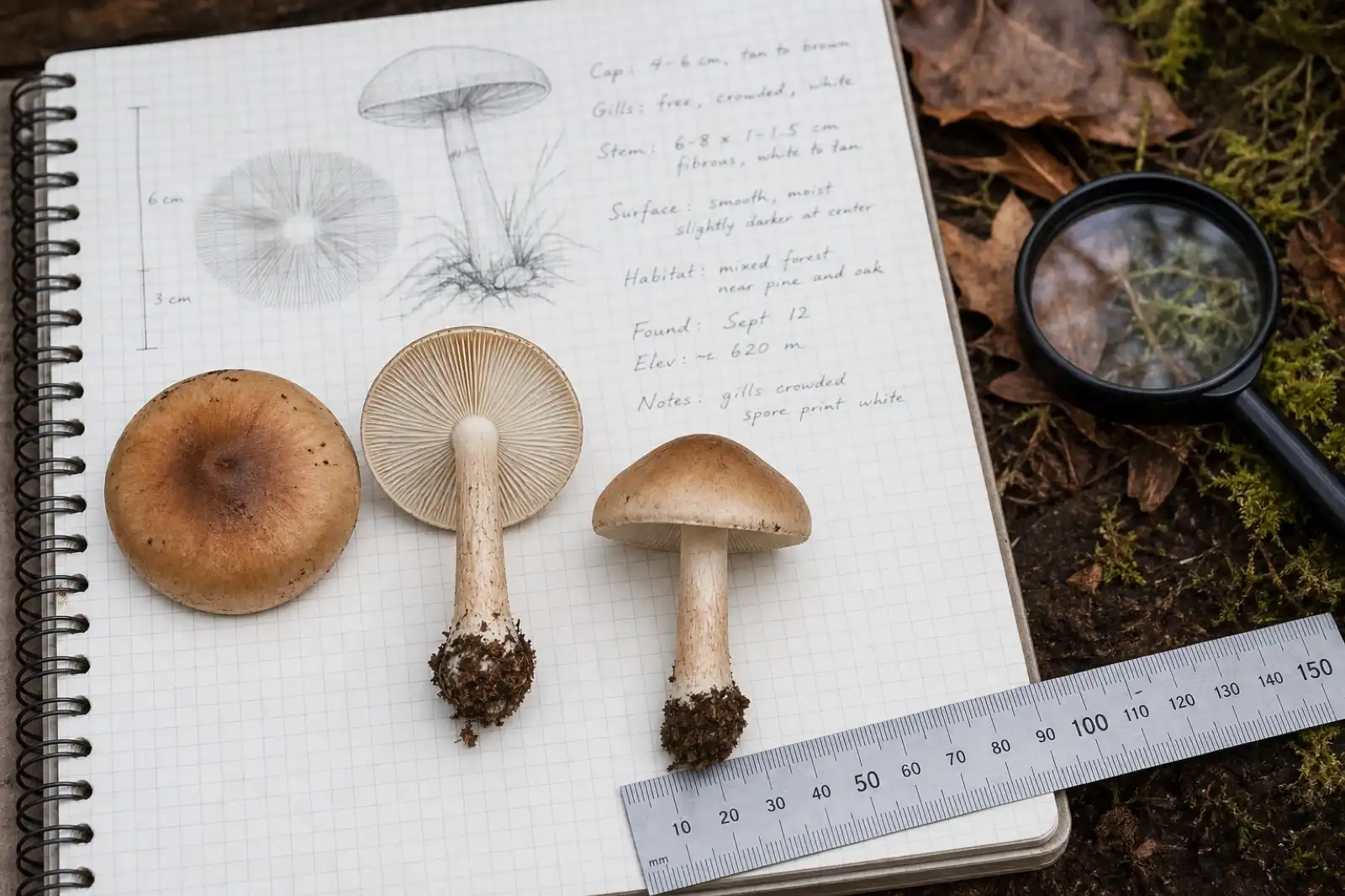
identification
How to Identify Mushrooms: A Beginner's Field Guide
Build an identification from the whole specimen, substrate, habitat, spore deposit, and location—not from a single photograph.
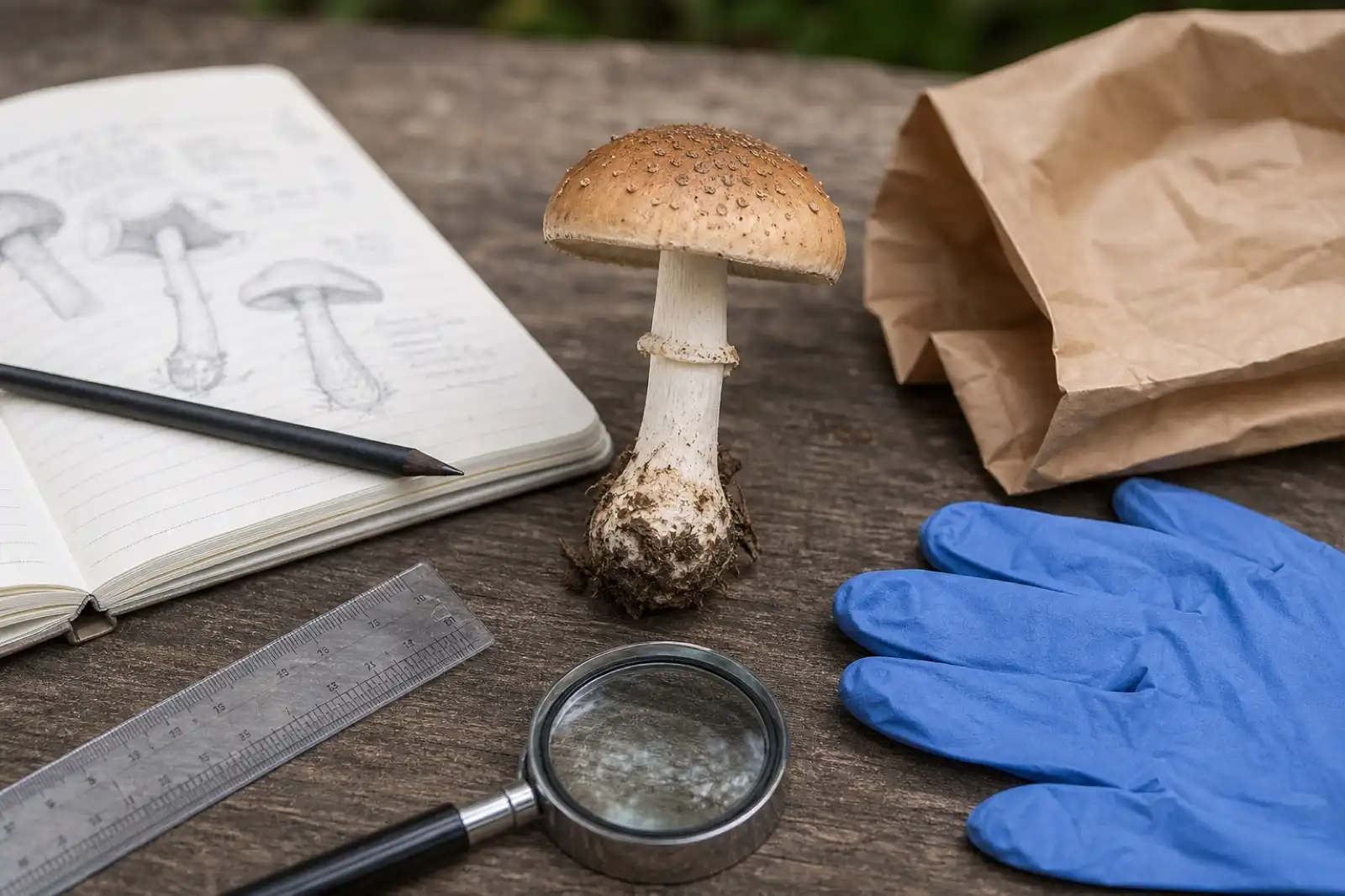
identification
Mushroom Identification Safety Checklist
Use a conservative checklist before handling, documenting, or discussing any wild mushroom, especially when edibility is being considered.
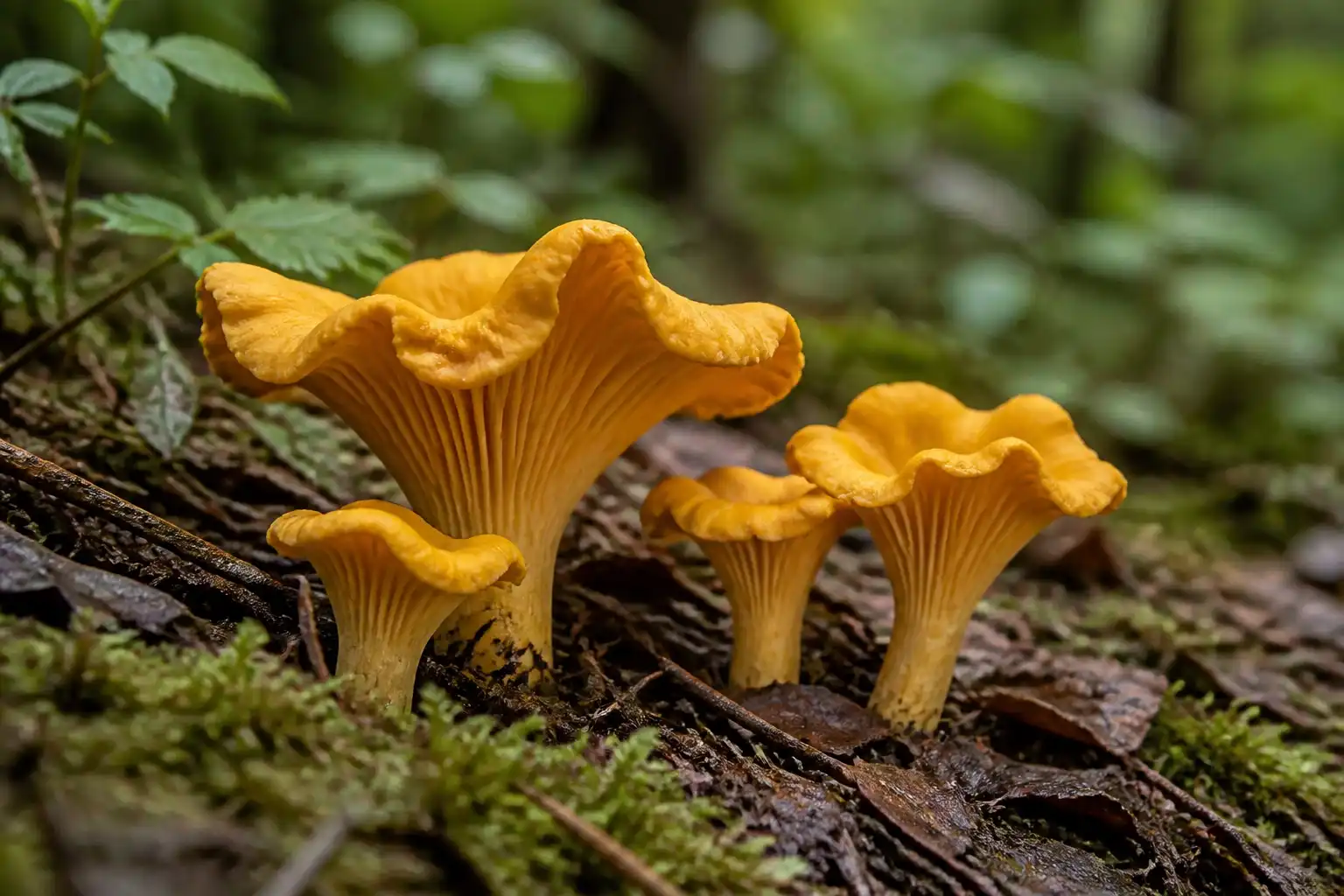
mushrooms
Cantharellus cibarius: Chanterelle Identification Guide
Learn chanterelle identification, false gills, habitat, season, poisonous lookalikes, edibility, nutrition, and why wild finds need local verification.
Continue exploring
Browse more practical guides in Mushroom Encyclopedia or visit the mushroom encyclopedia.