Mushroom Encyclopedia
Orange Mock Oyster: Hairy Caps, Orange Gills, and Wood
Document orange mock oysters by hairy fan-shaped caps, orange gills, stemless hardwood attachment, odor, white spores, ecology, and oyster lookalikes.
By MushroomScope Editorial Team · · Updated
Species context
Treat profiles as reference material
Species profiles summarize documented traits, taxonomy, and lookalikes, but natural variation can be substantial.
Use the safety checklist →Decision limit
A profile cannot authenticate a specimen
Do not eat a wild mushroom from an online match, single feature, or generated image.
Read the safety disclaimer →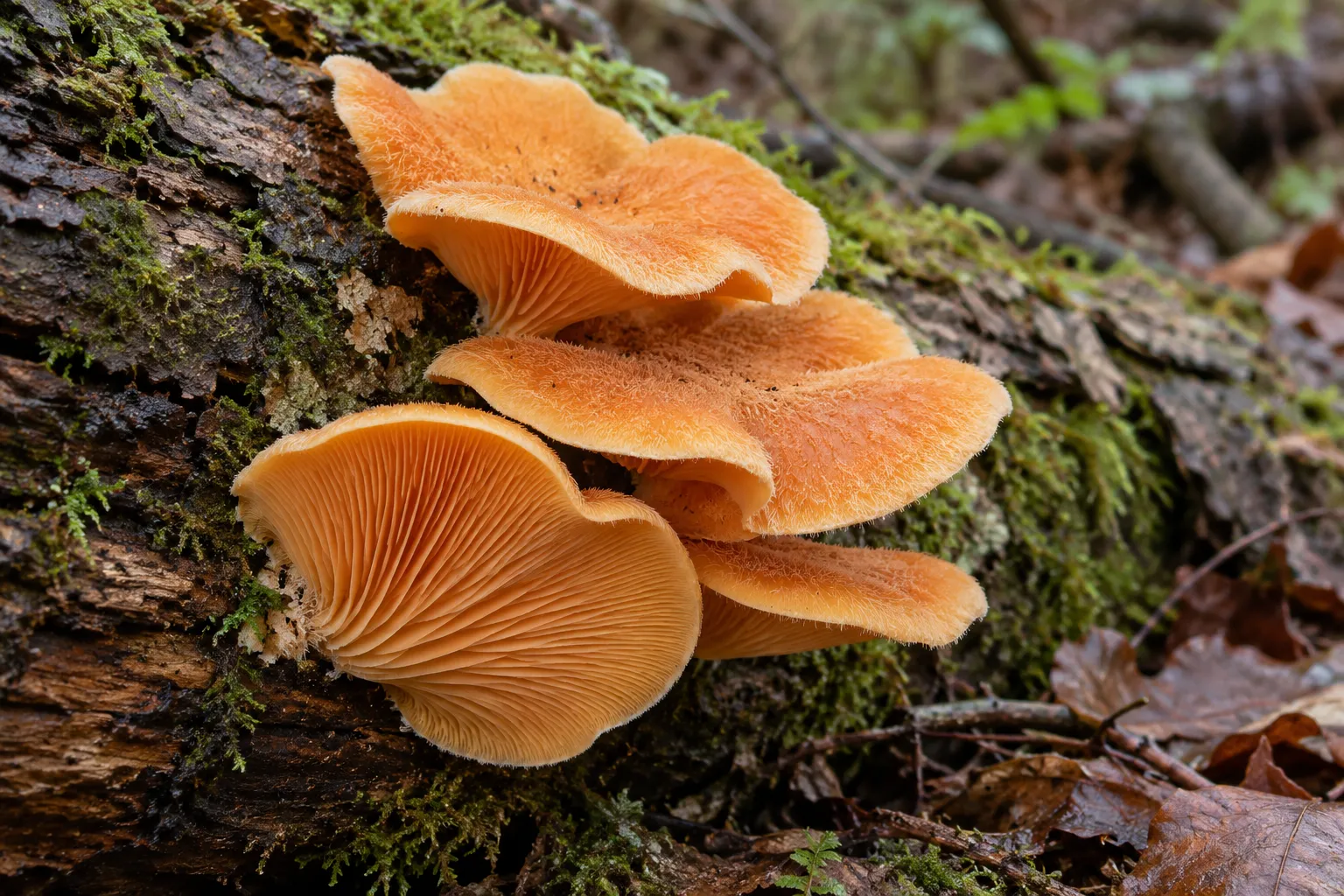
Quick facts
- Scientific name
- Phyllotopsis nidulans
- Common names
- Orange mock oyster, Mock oyster, Stinking orange oyster
- Taxonomy
- Phyllotopsis · Phyllotopsidaceae
- Edibility context
- Inedible: Treated here as unsuitable for food because odor, tough texture, lookalike risk, and variable field accounts do not support a food recommendation.
- Spore print
- White to pale cream.
- Toxicity context
- Low: Low documented inherent toxicity does not establish edibility; misidentification, spoilage, contamination, and gastrointestinal reactions remain possible.
- Season
- September, October, November, December, January
- Growing difficulty
- Expert
- Regions
- Europe, North America, temperate Asia, other regions supported by verified collections
Safety limit: These labels summarize documented context; they never authenticate a wild specimen. Cooking does not make a poisonous species safe.
Orange mock oyster earns its common name from architecture, not kinship. The fruit bodies project sideways from dead wood like oyster mushrooms, yet their caps are dry and finely hairy, their gills are orange, and fresh material may have a strong disagreeable odor. Those characters make a useful field hypothesis, but none should be used alone.
The practical task is to document a wood-attached fan from top, underside, base, and developmental context. True oyster mushrooms, Crepidotus, jack-o’-lanterns, and other orange wood fungi create different safety questions. This page keeps those comparisons explicit and makes no food recommendation.
Show the complete lateral attachment
Photograph the undisturbed cluster in profile before touching it. A typical fruit body projects directly from a fallen hardwood log, branch, or stump. The attachment is broad and eccentric, with no obvious central stem. Several caps may overlap like roof tiles.
Include one image wide enough to show whether the wood is standing, fallen, buried, barked, decorticated, or structurally decayed. Then photograph the base from below. A torn cap can leave a neck of flesh that looks like a stem, while a true stem may be hidden by overlapping caps. Describe the tissue that was present before removal.
This direct wood connection separates ecological evidence from nearby scenery. Moss, soil, and living trees in the frame are not the substrate unless the fruit body physically attaches to them.
Examine the cap hairs in side light
The cap surface is orange to ochre-orange and commonly covered in fine hairs that give it a felted or suede-like finish. Use diffuse side light or a hand lens to show the hairs without blowing highlights. Record whether they cover the center, margin, and older faded zones evenly.
Moisture can flatten hairs and make the surface appear smoother. Strong phone sharpening can invent a bristly texture, while compression can erase it. Keep an unprocessed close frame beside the habitat photograph and add a scale.
Young margins may roll inward. Older caps can flatten, fade, become ragged, or collect algae and debris. Measure several ages from the same log rather than defining the species from the brightest cap.
Confirm orange true gills
Turn one intact fruit body far enough to show the underside and broad attachment. The crowded true gills radiate outward from that eccentric base and are usually orange, apricot, or ochre. Record their attachment, spacing, branching, cross-veins, edge condition, and color under neutral light.
The gill-types guide helps standardize terms. Do not call every radiating fold a gill: true gills are thin plates with two faces, whereas pores, wrinkles, and torn cap fibers have different geometry.
Cap and gill colors can converge in a fresh specimen, but age may shift them differently. Photograph a young and mature underside in the same lighting. If the gills are white while the cap is vivid orange, redirect the comparison instead of forcing the name.
Record odor without making it a stunt
Fresh orange mock oysters are often described as having a strong unpleasant, cabbage-like, sulfurous, or otherwise distinctive odor. Record odor intensity at the intact log, at a freshly exposed base, and after a few minutes. Use plain comparisons and note observer disagreement.
Do not inhale deeply from decayed material, taste the fungus, or treat a missing odor as decisive. Cold temperature, age, rain, airflow, sinus congestion, and individual perception change the observation. Odor supports the structural evidence; it does not replace it.
Make a pale-spore record without scraping gills
A mature cap can be positioned gill-side down over both light and dark nonabsorbent surfaces while the base remains labeled. The expected deposit is white to pale cream. Orange gill fragments or condensed moisture can color a weak print, so inspect whether the material is loose powder with a radial pattern.
Use the spore-print method and retain a piece for microscopy. A brown deposit strongly redirects the comparison toward Crepidotus or another brown-spored lateral fungus. A pale print still does not prove Phyllotopsis.
When microscopy matters, record calibrated spore dimensions, shape, wall characters, mounting medium, number measured, and structures from the cap surface. Do not copy a range from a field guide and present it as an observation.
Separate it from Pleurotus oyster mushrooms
Many wild Pleurotus species have smooth or only subtly textured caps in gray, tan, cream, or brown, with white to pale decurrent gills. Orange mock oyster combines a conspicuously hairy orange cap with orange gills and often a strong odor. The oyster species guide covers Pleurotus morphology, while the oyster lookalike guide organizes the safety comparison.
Color is not enough. Pink and golden cultivated oyster mushrooms can be vividly colored, and escaped cultivation can put unusual colors on outdoor wood. Record provenance, cap texture, gill color, spore deposit, stem form, wood, temperature, and regional occurrence.
Do not interpret “mock oyster” as a culinary substitute. The common name warns that a similar silhouette belongs to a different fungus.
Separate it from jack-o’-lantern clusters
Jack-o’-lantern mushrooms are orange wood-associated fungi with true orange gills, so underside color overlaps. They typically form more substantial stemmed mushrooms in clusters, sometimes appearing terrestrial over buried roots. Orange mock oysters are thinner lateral fans with a broad stemless attachment and a hairy cap.
The difference must be documented, not assumed from one top view. Expose complete bases, show the attachment, and never use reported bioluminescence as a home safety test. Jack-o’-lanterns cause significant gastrointestinal poisoning.
If an orange cluster has clear central stems or ambiguous buried attachment, keep the identification open and consult the dedicated jack-o’-lantern guide.
Use a brown print to route toward Crepidotus
Species of Crepidotus commonly form small lateral caps on wood with little or no stem. Some can be buff, orange-brown, or hairy enough to resemble an old mock oyster. Their spore deposits are brown rather than white, and microscopy often carries more weight than gross color.
Keep mature material. A young cap that has not deposited spores cannot support a negative conclusion, and an old wet cap may contaminate the print. Photograph all caps used so that a loose specimen cannot be reassigned after the fact.
Document the wood and decay position
Orange mock oyster is a saprotroph on dead wood. Identify the host only to the level supported by bark, leaves, buds, wood anatomy, or a verified site record. “Hardwood” is more defensible than guessing oak from a fragment of dark bark.
Measure log diameter, decay class, bark cover, canopy exposure, moisture position, and whether fruiting occurs on the upper, side, or sheltered lower surface. Revisit after frost or rain. A cool-season series may reveal new fruit bodies, fading, insect use, and persistence.
Fruiting does not by itself prove the decay mechanism in a standing tree or establish structural risk. When a fungus occurs on retained urban wood, separate species documentation from professional tree assessment.
Treat regional records as hypotheses
The name Phyllotopsis nidulans has a broad reported distribution, but occurrence portals contain records of unequal certainty. Check coordinate precision, date, substrate notes, identifier, voucher repository, and whether microscopy or sequence data support unusual regional claims.
Older names and family placements may differ among sources. Preserve the name used by each voucher and give the current accepted interpretation separately. A database map is a discovery tool, not proof that a photograph from the same region has the same identity.
Keep food use outside this workflow
Field sources vary in how they label this fungus, but odor, texture, uncertain identification, decay condition, and lookalikes provide no reason to turn the page into a recipe. MushroomScope treats orange mock oyster as unsuitable for food. That conservative boundary is not a claim that every contact is poisonous.
Cooking cannot repair an incorrect identification, remove every environmental contaminant, or make spoiled tissue sound. Do not taste a specimen to test the odor description.
If illness follows ingestion of any wild orange mushroom, contact local poison-control or medical services. Preserve uncooked specimens, trimmings, meal remains, photographs, substrate details, amount, preparation, and symptom timing. Severe symptoms require emergency care, not an online vote.
Build an auditable wood-fungus record
- Photograph the complete log, cluster, and overlap pattern.
- Show the broad lateral base before detaching a cap.
- Capture dry cap hairs in neutral side light.
- Photograph orange true gills and their attachment.
- Record odor conservatively with time and temperature.
- Make a pale-spore record from a labeled mature cap.
- Retain a dried voucher for regional keys or microscopy.
This chain keeps cap surface, gills, spores, odor, and substrate attached to one collection. It prevents a smooth oyster cap and an orange mock-oyster underside from becoming an artificial composite.
Use the image as orientation, not evidence
The cover is an original AI-generated editorial image. It was compared with existing natural-light species covers for realistic woodland color, restrained depth of field, readable top and underside surfaces, complete wood attachment, texture, sharpness, and absence of text or watermark. The rendered cap hairs and gills are illustrative, not measurable characters or proof of identity.
Frequently asked questions in context
Can frost change the orange color?
Yes. Cold, soaking, sun, age, and microbial decay can dull or brown fruit bodies. Record fresh protected areas and several ages instead of digitally restoring a color you expected.
Is a bad smell unique to this species?
No. Odor varies and decaying fungi of many species smell unpleasant. It has value only when the structural, spore, substrate, and regional evidence also agree.
Can it be cultivated like oyster mushrooms?
Not by assuming that similar shape means similar crop behavior. Research cultivation requires an authenticated isolate, contained substrate, documented environmental variables, verified fruit bodies, and responsible disposal. It is not presented here as a food crop.
For a smaller ochre fan with conventional crowded gills and a short lateral attachment, compare the bitter oysterling field guide rather than stretching orange mock oyster to fit every pleurotoid cluster.
References
- Global Biodiversity Information Facility. Phyllotopsis nidulans taxon record. Accepted-name, synonym, and occurrence-record discovery context; individual records require verification.
- National Center for Biotechnology Information. Taxonomy Browser — Phyllotopsis nidulans. Nomenclature and lineage checkpoint.
- USDA Forest Service. Field Guide to Common Macrofungi in Eastern Forests. Professional wood-decay and macrofungus field context.
- North American Mycological Association. Mushroom Poisoning Syndromes. Conservative poisoning-response context.
Editorial review: October 22, 2026. This page has editorial review only and no named mycologist, toxicologist, or clinician review. Taxonomy, regional occurrence, lookalikes, and poison contacts should be checked again at each substantive update.
Source quality notes
MushroomScope cites sources that match the page scope, such as taxonomic databases, extension guidance, food-safety agencies, food-composition databases, and peer-reviewed or institutional health references. Sources support context and uncertainty; they do not turn an online page into specimen identification, medical advice, or a tested recipe record.
Frequently asked questions
Why is it called an orange mock oyster?
Its lateral fan-shaped growth resembles an oyster mushroom, but the dry hairy orange cap, orange gills, odor, and taxonomic placement distinguish the concept.
Does Phyllotopsis nidulans have a stem?
It is commonly stemless or has only a reduced eccentric attachment. Photograph the complete base because torn specimens can create a false stem.
What color is the spore print?
A sufficiently mature specimen is reported to produce a pale to white print; deposit color must be recorded separately from orange gill tissue.
Can color alone separate it from true oyster mushrooms?
No. Cap hairs, gill color, attachment, odor, wood, spore deposit, region, and maturity must agree; cultivated orange Pleurotus can also escape or appear outdoors.
Is orange mock oyster edible?
This guide does not recommend it as food. Identity, condition, odor, wood exposure, and individual risk cannot be cleared from an image.
Related guides
mushrooms
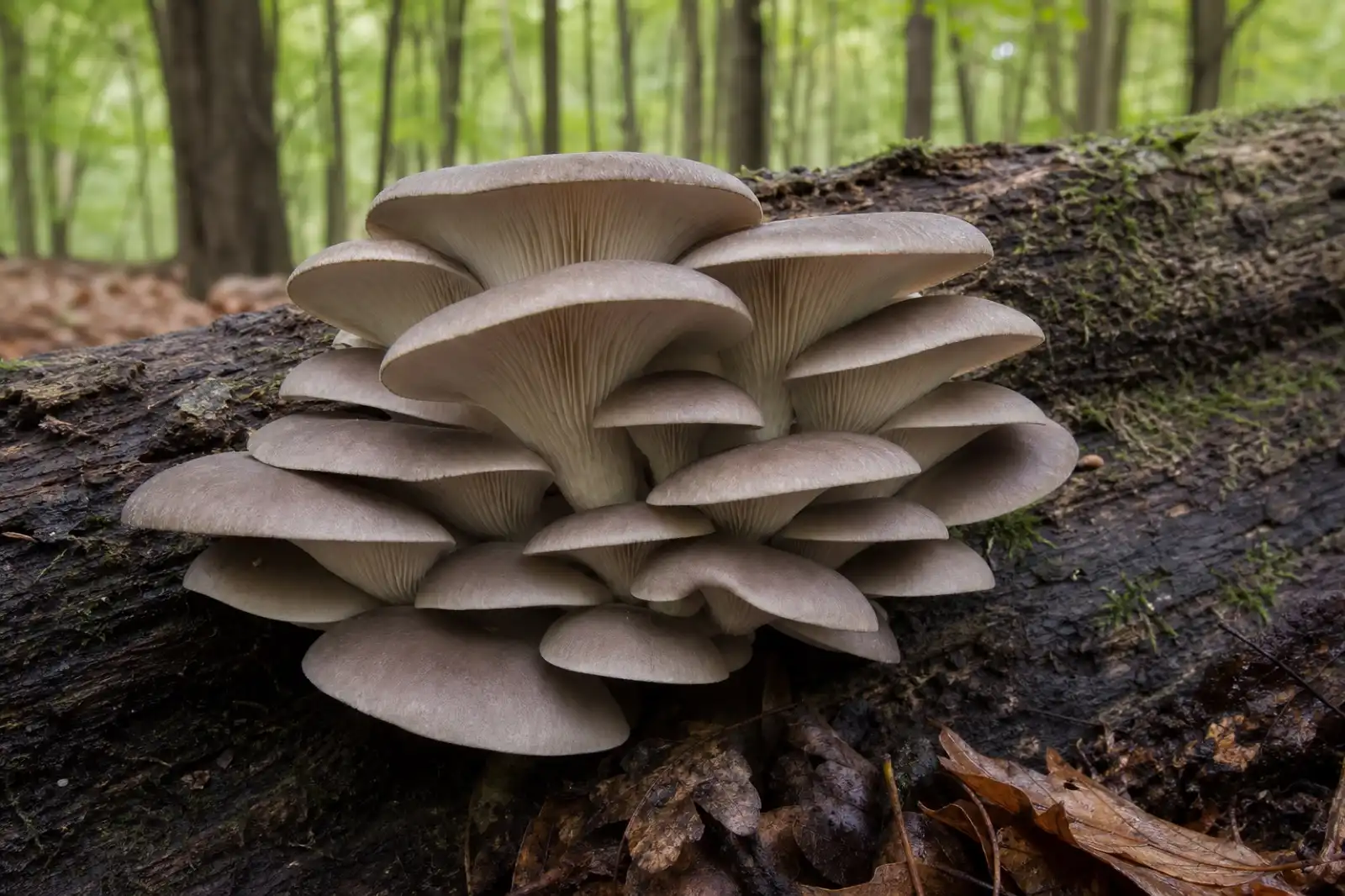
Pleurotus ostreatus: Oyster Mushroom Identification and Growing Guide
A careful guide to Pleurotus ostreatus identification, habitat, home cultivation, nutrition, lookalikes, food safety, and research limitations.
identification
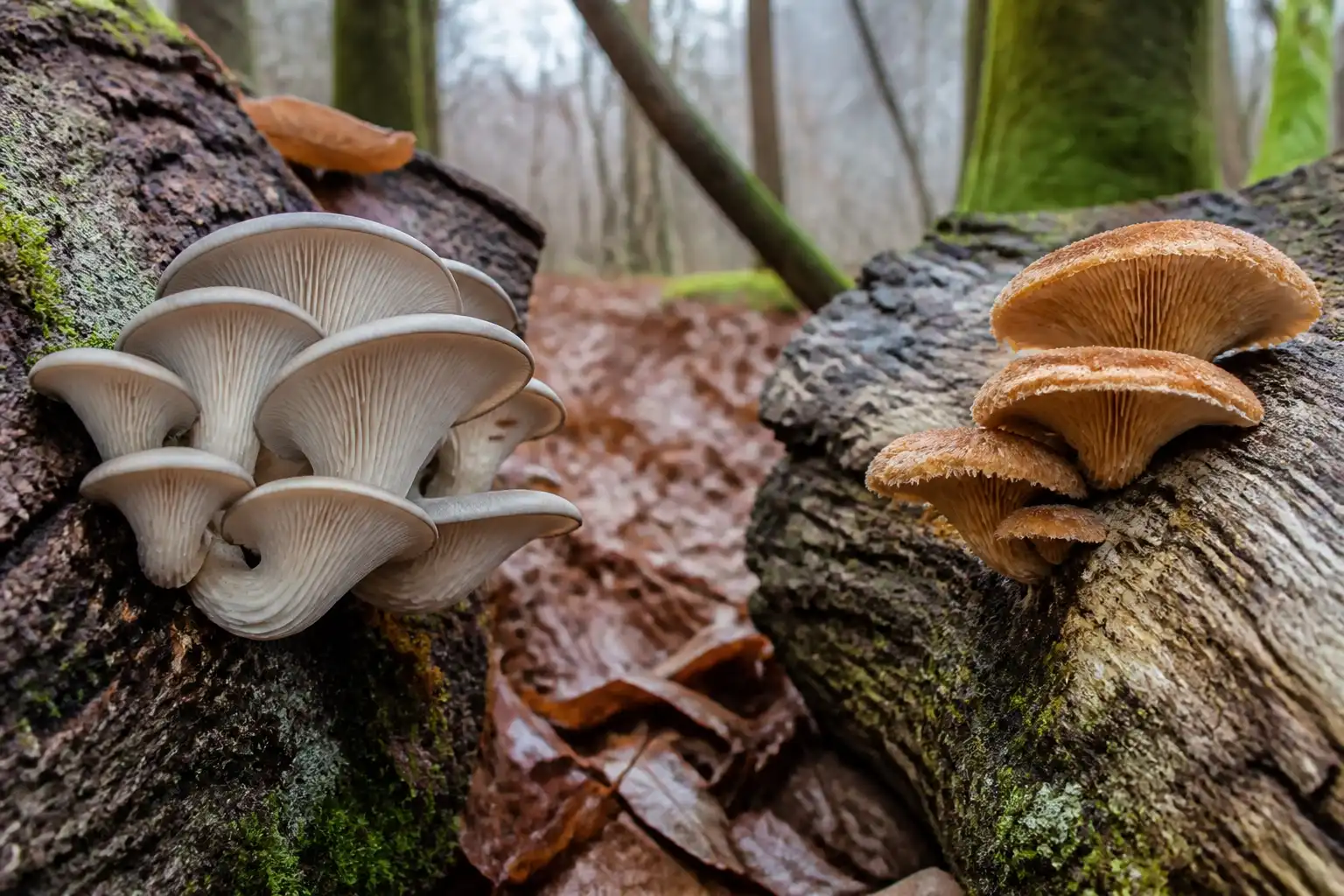
Oyster Mushroom Lookalikes and Identification Tips
Compare oyster mushroom lookalikes with conservative field observations, documentation steps, safety limits, and reasons to seek local expert help.
identification
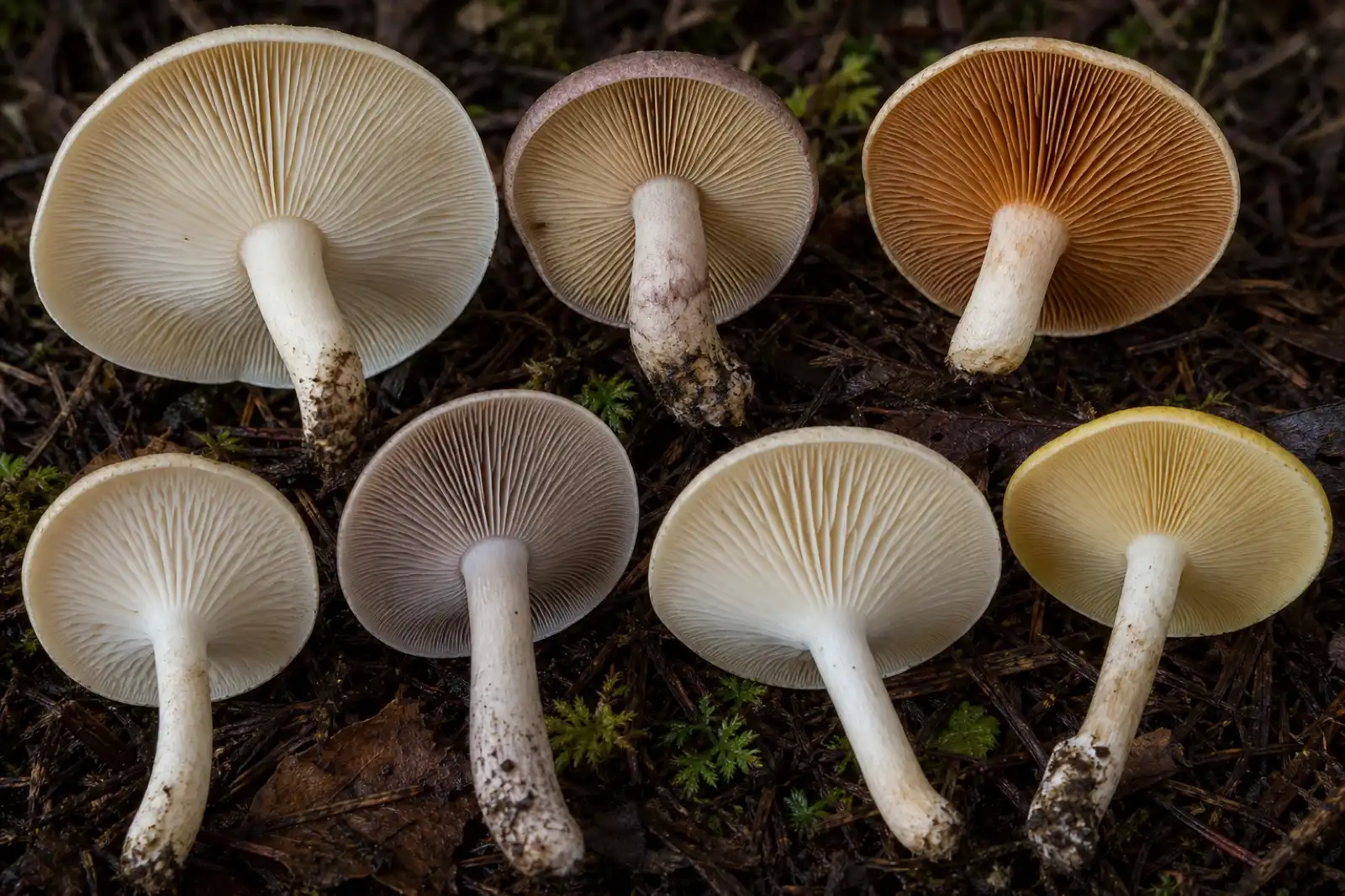
Mushroom Gill Types: Attachment, Spacing, and Color
Compare free, attached, notched, adnate, and decurrent mushroom gills while recording spacing, short gills, edge details, bruising, and color changes.
Continue exploring
Browse more practical guides in Mushroom Encyclopedia or visit the mushroom encyclopedia.