Mushroom Encyclopedia
Lentinula edodes: Shiitake Mushroom Identification and Cultivation
An evidence-aware guide to shiitake identification, hardwood cultivation, nutrition, dermatitis risk, safe cooking, classification, and FAQs.
By MushroomScope Editorial Team · · Updated
Species context
Treat profiles as reference material
Species profiles summarize documented traits, taxonomy, and lookalikes, but natural variation can be substantial.
Use the safety checklist →Decision limit
A profile cannot authenticate a specimen
Do not eat a wild mushroom from an online match, single feature, or generated image.
Read the safety disclaimer →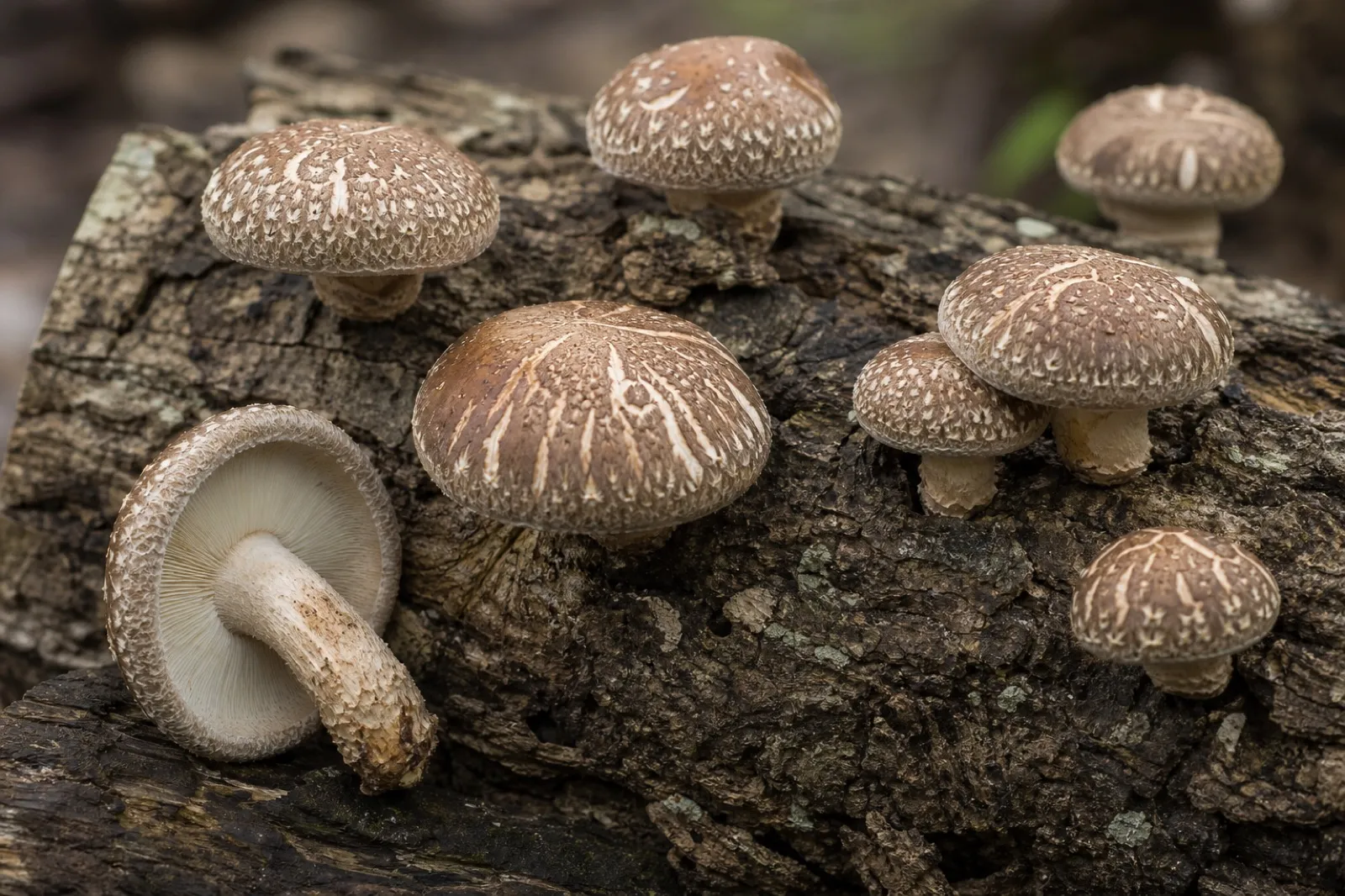
Quick facts
- Scientific name
- Lentinula edodes
- Common names
- shiitake, oak mushroom, xiang gu
- Taxonomy
- Lentinula · Omphalotaceae
- Edibility context
- Edible: A major cultivated food that should be thoroughly cooked.
- Spore print
- White.
- Toxicity context
- Low: Raw or undercooked shiitake can rarely trigger flagellate dermatitis; allergy and gastrointestinal reactions are also possible.
- Season
- March, April, May, September, October, November
- Growing difficulty
- Moderate
- Regions
- China, Japan, Korea, other parts of East Asia, cultivated worldwide
Safety limit: These labels summarize documented context; they never authenticate a wild specimen. Cooking does not make a poisonous species safe.
Separate a cultivated shiitake from a wild brown mushroom
Lentinula edodes is the cultivated hardwood mushroom sold globally as shiitake. For a packaged crop, the producer, lot, culture name, substrate and cold-chain history provide evidence that a photograph cannot. A wild brown cap on wood presents the opposite problem: the market name supplies no provenance, and similar color or cap cracking cannot establish identity. Keep those two workflows separate from the first observation.
This page treats shiitake as Lentinula edodes tied to an East Asian wild ecology or an authenticated cultivated culture. It does not use “brown cap on wood” as an identification shortcut, and it separates a grocery crop, a log-grown batch, lentinan research, raw-shiitake dermatitis, and a supplement label. Each of those contexts requires different evidence.
A cultivated record should preserve the package or spawn label, harvest date, storage temperature and whether the crop came from a log or sawdust block. A wild record should show the complete hardwood attachment, cap, gills, stem base and several ages, together with region and host evidence; the habitat identification guide explains how to document a host without treating the nearest tree as proof. Do not taste an unidentified mushroom. The species guide organizes those observations; it cannot convert a wild specimen into food clearance.
Read cap, gills and hardwood attachment together
A typical cultivated fruit body has a convex brown cap with whitish veil remnants or scales, pale crowded gills, a fibrous stem, white flesh, and a white spore print. Cap cracking is influenced by humidity and cultivation style and is not by itself a species test. Wild identification considers hardwood substrate, geographic range, attachment of the gills, texture, odor, spores, and microscopic characters.
Macroscopic characters
- Cap or upper surface: Brown, convex to broadly flattened, often with pale fibrillose scales or cracking as it expands.
- Fertile surface: White to cream crowded gills attached to or notched near the stem; darken with age or damage.
- Stem or attachment: Tough, fibrous, central to slightly eccentric, pale above and browner below.
- Flesh: White, firm, aromatic, with a pronounced savory odor when cooked or dried.
- Spore print: White.
Document shiitake from closed button through expanded cap. Record the pale fibrillose veil remnants or scaling on the brown cap, crowded pale gills, short central-to-eccentric fibrous stem, attachment to hardwood, and changes after handling. Older caps flatten and split, gills darken or spot, and cultivated strains vary; a white spore deposit supports the record but cannot turn an unknown wild brown mushroom into shiitake.
Record a developmental series, not one ideal cap
Shiitake changes enough during expansion that one “textbook” photograph can mislead. On a cultivated block, mark three fruit bodies and measure cap width at the same time each day. Record when the margin changes from tightly inrolled to nearly level, when pale veil remnants stretch or disappear, and when the crowded cream gills become fully exposed. The familiar white cracking pattern is influenced by strain and humidity; it is neither required nor diagnostic.
For a wild collection, pair those measurements with the diameter and condition of the woody attachment, whether fruit bodies share one buried piece of wood, and the exact gill attachment visible in a longitudinal section. Preserve one mature cap for a deposit and, where lawful, dry a documented voucher. This sequence separates stable structures from weather damage and gives a local specialist more evidence than a close-up of the cap alone.
Similar species
- Lentinula species: Related taxa may be separated by geography, morphology, and molecular data.
- Neolentinus species: Tough wood-decayers that can look similar; microscopic features and wood ecology help separate them.
- Galerina species: Some small brown wood-growing mushrooms are dangerously toxic; a generic brown-cap comparison is never enough.
The comparison list is not exhaustive. Geographic checklists and local keys matter because the likely Lentinula, Neolentinus and unrelated brown-spored wood fungi change by continent. A white print supports shiitake but does not prove it; an unexpected brown deposit contradicts the hypothesis and requires a new comparison set. Apps can organize observations, but their suggestions remain hypotheses. A wild food decision requires in-person confirmation from a qualified local identifier who can inspect the complete material.
Scientific Classification
| Rank | Name |
|---|---|
| Kingdom | Fungi |
| Phylum | Basidiomycota |
| Class | Agaricomycetes |
| Order | Agaricales |
| Family | Omphalotaceae |
| Genus | Lentinula |
| Species | Lentinula edodes |
The familiar name Lentinus edodes persists in older cultivation and medical literature, while current databases generally place shiitake in Lentinula. Record the name used by the source, culture accession or commercial strain, and identification method. This matters when a trial tested purified lentinan from a defined production system rather than ordinary cooked caps or an unspecified “shiitake complex.”
Distinguish East Asian range from worldwide cultivation
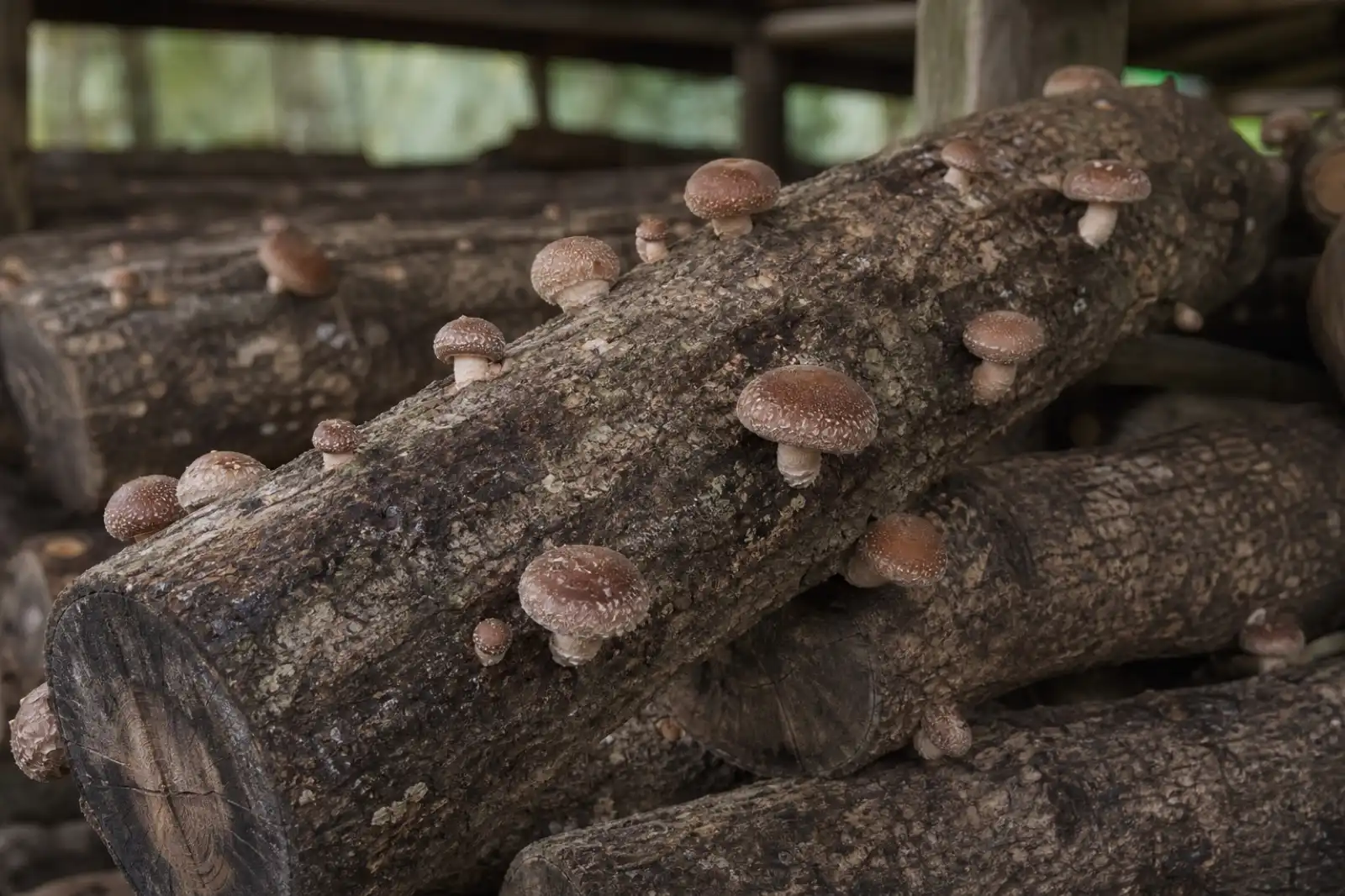
Shiitake is a white-rot decomposer of hardwood. Traditional log cultivation drills inoculation points into sound logs, inserts spawn, seals the holes, and allows a long colonization period before fruiting is induced. Modern farms often use heat-treated sawdust blocks. In both systems, the grower is managing a wood-decay organism, not planting a seed in soil.
Known range represented here: China, Japan, Korea and other parts of East Asia, while commercial cultivation occurs worldwide. Those are not interchangeable statements. A shiitake block discarded in Europe or North America does not demonstrate a native wild population. Typical production substrates: suitable hardwood logs and heat-treated hardwood sawdust blocks. Log crops often fruit after seasonal temperature changes, rain or deliberate soaking; controlled blocks can fruit outside that outdoor calendar.
Wild L. edodes belongs to East Asian hardwood forests, commonly associated in cultivation literature with oak and related broadleaf logs. Worldwide fruiting on inoculated logs, sawdust blocks, garden wood, or discarded substrate is cultivation evidence, not proof of a native range. Record whether the wood was deliberately inoculated, stacked, drilled, plugged, bagged, or moved before interpreting the site as wild habitat.
At a suspected wild East Asian site, document host, forest type, wood condition, attachment, developmental series, and a retained voucher under local rules. Outside that range, first investigate cultivation escape, inoculated landscape logs, and transported wood. Do not publish precise coordinates for a sensitive population, and do not remove every cap from a log merely to demonstrate that several sizes were present.
Keep shiitake, xiang gu and culture labels attached to evidence
Shiitake is a Japanese market name now used internationally; Chinese retail labels may use xiang gu for fragrant mushroom or dong gu for a winter-style grade. These commercial terms describe products and traditions, not a field character that establishes species. Retain the name printed on a package, country of origin, producer, lot, and scientific-name declaration rather than translating every brown cultivated mushroom into Lentinula edodes.
Scientific databases place L. edodes in an East Asian context, while related Lentinula occur elsewhere. A commercial block fruiting on another continent is evidence of cultivation at that address, not evidence that the species is native or naturalized there. A credible locality claim needs a wild substrate, collection record, identifier, date, and preferably a deposited specimen or sequence linked to that record.
Choose a log system or a sawdust-block system deliberately
For a small outdoor project, obtain regionally appropriate hardwood logs and authenticated shiitake spawn. Record tree species, log diameter, felling and inoculation dates, spawn type, hole pattern and sealing material. Keep logs shaded and protected from severe drying without wrapping them into stagnant conditions. Colonization takes many months, so a calendar copied from a different climate or log diameter is not a reliable endpoint. The separate shiitake log-growing guide covers drilling, sealing and yard layout; this page keeps the focus on species provenance and the choice between log and block systems.
Supplemented sawdust is a different production system rather than a faster version of the same recipe. Dry substrate mass, water addition, supplement fraction, bag geometry, heat treatment, inoculation rate, incubation temperature and strain all interact. Blocks demand stronger contamination control and clear separation between clean inoculation and fruiting waste. Compare yields only against recorded dry substrate mass; fresh bag weight hides differences in water and packaging.
Interpret host and substrate at the correct scale
“On oak” is incomplete evidence. In log culture, record the tree species, whether the wood was living when cut, bark condition, log diameter, felling-to-inoculation interval, and moisture history. Competing fungi can enter through damaged bark or old cut surfaces. In a sawdust block, the fruit body is attached to a manufactured mixture; hardwood species, particle size, supplement, water addition, bag geometry, and heat-treatment schedule all belong to the substrate record.
Wild observations require the same discipline. A mushroom emerging beside a tree may be attached to buried wood from a different species. Expose only enough of the base to document the connection, then restore the site. Do not infer a host from the nearest canopy tree, and do not use a cultivated hardwood preference as proof of a wild association.
A safe cultivation workflow
- Choose verified material. Buy spawn or a fruiting block from a specialist supplier that identifies the culture and provides strain-specific parameters.
- Match the substrate. Use oak and other suitable hardwood logs or sterilized hardwood sawdust blocks only through a proven recipe. Moisture and heat treatment must suit the method.
- Separate clean and dirty work. Clean tools and surfaces, wash hands, label every batch, and keep finished fruiting areas away from substrate preparation waste.
- Monitor colonization. Healthy appearance depends on the species and culture. Do not assume every white growth is the intended fungus; odor and unexpected pigments are warning signs.
- Initiate fruiting deliberately. Temperature, humidity, light, oxygen, and carbon dioxide interact. Follow the culture supplier rather than copying one universal number.
- Harvest and cool promptly. Use clean tools, avoid saturating fruit bodies, refrigerate culinary crops, and document yield and abnormalities.
Shiitake log and supplemented-sawdust systems should not share one generic schedule. Log diameter, bark integrity, tree species, felling and inoculation interval, spawn type, stacking, moisture, strain, and seasonal forcing govern a log cycle; particle size, supplementation, bag geometry, sterilization, browning, block temperature, and fruiting-room exposure govern a block. Record the system explicitly and reject any unit with an unexpected fruit body or unresolved contamination.
Keep food composition, purified lentinan and supplements separate
Shiitake is a culinary ingredient with measurable nutrients. Lentinan, a purified beta-glucan preparation, has been studied in medical contexts, but evidence about a purified preparation cannot be transferred to a serving of cooked caps, a mycelial powder or an unspecified extract. Those materials differ in identity, concentration, manufacturing controls, dose and sometimes route of administration. Grocery-store shiitake is not an approved cancer treatment.
The phrase “health benefits” should begin with what can be supported. Mushrooms can contribute variety, fiber, micronutrients, and flavor to a balanced diet. Nutrient values vary by strain, substrate, water content, maturity, ultraviolet exposure, processing, and cooking. USDA FoodData Central is useful for representative values, but a database average is not a laboratory analysis of a particular package. For cross-species food comparisons rather than shiitake identification, use the mushroom nutrition guide.
Shiitake evidence must be matched to its material. Cell and animal experiments with isolated compounds can propose mechanisms; trials of lentinan or another defined preparation address that intervention; and food-composition data describe a measured serving. None of those designs establishes that a retail powder reproduces the preparation or that eating shiitake treats cancer, infection, cholesterol, or another condition.
A shiitake supplement needs the scientific name, fungal part, substrate disclosure, extraction solvent, input and final mass, serving size, lot, and identity and contaminant testing. “10:1” without starting-material quality or final analytical data is not a potency result. Raw or undercooked shiitake also has a separate dermatitis risk; supplement marketing must not blur that food reaction with evidence for a purified research preparation.
Cook shiitake and recognize the dermatitis boundary
Thorough cooking is important. The clinical review by Stephany and colleagues describes shiitake dermatitis after raw or undercooked mushrooms as a severely itchy eruption with linear papules, small blisters or plaques. Case literature does not provide a universal home cooking time that guarantees prevention for every portion, and the mechanism is not a reason to diagnose a rash from this page. Cook cultivated shiitake thoroughly using a validated recipe; if a marked linear itchy rash follows exposure, stop eating the product and seek medical advice.
That reaction is distinct from immediate allergy, ordinary gastrointestinal intolerance and foodborne illness. Breathing difficulty, facial swelling or collapse requires emergency care. Dried mushrooms still need clean rehydration, prompt cooking and refrigeration if held. Never extrapolate the familiar appearance of a cultivated shiitake cap to a wild brown mushroom growing on wood.
General food practice still applies: source cultivated mushrooms from reputable producers, transport them cool, wash hands and utensils, prevent contact with raw animal foods, and cook with clean equipment. Cooking can reduce microbial risk and improve digestibility, but it cannot make a poisonous species safe and may not destroy every toxin or environmental contaminant.
Use a two-stage pan method for dense caps
Fresh shiitake caps contain enough water that a crowded pan can steam them before browning. Trim the fibrous stems for stock, slice caps to a consistent thickness, and begin in a broad pan with enough space for vapor to escape. Let released moisture cook away before adding final fat and aromatic ingredients; this prevents garlic or butter from scorching while the mushroom is still shedding water. Continue until the pieces are hot and cooked through rather than judging doneness from surface color alone.
Dried shiitake behave differently. Rehydrate them with clean water under controlled time and temperature, remove grit, and cook the softened caps thoroughly. If the soaking liquid is used for flavor, strain it and bring it into the cooked preparation promptly; it is not a shelf-stable broth. This culinary mechanism belongs on the species guide because shiitake’s fibrous stems, dried-product market, and dermatitis boundary create decisions that a generic sautéing paragraph does not capture.
Children, older adults, pregnant people, and immunocompromised individuals can face greater consequences from foodborne infection. Follow national and local recall advice. For severe vomiting, persistent diarrhea, confusion, jaundice, breathing difficulty, or symptoms after eating an unidentified wild mushroom, contact emergency services or a poison center immediately; do not wait for an online identification.
For claims about cooked food, lentinan, cholesterol, or dermatitis, the shiitake health-benefits evidence guide separates the whole mushroom from extracts and defined preparations.
References
- National Center for Biotechnology Information. NCBI Taxonomy Browser. Used for a current lineage check; NCBI notes that nomenclature should also be assessed against specialist literature.
- U.S. Department of Agriculture. FoodData Central. Food-composition reference; values vary by sample and preparation.
- Penn State Extension. Mushroom Food Safety. Production hygiene and preventive-control context.
- Schoch CL, et al. NCBI Taxonomy: a comprehensive update on curation, resources and tools. Database (Oxford). 2020.
- U.S. Food and Drug Administration. Selecting and Serving Produce Safely. General produce handling guidance.
- Stephany MP, et al. Shiitake Mushroom Dermatitis: A Review. American Journal of Clinical Dermatology. 2016;17(5):485–489. Clinical pattern and raw-or-undercooked exposure boundary.
Editorial review: August 31, 2026. No named clinician, mycologist or cultivation specialist reviewed this page. Scientific names and public-health recommendations should be rechecked at every substantive update.
Source quality notes
MushroomScope cites sources that match the page scope, such as taxonomic databases, extension guidance, food-safety agencies, food-composition databases, and peer-reviewed or institutional health references. Sources support context and uncertainty; they do not turn an online page into specimen identification, medical advice, or a tested recipe record.
Frequently asked questions
Can this mushroom be identified from a photograph?
No. A photograph can support documentation, but a defensible identification of Lentinula edodes also considers substrate, location, developmental stage, underside, spore deposit, odor, texture, and sometimes microscopy or DNA. Never make an edibility decision from an image alone.
Is it safe to eat?
shiitake is an established food when it comes from a reputable cultivated source and is stored and cooked properly. Individual allergy or intolerance is still possible. A wild specimen needs independent expert confirmation.
Can beginners grow it?
The database rates cultivation as moderate. Beginners should use authenticated spawn or a reputable ready-to-fruit block, follow the supplier's temperature and hygiene instructions, and discard cultures showing unexplained mold colors or foul odors.
Does it have proven health benefits?
It has nutritional or research interest, but that wording must not be converted into a treatment claim. Laboratory findings do not prove clinical benefit, and human evidence must match the exact species, preparation, dose, and outcome.
How should it be stored?
Refrigerate fresh cultivated mushrooms promptly in breathable food-safe packaging and use them while sound. Keep dried material sealed, dry, and away from heat. Follow local recall notices and discard spoiled or contaminated products.
Related guides
growing
How to Grow Shiitake Mushrooms on Logs
Log cultivation is slow but durable: use suitable fresh hardwood, authenticated shiitake spawn, correct inoculation, and patient incubation.
recipes
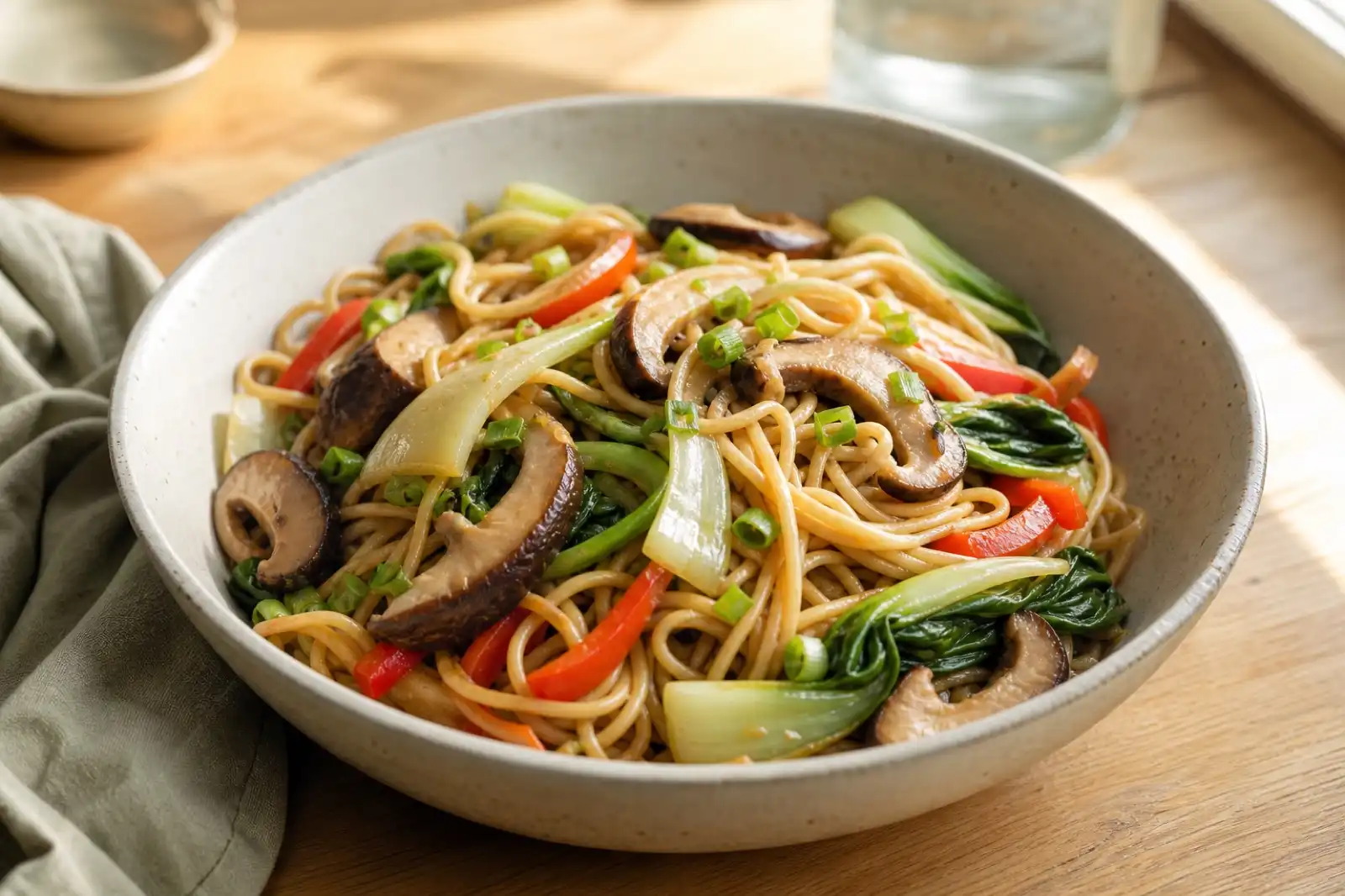
Shiitake Mushroom Noodle Stir-Fry
Make shiitake mushroom noodle stir-fry with cultivated shiitake mushrooms, clear steps, practical substitutions, and conservative food-safety guidance.
health
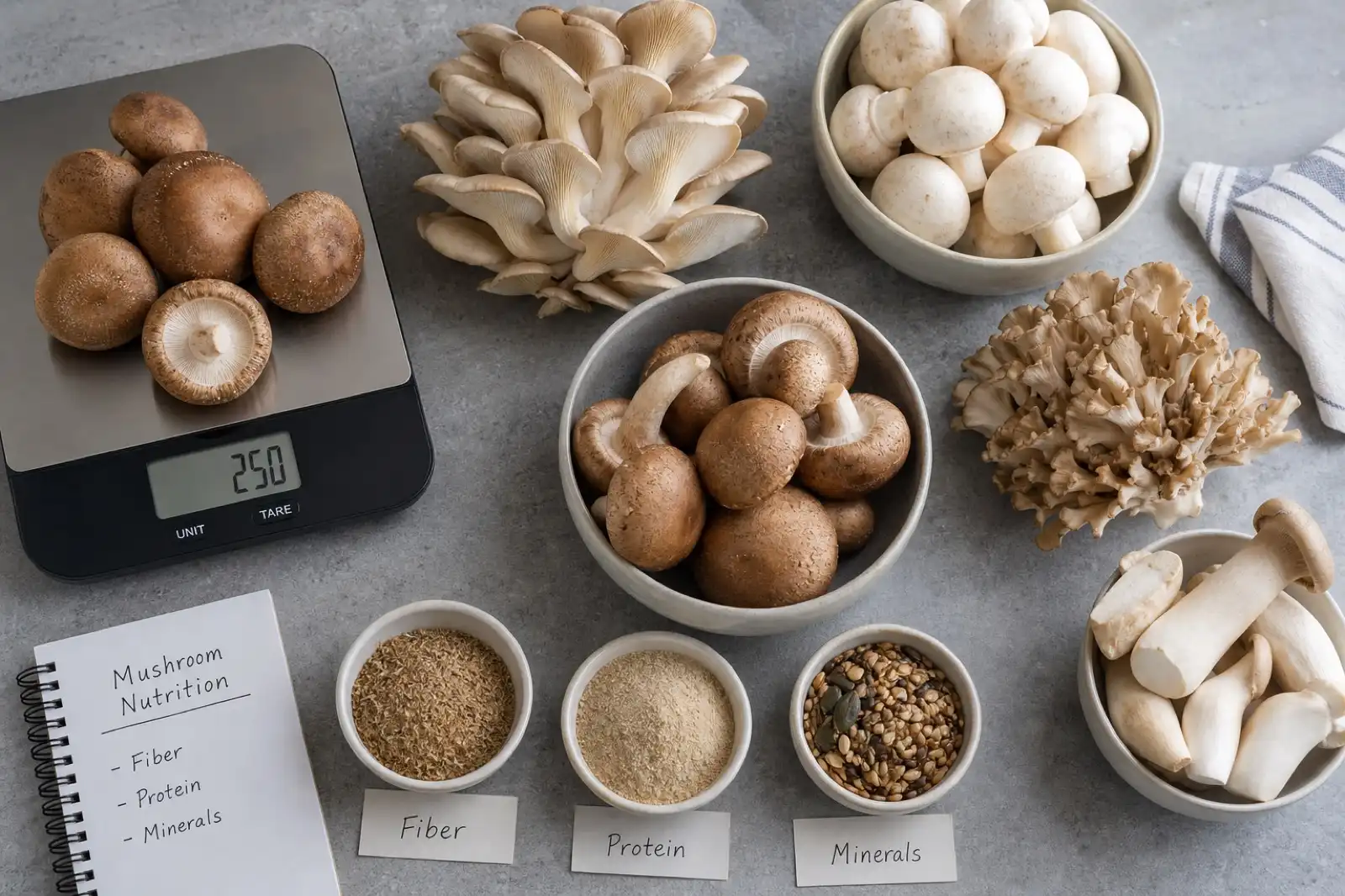
Mushroom Nutrition: Fiber, Protein, Calories, and Vitamins
Are mushrooms a source of fiber or protein? Compare calories, fiber, protein, vitamins, food forms, serving sizes, and preparation without overstating benefits.
Continue exploring
Browse more practical guides in Mushroom Encyclopedia or visit the mushroom encyclopedia.