Mushroom Encyclopedia
Woolly Milkcap: Birch Habitat, Latex, and Lookalikes
Study woolly milkcap through its zoned pink cap, shaggy margin, white latex, birch association, spore ornament, lookalikes, and conservative safety limits.
By MushroomScope Editorial Team · · Updated
Species context
Treat profiles as reference material
Species profiles summarize documented traits, taxonomy, and lookalikes, but natural variation can be substantial.
Use the safety checklist →Decision limit
A profile cannot authenticate a specimen
Do not eat a wild mushroom from an online match, single feature, or generated image.
Read the safety disclaimer →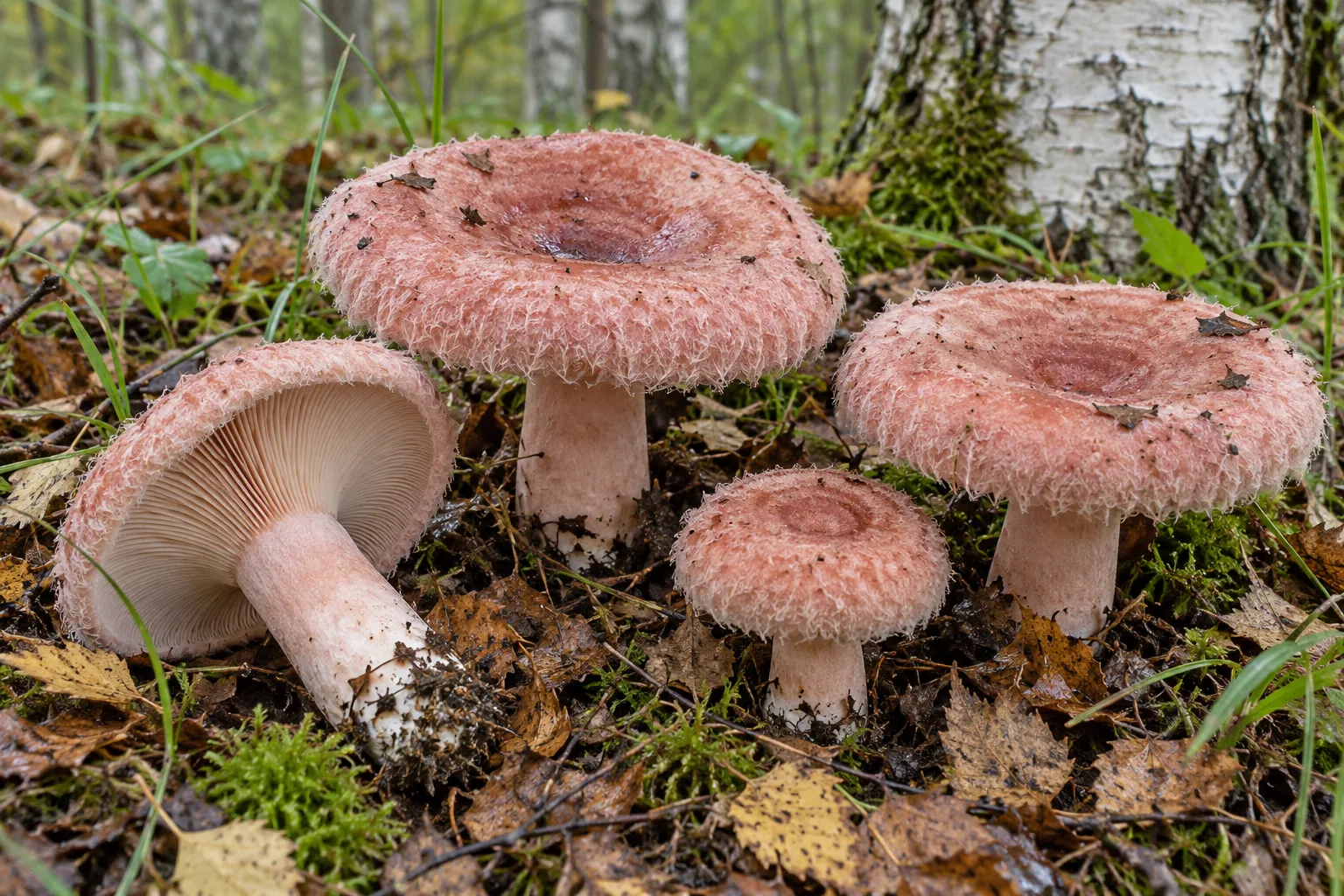
Quick facts
- Scientific name
- Lactarius torminosus
- (Schaeff.) Pers.
- Common names
- woolly milkcap, bearded milkcap, woolly milkcap mushroom
- Taxonomy
- Lactarius · Russulaceae
- Edibility context
- Inedible: Treated conservatively as inedible here; raw or inadequately prepared material can cause gastrointestinal illness, and regional processing traditions do not provide remote specimen clearance.
- Spore print
- Pale cream; ornamented spores and the pattern of connecting ridges require microscopy for serious comparison.
- Toxicity context
- Moderate: The practical risks include misidentification and gastrointestinal effects; online images and household processing cannot establish safety.
- Season
- August, September, October, November
- Growing difficulty
- Expert
- Regions
- Europe, northern Asia, northern North America under regional records
Safety limit: These labels summarize documented context; they never authenticate a wild specimen. Cooking does not make a poisonous species safe.
Start with a birch-root-zone hypothesis
Woolly milkcap, Lactarius torminosus, is memorable for a pink cap with darker rings and a shaggy edge. Those features make a useful search image, but the ecological clue is equally important: this fungus forms an ectomycorrhizal relationship with birch. A convincing record joins body structure, fresh latex, spores, season, region, and birch context instead of treating the color as a verdict.
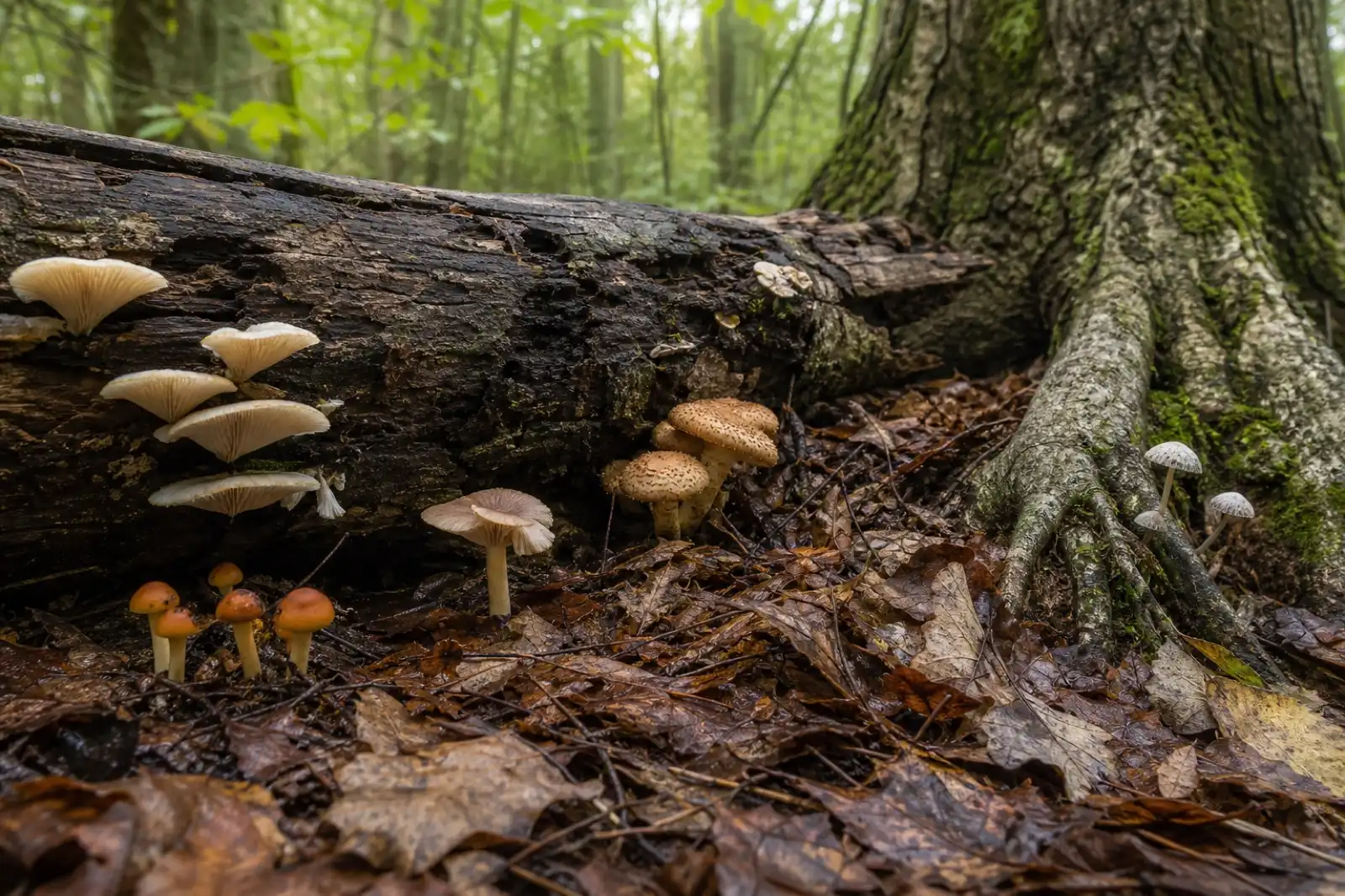
Photograph the group before handling it. Include birch trunks, fallen leaves, moss, soil, and the spacing between fruit bodies. Record the nearest birches and other trees within the apparent root zone. A birch leaf beside a cap can have blown from elsewhere, while roots may extend well beyond the canopy. Phrase the observation as “fruiting on soil in birch-dominated woodland” unless stronger evidence supports a particular host connection.
Map the cluster and assign specimen numbers. Keep the young inrolled cap, mature depressed cap, damaged-gill test, spore deposit, and microscopy linked to their original fruit bodies. The habitat guide provides a framework for separating directly observed substrate from inferred association.
Measure zones and margin hairs across ages
Young caps are convex with a strongly inrolled margin. Pale hairs can form a conspicuous beard around that edge. As the cap expands, the center becomes depressed and the margin loosens; rain, abrasion, or age may flatten the hairs. A mature weathered specimen can therefore look much less “woolly” than the common name implies.
Measure cap width on at least three ages and photograph each directly above and in profile. Count visible darker zones from center to margin, but record broken or faint bands rather than forcing a perfect target pattern. Moist caps may deepen from soft pink to salmon or rose, and phone processing can exaggerate the contrast. Use open shade, a neutral reference, and an unedited file.
Inspect the surface with a hand lens. Distinguish attached fibers from grass, birch catkin fragments, soil, or mold. Note whether the center is smooth, slightly sticky, or cracked by drying. The cap’s developmental series is more informative than a single unusually photogenic individual.
Record gills and latex as a timed sequence
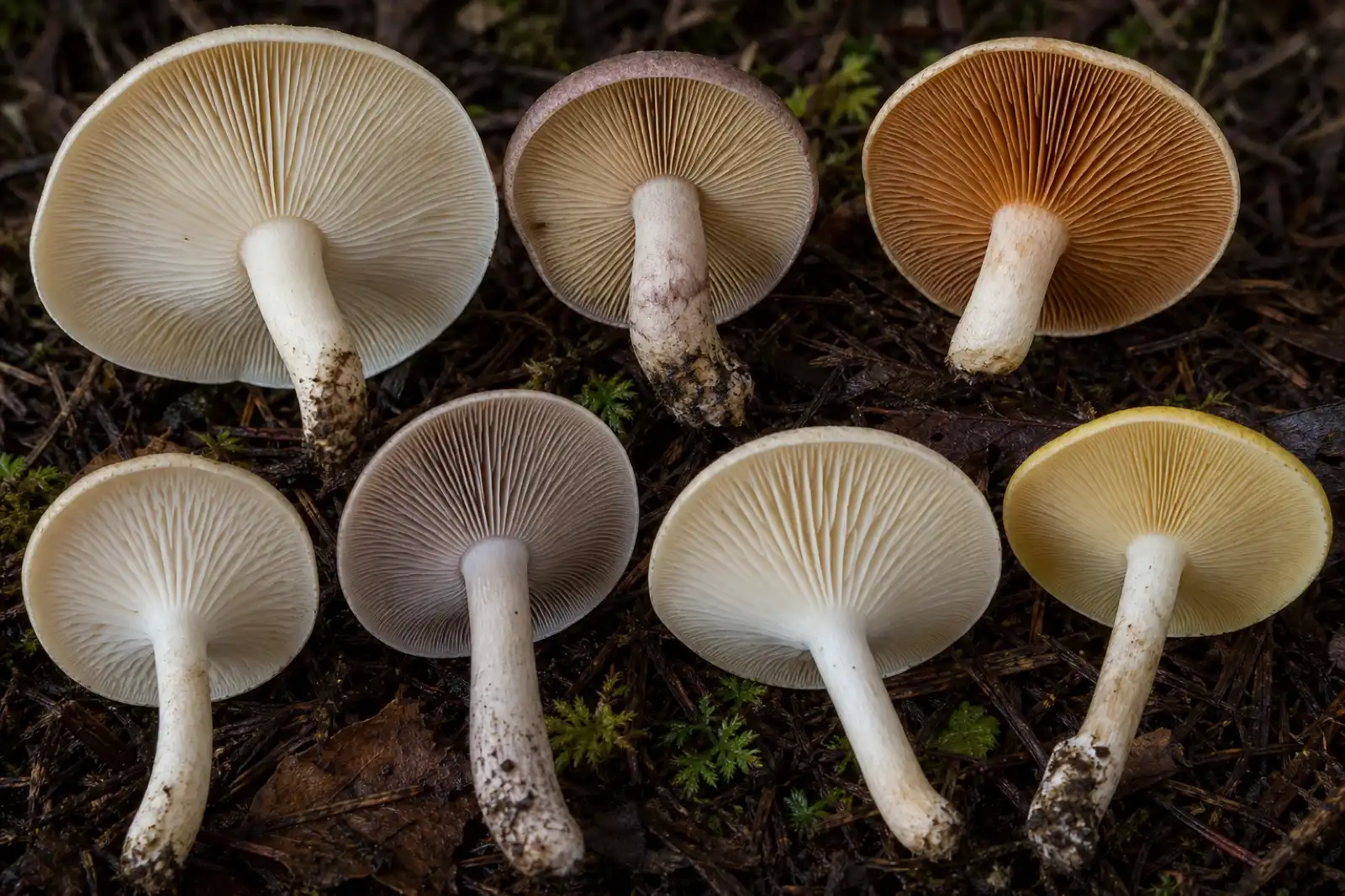
Turn one representative fruit body without trimming the stem base. The gills are crowded, pale cream to pinkish, and attached to slightly decurrent. Photograph the junction where each gill meets the stem; a side view cannot reliably show attachment. The gill-types guide explains how to preserve this angle.
Fresh damage should release white latex. Make one small cut across several gills and start a timer. Photograph immediately, then after one, five, and fifteen minutes under the same lighting. Record abundance, initial color, later staining of gill tissue, and whether drying creates a misleading translucent film. Old, dry, frozen, or insect-damaged specimens may yield little latex, so absence in poor material is not decisive.
Do not taste uncertain mushrooms. Some specialist keys use carefully controlled taste characters, but the general reader does not need oral exposure to document a suspected woolly milkcap. Latex color, cap hairs, birch setting, spores, and microscopic structure provide safer evidence.
Preserve the stem base and brittle fracture
The stem is usually pale pinkish or flesh-colored, without ring or volva. It may be firm when young and become hollow or chambered with age. Record length, width at top and base, surface pits, bruising, and insect damage. Extract it carefully enough to show the complete base and attached soil.
Members of Russulaceae have flesh that tends to snap rather than pull into long fibers. Demonstrate that character only on a collected, numbered specimen where collection is legal. A clean break can support the family-level hypothesis, but weathered flesh, freezing, and decay alter texture. It does not separate every Lactarius species.
Make one longitudinal section to show stem interior, cap thickness, larval channels, and any staining. Keep the section tied to the same latex series. A market-trimmed stem or a cap detached by a previous observer cannot establish that a ring or volva was absent.
Use birch association without overstating it
Birch association is a powerful filter because L. torminosus obtains nutrients through living root partnerships. Yet “near birch” is not the same as “proved partner.” Map distance to several trees, note sapling density, and include other potential hosts. In mixed woodland, a root-level association may remain unresolved without ecological or molecular work.
Site conditions help explain fruiting. Record soil moisture, moss cover, drainage, recent rainfall, canopy openness, and whether the ground was compacted. Revisit fixed plots after rain and note new caps by age class. This produces a local fruiting curve rather than a list of isolated sightings.
Geography affects interpretation. A northern European key may not cover every pink milkcap reported from North America or Asia, and names can shift as molecular sampling improves. Store the source, access date, region, and confidence level with the observation.
Compare the closest pink milkcaps
Lactarius pubescens is a central comparison. It also grows with birch and can have a hairy margin, but it is often paler and less strongly zoned. Those tendencies overlap. Compare multiple ages, latex behavior, cap surface, spore ornament, and a current regional key rather than choosing between two gallery thumbnails.
Lactarius mairei can be conspicuously woolly but is associated with oak. Host context is therefore informative when tree identification is solid. Lactarius controversus is typically larger and paler, often with poplar or willow, and may develop pinkish gills. Atypical specimens still require microscopy.
Other milkcaps with pink, buff, or zoned caps enter regional keys. Build a comparison table for margin hairs, zone contrast, cap width, gill attachment, latex color and change, stem surface, spore mass, host neighborhood, and microscopy. Mark a feature unknown when it was not observed. Do not convert a missing latex test into “latex white.”
The indigo milkcap guide shows how a very different color system still requires a timed latex and staining record. The shared genus-level workflow does not make the two species interchangeable.
Add a calibrated spore record
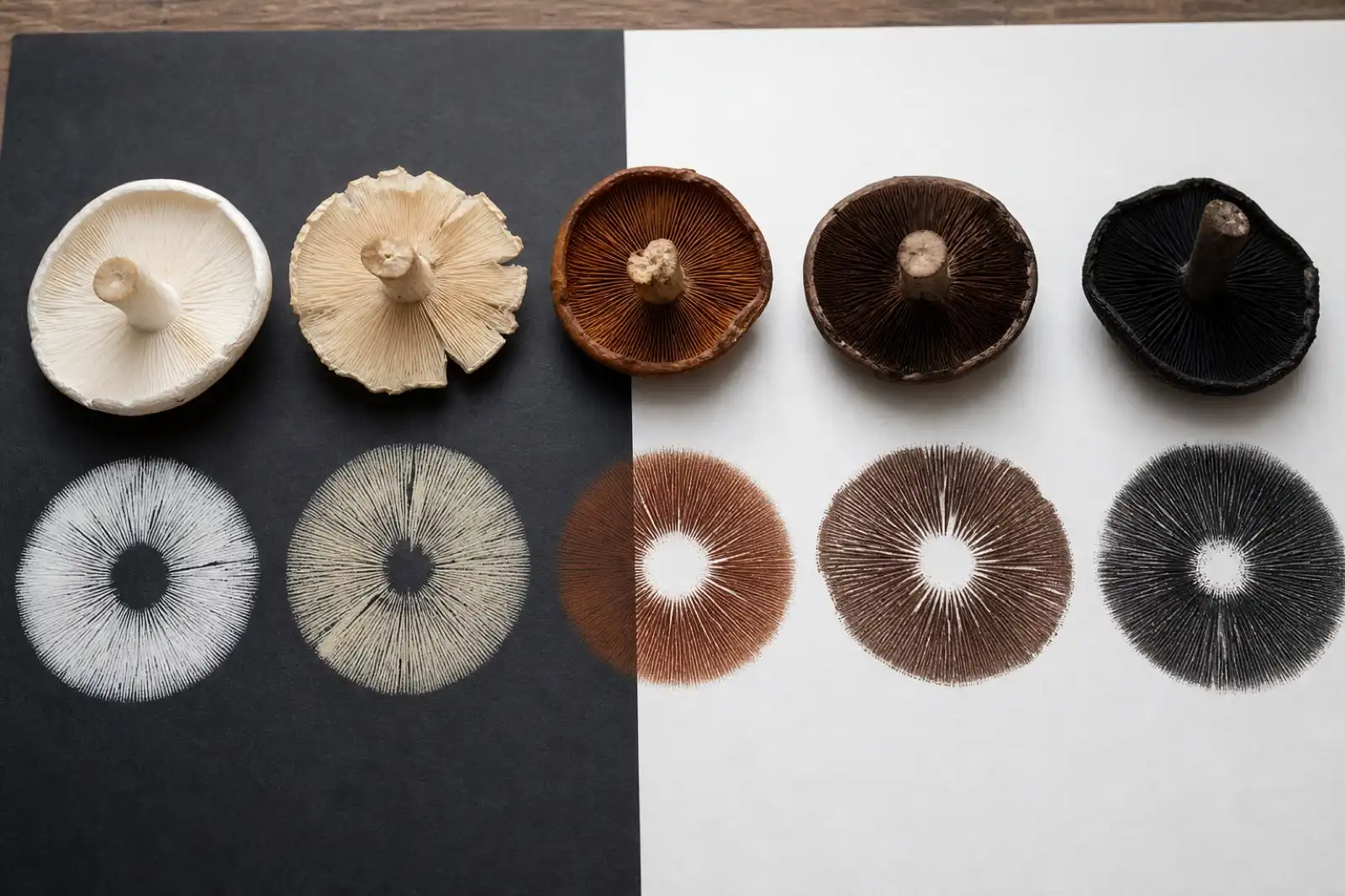
A sufficiently heavy deposit is pale cream rather than pure white. Collect it on half black and half white nonabsorbent surfaces, protected from drafts. Record cap maturity and elapsed time. A thin deposit may take on the color of the paper or moisture, so do not grade it from a few scattered spores. The spore-color guide outlines a controlled setup.
Under appropriate preparation, Lactarius spores show amyloid ornament that reacts in Melzer’s reagent. For species-level work, measure length and width across a reasonable sample and describe warts, ridges, and how completely they connect. Report equipment, calibration, mounting medium, sample size, and range. A single attractive micrograph is not a population.
Cap cuticle and cystidial characters may also matter in a regional key. If the specimen is too old, the microscopy contradictory, or reference coverage weak, retain a label such as “pink birch-associated Lactarius” rather than forcing L. torminosus.
Keep processing traditions separate from safety clearance
Some northern and eastern European food traditions describe repeated processing of acrid milkcaps. Other sources classify woolly milkcap as poisonous or inedible, especially raw or inadequately prepared. A cultural preparation history does not solve four separate questions: whether the specimen is correctly identified, whether it is fresh and uncontaminated, whether the method is validated for that material, and whether the individual can tolerate it.
This guide therefore does not recommend consumption. Washing, soaking, salting, fermenting, or boiling cannot repair a mistaken species name, and online advice cannot supervise dose or preparation. Never serve a wild mushroom based on a photograph or a common name.
If illness follows mushroom ingestion, contact the relevant poison center or emergency medical service promptly. Save uncooked material, leftovers, photographs, location, preparation steps, amount eaten, and symptom timing. Do not induce vomiting unless instructed by a medical professional.
Build a reviewable woolly milkcap record
Run a contradiction audit before selecting the species name. Confirm that the margin hairs are attached fungal tissue, that fresh gill damage produced latex, that the flesh breaks with the expected brittle texture, and that birch is genuinely present in the root neighborhood. A fibrous flesh, no latex from several fresh specimens, a ring or volva, or a site without birch redirects the investigation. Preserve those facts rather than explaining them away as variation.
Summarize measurements across age classes: cap width, central depression depth, margin-hair length where practical, stem height and width, gill density across a stated distance, and timing of latex observations. Report how many specimens contributed to each range. This prevents one oversized or rain-damaged cap from defining the collection.
Keep field identity, toxicity classification, and cultural food practice as separate data fields. A strong morphological determination does not establish that a particular preparation is safe, and a market tradition does not authenticate a wild specimen. Note which regional source supports each statement and when it was checked.
A strong record includes the undisturbed group, birch-root-zone map, cap measurements across ages, neutral-color top and profile images, margin-hair close-up, gill attachment, timed latex series, complete stem base, one section, pale spore deposit, and calibrated microscopy where available. List each lookalike and the evidence that supports or contradicts it.
Keep a legal voucher when expert review is feasible. Preserve the original image files and avoid hiding uncertainty in a definitive caption. A careful provisional name is more useful than a confident food claim built from pink color and a shaggy edge.
References
For a dry cinnamon-red conifer associate with a small persistent umbo rather than a pink zoned cap and woolly margin, use the rufous milkcap field guide as a separate comparison path.
The sources in the page record support accepted taxonomy, specialist morphology and ecology, records practice, and conservative poisoning response. They do not authenticate a reader’s specimen or provide permission to eat it.
Source quality notes
MushroomScope cites sources that match the page scope, such as taxonomic databases, extension guidance, food-safety agencies, food-composition databases, and peer-reviewed or institutional health references. Sources support context and uncertainty; they do not turn an online page into specimen identification, medical advice, or a tested recipe record.
Frequently asked questions
Does a pink cap with a woolly edge identify Lactarius torminosus?
No. The cap zones and woolly inrolled margin are useful, but a record also needs white latex, gill attachment, brittle flesh, birch context, a pale spore deposit, region, and comparison with other pink milkcaps.
Why is birch important for woolly milkcap records?
Lactarius torminosus is ectomycorrhizal with birch. Documenting nearby birch and the wider root zone supports the hypothesis, although proximity alone does not prove the individual fungal partner.
What happens when woolly milkcap gills are damaged?
Fresh tissue typically releases white latex. Record its initial color, amount, taste only through expert protocols that avoid ingestion, and any timed color change rather than relying on a still photograph.
Can washing or cooking make an uncertain woolly milkcap safe?
No household preparation repairs a wrong identification. Culinary traditions differ, but this guide does not recommend consuming remotely identified or unverified specimens.
Can a photograph confirm woolly milkcap?
A photograph can show cap zones, margin hairs, gills, and habitat, but it cannot reliably establish latex behavior, spores, microscopy, site history, or all regional lookalikes.
Related guides
identification
Mushroom Gill Types: Attachment, Spacing, and Color
Compare free, attached, notched, adnate, and decurrent mushroom gills while recording spacing, short gills, edge details, bruising, and color changes.
identification
Mushroom Spore Print Colors and How to Record Them
Use a controlled spore deposit to distinguish broad color groups while recognizing that print color alone never identifies a species.
identification
Using Habitat to Identify Mushrooms
Record substrate, associated plants, soil, wood type, moisture, elevation, and fruiting pattern as identification evidence.
Continue exploring
Browse more practical guides in Mushroom Encyclopedia or visit the mushroom encyclopedia.